
Attractor Plate Book: Cabinet of Seven Flows
- Lab Skill
- v1.0.1
- Interactive 3D
Leaf a folio of seven strange attractors. Each plate runs a real Runge–Kutta integration you can retune with parameter dials, orbit in three dimensions, and split into a twin-trajectory divergence chart.
Beispiel
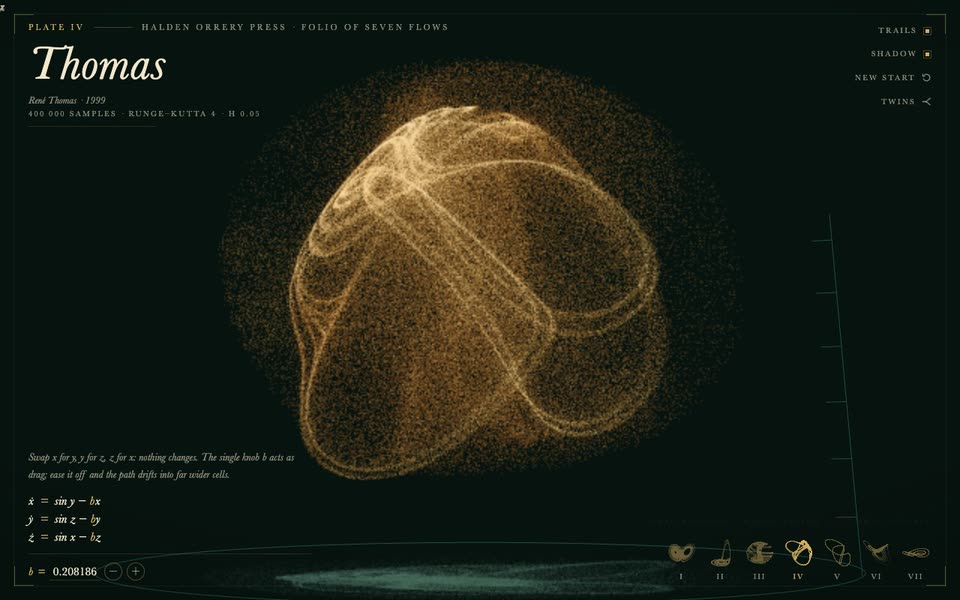
Attractor Plate Book interactive folio
Das Beispiel läuft in einem sandboxed Frame ohne Zugriff auf diese Seite.
Online ausführen
In einer SandBase-Sandbox ausführen und Ihre Ergebnisse in Lab ansehen.
In Lab öffnen ↗Was Sie erhalten
Bring a dynamical system and the plates and dials to show it with. The Skill returns a downloadable Skill and a runnable reference plate book.
So funktioniert es
- 01
Pick a brief and plates
Attractor Plate Book reads a brief from assets/briefs/, such as cabinet-en or gallery-zh. The brief sets the point count, startPlate and every visible string, including the seven plate notes in copy.notes and the warn line. The seven systems are Lorenz, Rössler, Aizawa, Thomas, Halvorsen, Dadras and Chen–Lee, each defined in the SYS table of src/attractor.js with its ODEs, dt and parameter ranges.
- 02
Integrate and splat each plate
For each plate, rk4 integrates the flow with a 1500-step burn-in, keeps mid-segment samples and normalizes them into a unit ball. A run under 6000 bounded points returns null, so the page keeps the last good plate and shows the warn line. Points splat additively on Canvas 2D through a gold to champagne tonemap, with a floor shadow, a floor ring and live tracer trails. No WebGL is used.
- 03
Build and run the shoot checks
npm install fetches playwright-core, then npm run build inlines the engine and brief into dist/index.html, and npm run build:gallery makes the Chinese gallery version. npm run shoot runs 20 or more offline checks: all seven systems integrate bounded, escape returns null, plates morph, tracers advance, the twin pair diverges and the camera moves. Open the file and turn the volume to confirm.
FAQ
What does Attractor Plate Book show?
Attractor Plate Book shows seven chaotic systems as a turnable folio of glowing orbit plates. Each plate carries a Roman numeral, a staggered title, a credit line, a sample count, a prose note, its equations and editable parameter spinbuttons. You switch plates with the arrow keys, number keys 1 to 7 or the thumbnail strip, and drag, wheel or pinch to turn and zoom.
What is the Twins panel in Attractor Plate Book?
The Twins panel in Attractor Plate Book runs two orbits that start 1e-5 apart side by side. It plots log10 of their separation live, fits a least-squares Lyapunov estimate and reports a final split time. It makes sensitive dependence on initial conditions visible on the same plate you are looking at.
Can I change the equations in Attractor Plate Book?
Yes, within limits. Attractor Plate Book exposes each system's parameters as spinbuttons, and the dt and parameter bounds come from that system's entry in the SYS table. Editing those bounds is a content edit in src/attractor.js rather than an engine change. If a parameter makes the orbit escape, the page keeps the last bounded plate and shows the brief's warning.
Does Attractor Plate Book need a GPU or WebGL?
No. Attractor Plate Book ships a 2D accumulation renderer on Canvas 2D as its only path. Points go into brightness, slowness and shadow grids, and a 1024-entry exposure table maps brightness to amber ramps. A half-float WebGL variant is described as a possible fidelity upgrade, not something the Skill includes.
Is Attractor Plate Book free to run?
Yes. Attractor Plate Book integrates every orbit in the browser with its own RK4 code and makes no model calls at runtime. The build only inlines src/attractor.js and the chosen brief into one self-contained HTML file. npm install is needed once for playwright-core, which the shoot and align scripts use.
How does Attractor Plate Book respect reduced motion?
Attractor Plate Book skips the entrance sweep, hides the tracers, stops auto-rotate and shortens the plate morph to about 0.9 seconds when reduced motion is requested. Without that setting, the volume starts turning by itself after about 3.4 seconds idle. Double-click or the 0 key resets the view.
Weitere Skills
Alle Interactive 3D Skills →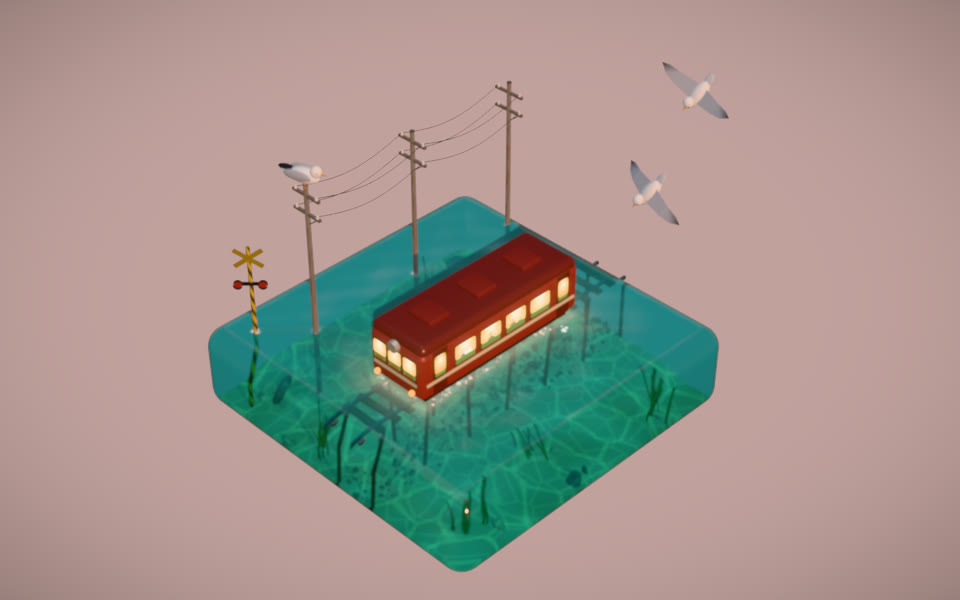
Resin Diorama
Live 3D resin-block dioramas in your browser: send a little tram across a clear turquoise sea, or ripple the bay of a cliff island. Synthesized sound, and every scene can be tuned.
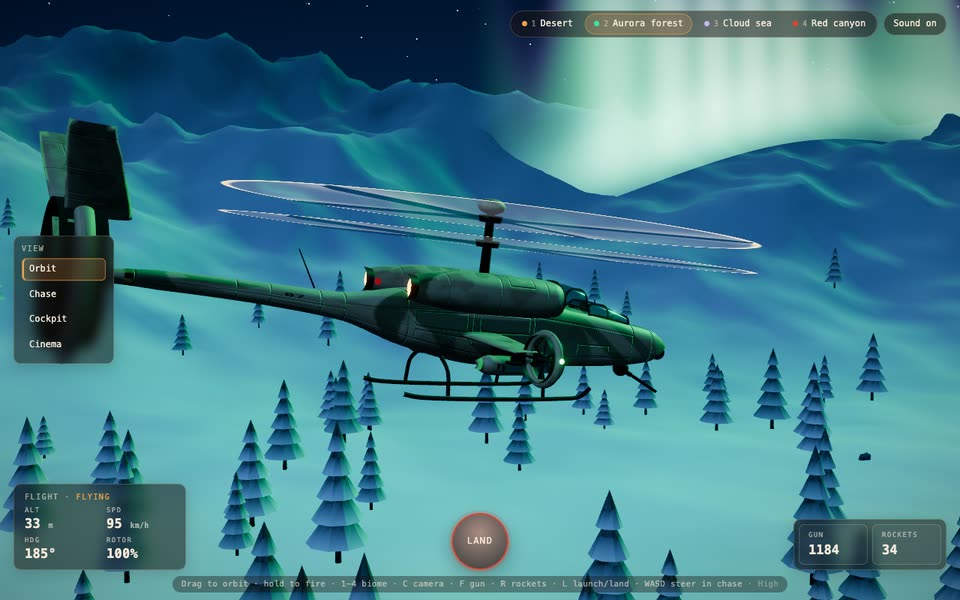
3D Vehicle Worlds
Explore interactive 3D vehicle worlds in your browser, with varied terrain, camera controls and driving effects. Choose a playable example to begin.
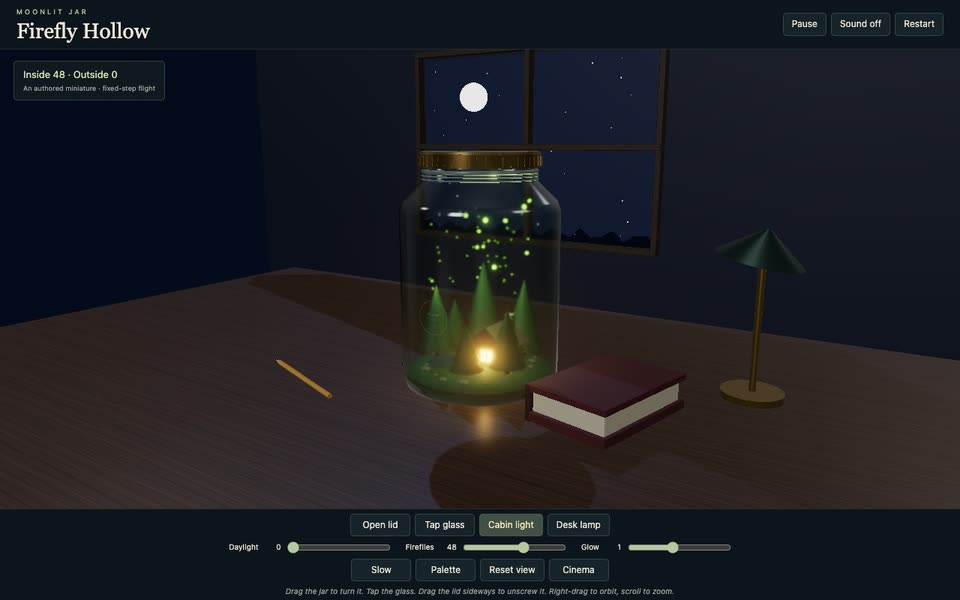
3D Firefly Terrariums
Turn a thick glass miniature, scatter glowing fireflies and open its brass lid. Actual particles leave through the neck and return before it seals. A moonlit cabin, forest and real local lights in one offline HTML.
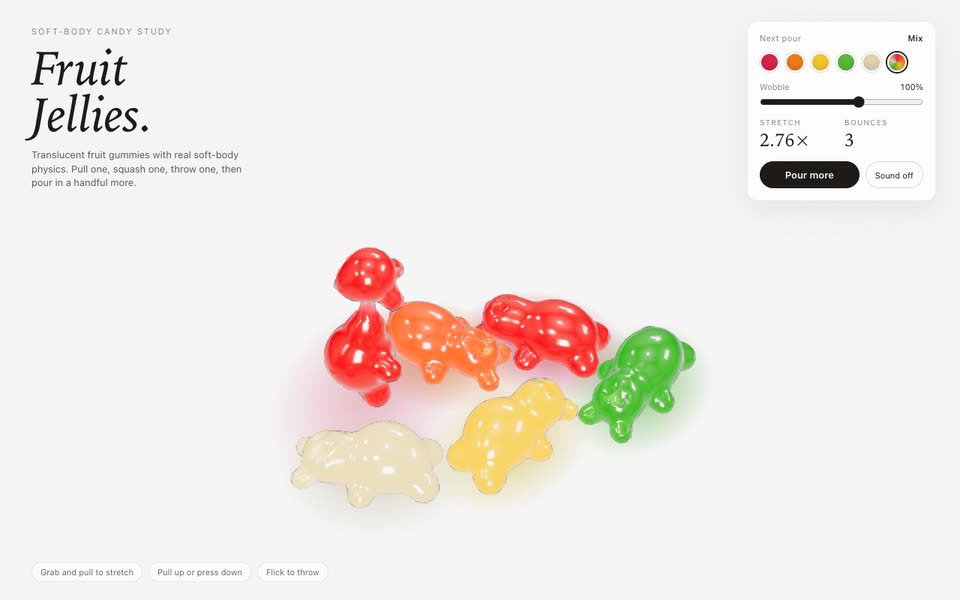
Jelly Candy: Fruit Bears
Six translucent fruit gummies on a white table. Grab any part and pull, lift a head until the neck stretches thin, press one flat until it springs back, flick one across the pile or pour in more. Fixed-step soft-body physics and a marching-cubes skin in one offline HTML.
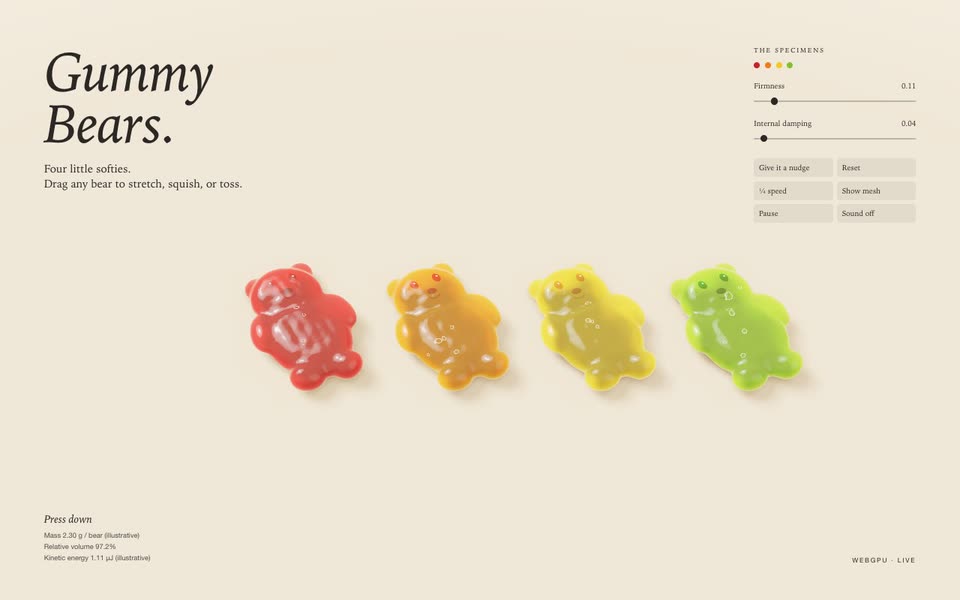
WebGPU Soft-Body Gummy Bears
Four translucent gummy bears on an ivory floor, rendered with native WebGPU. A deterministic 36-second choreography stretches, presses, flips and tumbles them before they settle back to the exact rest pose. Drag any bear to stretch, squish or toss it. A fixed-step tetrahedral XPBD solver in one offline HTML.
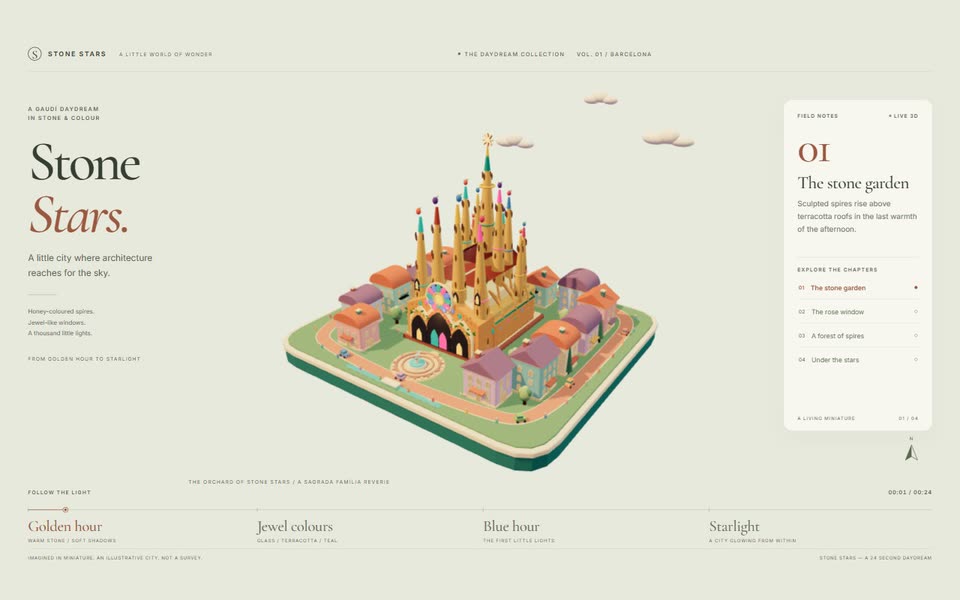
Stone Stars: 3D Miniature Landmark City
Turn a city into a storybook 3D island around one landmark, with chapters, a daylight-to-starlight slider, street life and a matching scored 24-second film. Sample: a Gaudí-style basilica.