
Lumen Grid
- Lab Skill
- v0.1.3
- Interactive 3D
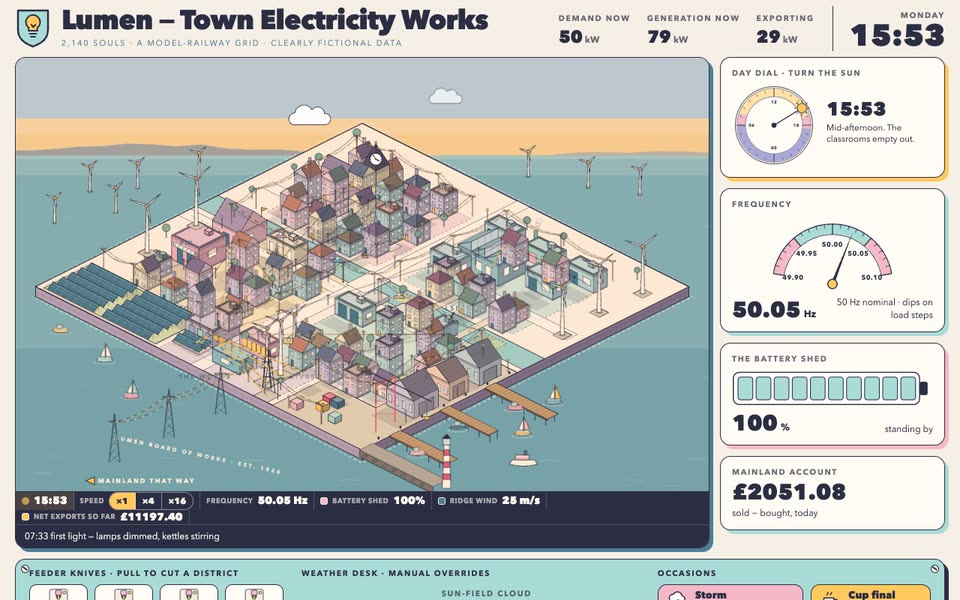
An isometric municipal power board — a toy-model town wired to a substation while a 24-hour supply/demand simulation runs underneath; lit windows and dashes flow along wires.
उदाहरण
Lumen Grid
यह उदाहरण एक sandboxed frame में चलता है और इस page तक इसकी पहुँच नहीं है।
ऑनलाइन चलाएँ
SandBase sandbox में चलाएँ और अपने परिणाम Lab में देखें।
Lab में खोलें ↗आपको क्या मिलेगा
Bring a town and the day to power. The Skill returns a downloadable Skill and a runnable power board.
यह कैसे काम करता है
- 01
Load the town brief
Lumen Grid draws a fictional town called Lumen as an isometric SVG board: terraced houses, a bakery, a clock tower, workshops, a cinema, allotments, a tram depot and the Works with substation, battery barn, three wind turbines, a solar field, a weir and a pylon line. All copy comes from assets/briefs/lg-en.json or lg-zh.json. Try 'Use lumen-grid to power a harbour village through a day.'
- 02
Run the day simulation
GridSim in src/lumen.js steps a 24-hour model: value-noise wind and cloud, solar, turbine and hydro supply, per-district and per-landmark demand, a tram and a big-match kettle surge. A 40 kWh battery charges on surplus and discharges on deficit, and the interconnector balances the rest. Knife switches drop districts, Storm islands the town and sheds landmarks from cinema first to bakery last.
- 03
Build and verify the board
npm run build writes dist/index.html and npm run build:zh writes dist-zh/index.html, both offline with no fonts, CDNs or network calls. npm run shoot blocks all network and asserts 13 checks, including noon-versus-night solar, the evening peak, battery discharge, a switch-off dropping demand, storm islanding, the meter card, a deterministic re-step and zero external requests.
FAQ
What does Lumen Grid show?
Lumen Grid shows a toy town wired to a substation while a supply and demand simulation runs underneath. The model and the instruments are two views of the same state: a stacked supply chart, a 50 Hz frequency gauge, battery charge, a mix ring and a mainland account. Lit windows and yellow dashes on the wires follow the same numbers.
What happens in a Lumen Grid storm?
Lumen Grid trips the interconnector in a storm, so the town islands with zero grid flow. Any deficit then sheds landmarks in priority order, cinema first and bakery last, and their windows go dark. The headless check asserts both the islanding and the shed landmark.
Can I control the weather in Lumen Grid?
Yes. Lumen Grid has wind and cloud sliders that override the noise-driven weather, plus Forecast, Storm and Big match buttons. A day dial scrubs the hour, and speed runs at x1, x4 or x16. Clicking any building opens its meter card.
Is Lumen Grid free to run?
Yes. Lumen Grid is one self-contained HTML file with the engine and brief inlined by scripts/build.mjs, and it makes no external request, so no model or paid service is touched. Headless Chrome is only needed for npm run shoot.
Does Lumen Grid use real grid data?
No. Lumen Grid runs a deterministic toy model: a bell-curve sun, turbines scaled by wind squared, flat hydro and authored demand curves such as a bakery from 3 to 10 and a cinema from 18 to 23.5. Wire flows are approximated for drawing, not simulated per wire.
Why does Lumen Grid give the same result every time?
Lumen Grid reads sim.now everywhere instead of wall time, so the day dial, speed multiplier and __scene.step() all produce identical states. Only the frame accumulator converts real seconds into simulated hours. The verification re-steps the simulation to confirm it.
और Skills
सभी Interactive 3D Skills →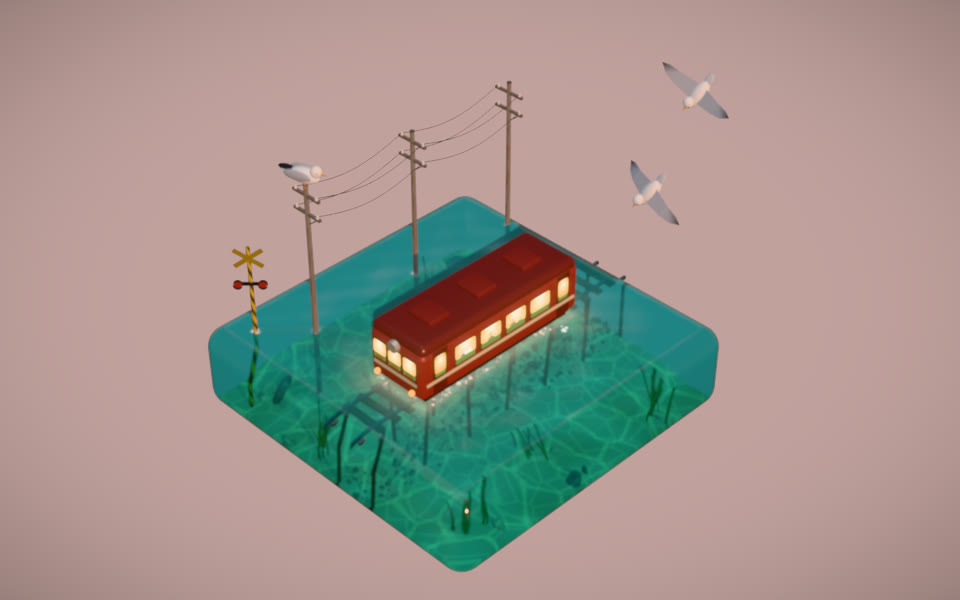
Resin Diorama
Live 3D resin-block dioramas in your browser: send a little tram across a clear turquoise sea, or ripple the bay of a cliff island. Synthesized sound, and every scene can be tuned.

3D Vehicle Worlds
Explore interactive 3D vehicle worlds in your browser, with varied terrain, camera controls and driving effects. Choose a playable example to begin.
3D Firefly Terrariums
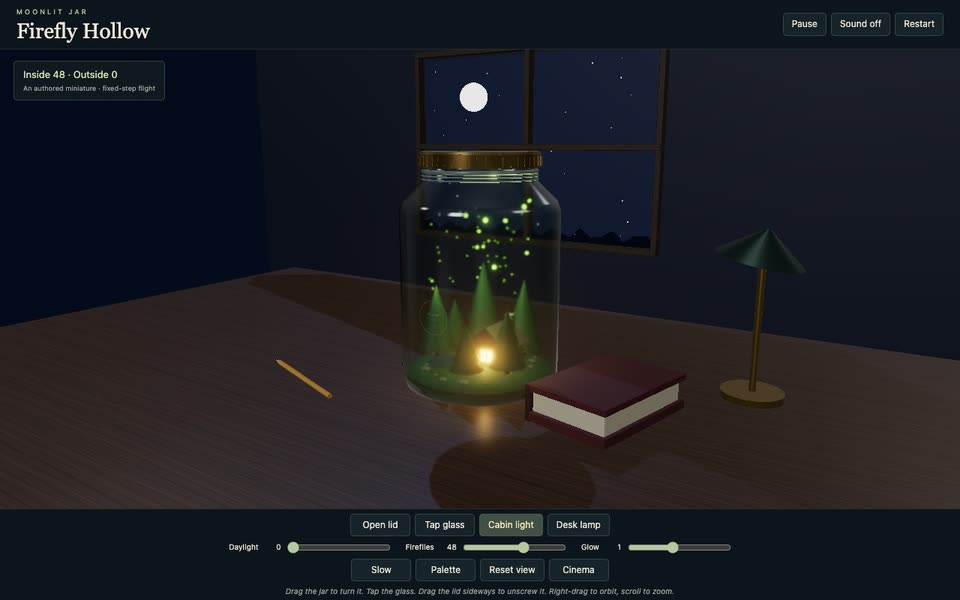
Turn a thick glass miniature, scatter glowing fireflies and open its brass lid. Actual particles leave through the neck and return before it seals. A moonlit cabin, forest and real local lights in one offline HTML.
Jelly Candy: Fruit Bears
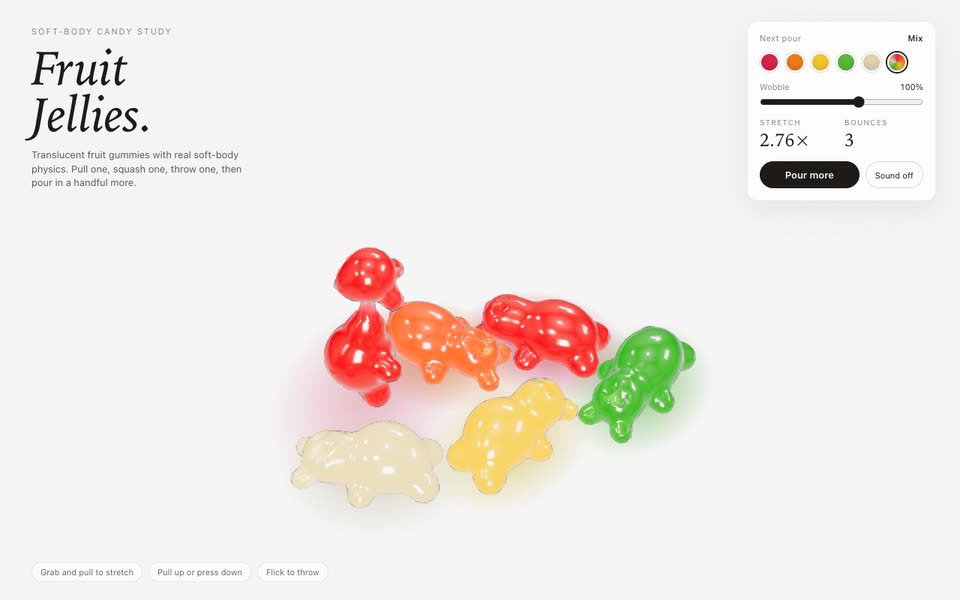
Six translucent fruit gummies on a white table. Grab any part and pull, lift a head until the neck stretches thin, press one flat until it springs back, flick one across the pile or pour in more. Fixed-step soft-body physics and a marching-cubes skin in one offline HTML.
WebGPU Soft-Body Gummy Bears
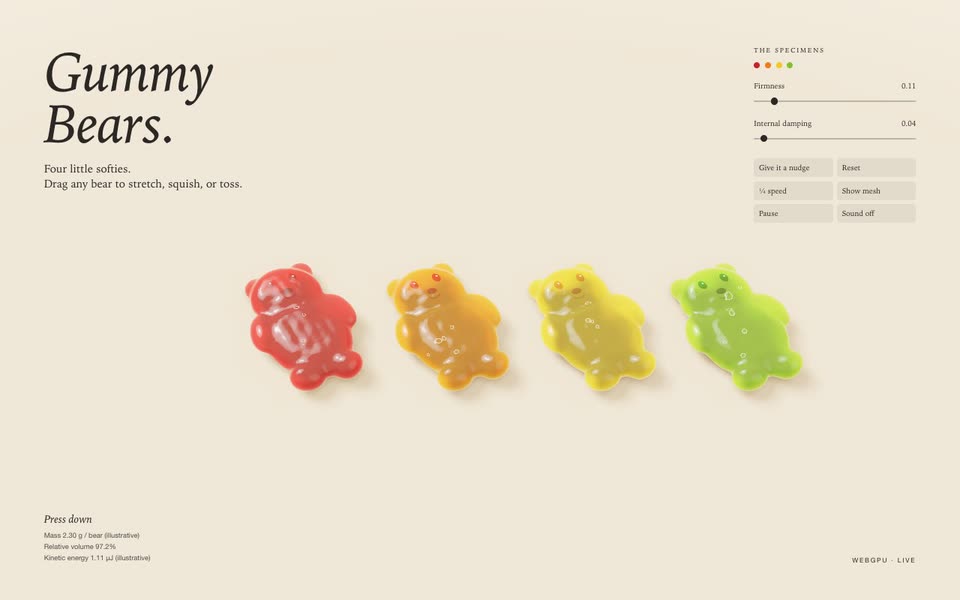
Four translucent gummy bears on an ivory floor, rendered with native WebGPU. A deterministic 36-second choreography stretches, presses, flips and tumbles them before they settle back to the exact rest pose. Drag any bear to stretch, squish or toss it. A fixed-step tetrahedral XPBD solver in one offline HTML.
Stone Stars: 3D Miniature Landmark City
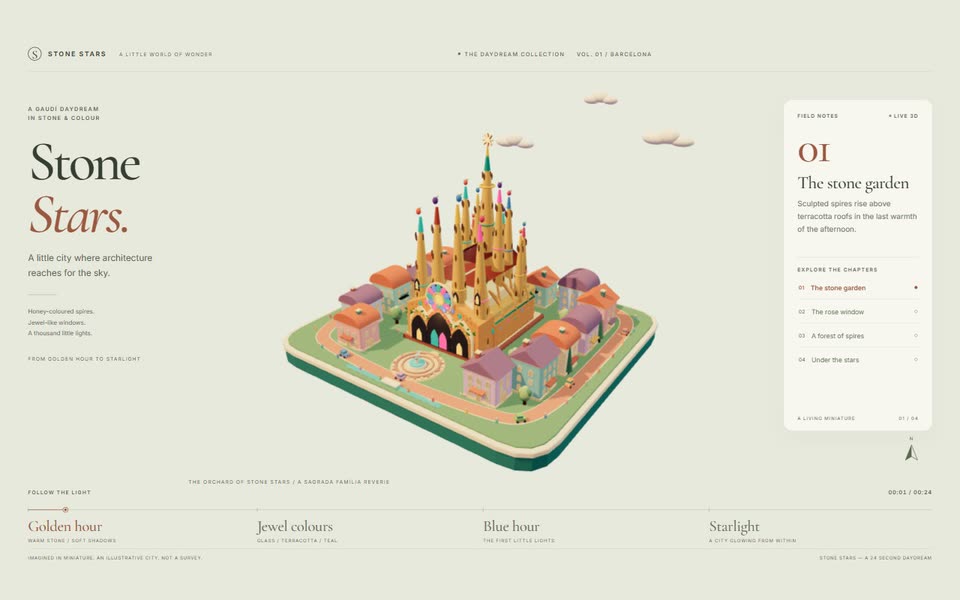
Turn a city into a storybook 3D island around one landmark, with chapters, a daylight-to-starlight slider, street life and a matching scored 24-second film. Sample: a Gaudí-style basilica.