
Winter Core
- Skill Lab
- v0.1.2
- Interactive 3D
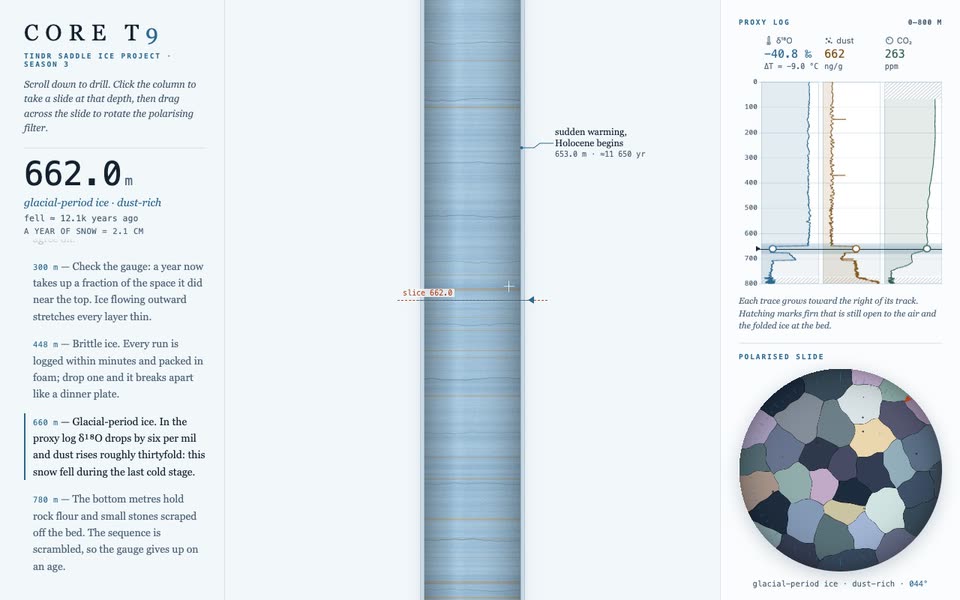
Scroll down an 800 m ice core on a pale arctic page, past firn, bubbly, brittle and glacial-period ice to the debris at the bed, while a proxy log plots δ¹⁸O, dust and CO₂ at the drill depth; click to cut a slide and turn a polarising filter over its crystals.
Contoh
Winter Core ice core
Contoh berjalan di frame sandbox tanpa akses ke halaman ini.
Jalankan online
Jalankan di sandbox SandBase dan lihat hasil Anda di Lab.
Buka di Lab ↗Apa yang Anda dapatkan
Bring a drilling site, its ash depths and the field notes along the core. The Skill returns a downloadable Skill and a runnable ice-core scene.
Cara kerjanya
- 01
Build the ice-core page
Winter Core needs only npm install, which brings in playwright-core for the checks, then npm run build for one bilingual dist/index.html or npm run build:zh for a Chinese-only page from the saddle-zh brief. The core, the surface camp, the proxy log and the polarised slide are Canvas 2D code with no image assets and no network requests, so the page opens offline in a browser.
- 02
Generate strata, proxies and slides from depth
Layer thickness follows ACC·(1−z/HP)·917/ρ(z) and age sums its inverse down the core, so annual layers thin from about 0.24 m to 0.5 cm with depth. scanline(z, row) adds a depth tint, yearly couplets, a melt crust, three tephra bands and silt, baked once into one tall canvas. proxies(z) reads δ¹⁸O, dust and CO₂ through the age, and a cut lights each grain by sin²(2(φ−θ)).
- 03
Drill, read the log and cut slides
Open dist/index.html, or add ?lang=zh-CN for Chinese, and scroll down from the station sheet: the depth at the reading line is scrollY / 24. The left rail shows zone, age and one year's thickness, and the proxy cursor follows the drill. Click the column to cut a slide, then drag around it or press ← and → to turn the filter. At bedrock, Return to the surface winches the page back to the top.
FAQ
What does Winter Core show?
Winter Core shows an ice core about 800 m long on a pale arctic page that you drill by scrolling, from firn through bubbly, brittle and clear ice to dusty glacial-period ice, basal debris and bedrock. A station sheet for an invented site and a drawn drill camp open the page. The left rail holds a depth gauge and seven field notes, and the right panel holds a proxy log and a polarised thin slide.
Is Winter Core based on a real ice core?
No. Winter Core's age model, zone depths, ash depths, proxy curves, station figures and field notes are illustrative rather than data from a real core, and the drilling project and the people named in the copy are invented. The model follows one simple rule: layer thickness falls with depth through a density curve, so a metre near the surface holds a few years and a metre near the bed holds thousands.
What does the proxy log in Winter Core plot?
The Winter Core proxy log plots three traces against depth: δ¹⁸O as a temperature proxy with a ΔT readout, insoluble dust per gram of ice, and CO₂ in the air bubbles. A cursor follows the drill with the three readouts at that depth. CO₂ appears only below pore close-off at 68 m, glacial-period ice shows lower δ¹⁸O and far more dust, and the folded ice near the bed is hatched instead of read.
Does Winter Core need an API key?
No. Winter Core runs offline in the browser and makes no model calls, so it needs no API key and is free to run. The column, the proxy log and the surface camp are generated by code and baked when the page loads, with no image files or network requests. playwright-core, installed by npm install, serves only the headless checks.
What does the polarising filter in Winter Core show?
The Winter Core polarising filter lights each ice grain by sin²(2(φ−θ)), where φ is the filter angle and θ the grain's orientation, through a six-stop interference colour table. Turning the filter makes a grain go dark, bright and dark again as it crosses its axis, so different grains light in turn. Deeper slides hold fewer, larger grains, and the same depth and seed always rebuild the identical slide.
How do I get back to the surface in Winter Core?
When the drill reaches bedrock, Winter Core shows a field-log card with the final depth, the oldest dated ice, the runs logged and the number of slides you cut, under a short entry from the invented drill log. Its Return to the surface button winches the page back to the top. A wheel, touch or key press takes over mid-climb, and with reduced motion set the return is an instant jump.
Does Winter Core work on a phone?
Yes. Below 720 px wide, Winter Core runs the core down the left edge and stacks the rail and the panel beside it. Scrolling drills as on a desktop, a tap cuts a slide at that depth and a drag over the slide turns the filter. The drawn callouts that label depths along the core are hidden at 1040 px wide and below, and ?lang=zh-CN switches the copy to Chinese.
What are the limits of Winter Core?
Winter Core is Canvas 2D only, and the column and the proxy log are baked once at load and on resize, so scrolling moves finished images and the log cursor rather than drawing new strata. The tall canvas keeps its backing store under the 32,767 px limit. The ages come from an illustrative model, and in the folded basal metres the gauge reports no reliable date instead of guessing one.
Lebih Banyak Skills
Semua Skills Interactive 3D →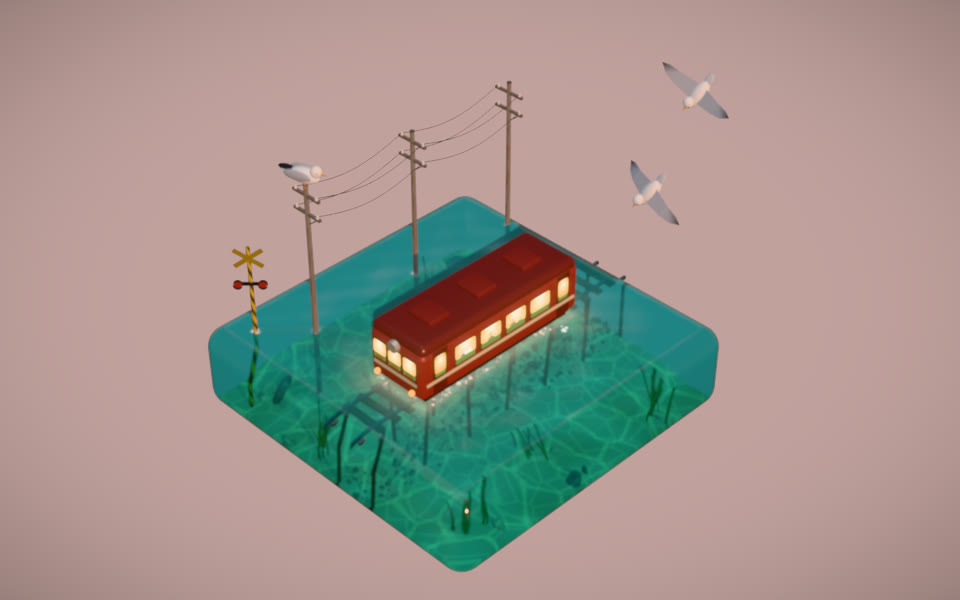
Resin Diorama
Live 3D resin-block dioramas in your browser: send a little tram across a clear turquoise sea, or ripple the bay of a cliff island. Synthesized sound, and every scene can be tuned.

3D Vehicle Worlds
Explore interactive 3D vehicle worlds in your browser, with varied terrain, camera controls and driving effects. Choose a playable example to begin.
3D Firefly Terrariums
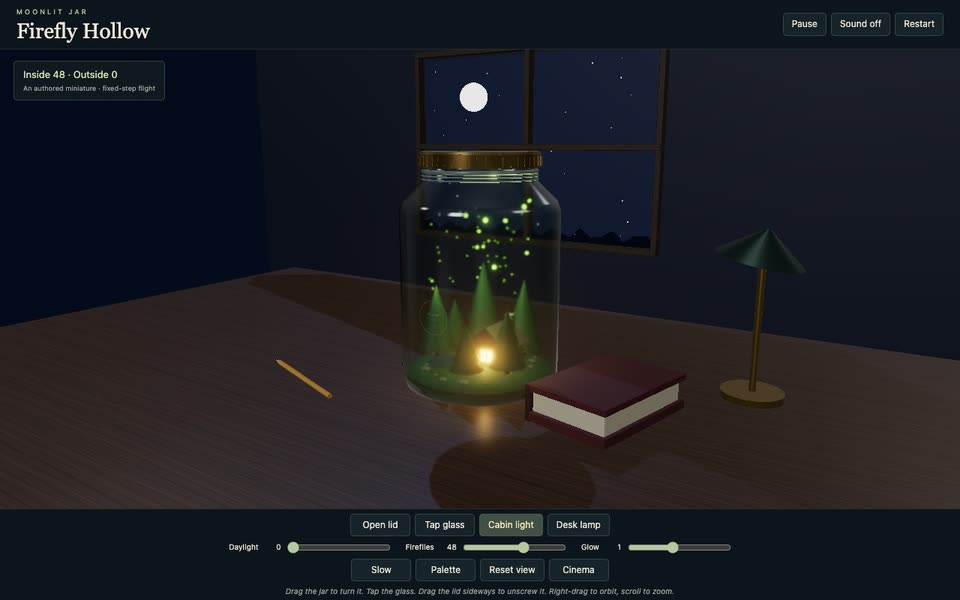
Turn a thick glass miniature, scatter glowing fireflies and open its brass lid. Actual particles leave through the neck and return before it seals. A moonlit cabin, forest and real local lights in one offline HTML.
Jelly Candy: Fruit Bears
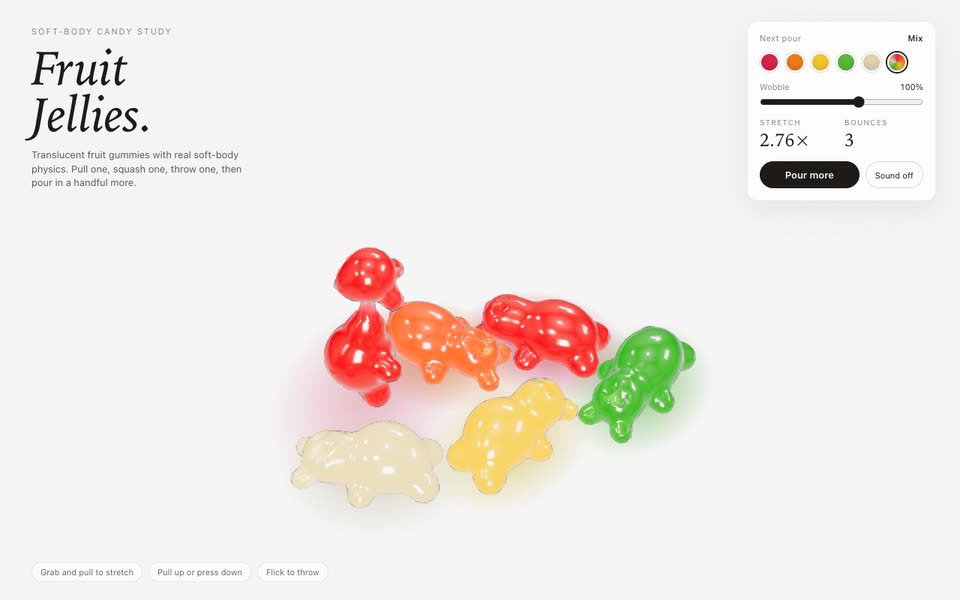
Six translucent fruit gummies on a white table. Grab any part and pull, lift a head until the neck stretches thin, press one flat until it springs back, flick one across the pile or pour in more. Fixed-step soft-body physics and a marching-cubes skin in one offline HTML.
WebGPU Soft-Body Gummy Bears
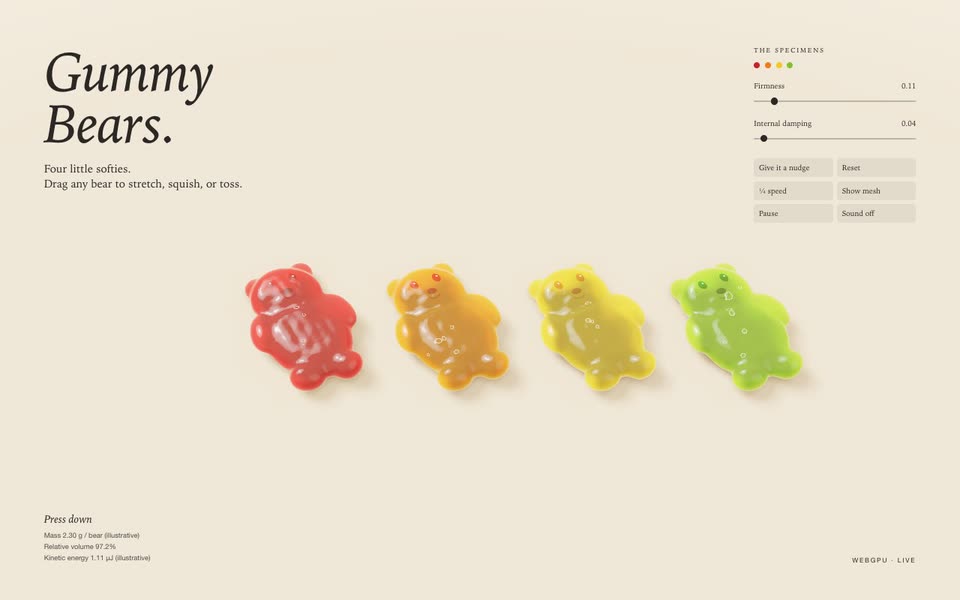
Four translucent gummy bears on an ivory floor, rendered with native WebGPU. A deterministic 36-second choreography stretches, presses, flips and tumbles them before they settle back to the exact rest pose. Drag any bear to stretch, squish or toss it. A fixed-step tetrahedral XPBD solver in one offline HTML.
Stone Stars: 3D Miniature Landmark City
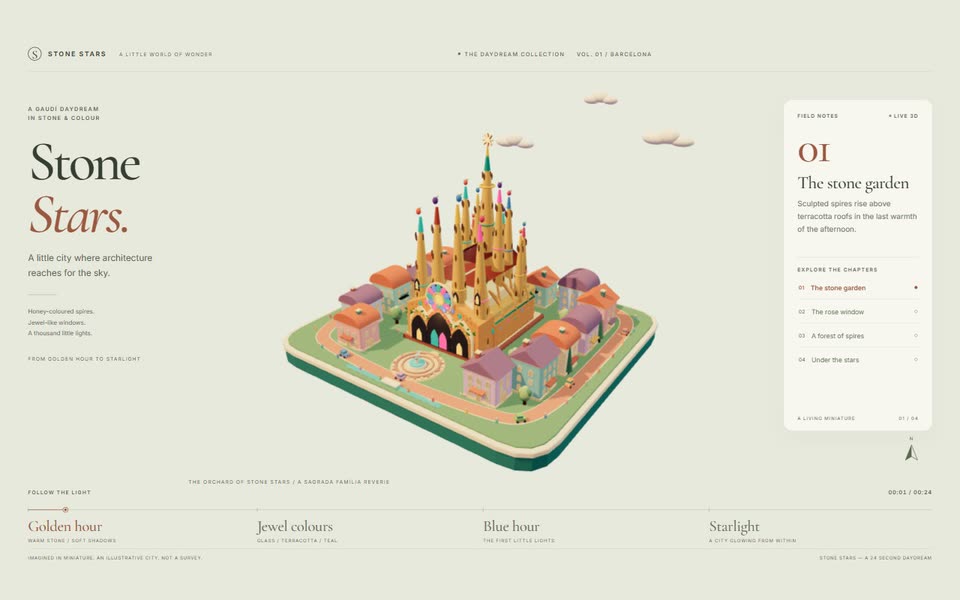
Turn a city into a storybook 3D island around one landmark, with chapters, a daylight-to-starlight slider, street life and a matching scored 24-second film. Sample: a Gaudí-style basilica.