
Volt Brief Slides
- Skill del Lab
- v0.1.0
- Research
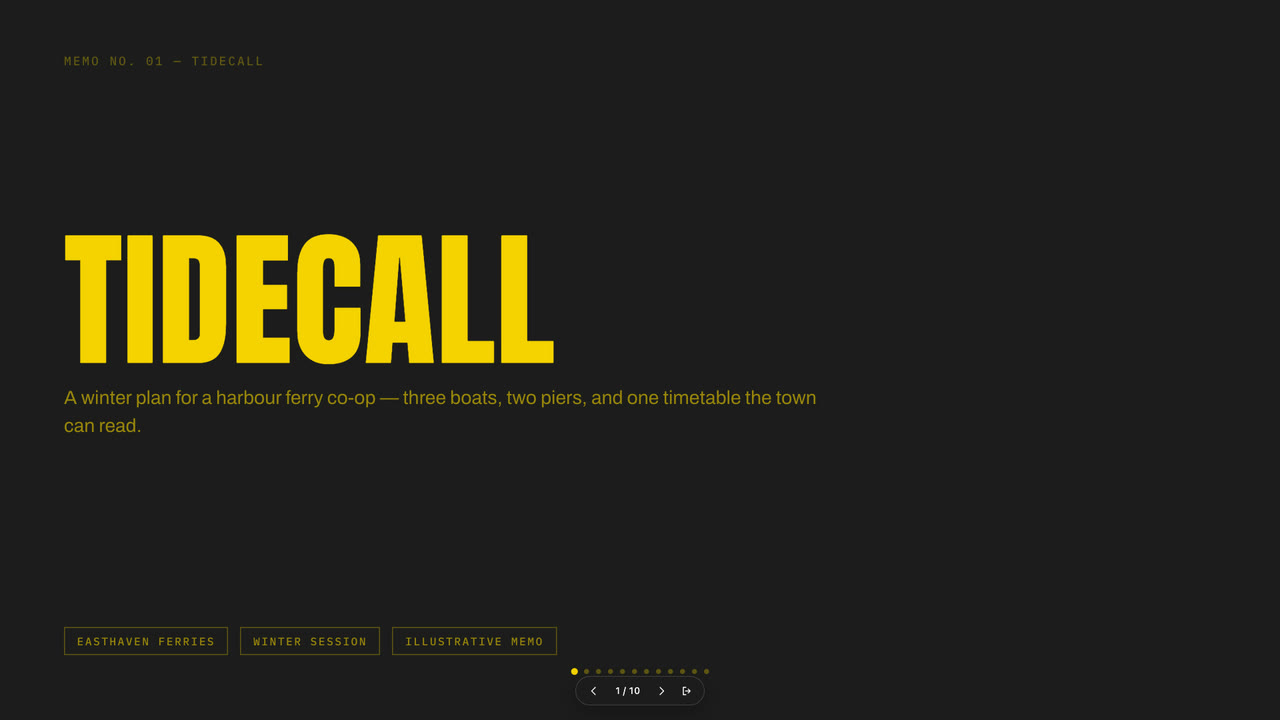
Make decks that read like high-voltage two-register briefs: near-black ink pages or full volt-yellow pages, uppercase condensed grotesk titles, mono chrome labels, em-dash bullets, stepped bar charts and hairline-framed drawn panels.
Esempi · 2
Cosa ottieni
Bring the topic, the audience, the one premise the deck should land, the facts and numbers to use exactly, the page count and content language; drawn plates are optional and painted by the Skill. The Skill returns one offline HTML deck that edits in the browser and exports editable PowerPoint.
Come funziona
- 01
State the ask
Volt Brief Slides asks for the topic, the one thing the deck must get approved, the audience, numbers you can stand behind, page count, language and pictures you own. It is for project briefs, proposals, season plans and infrastructure reports that should read as urgent and official, not documentation. The default arc runs cover, chapter, statement, picture split, numbers, offer, quote, compare, chart, method and closing.
- 02
Alternate ink and volt pages
Your Agent sets a swatch with accent and wash equal, so the signal colour fills the paper register at full bleed. It runs python3 scripts/volt-art.py art.json --out art/ for rooflines, pylons, sun discs, meter dials or the bolt mark, then fills plan.json, including every kick, cnum, f1 and f2 chrome field. kit.py compose renumbers NN / TT counters, using the Python 3 standard library.
- 03
Build and read every page
make-deck.py writes presentation.html and verify-deck.py reports page count and sampleLeft. The dot row keeps the sample's count, so drop extra dotN nodes. Over local HTTP, check uppercase Anton wraps, that no three pages share a register, hairline rules, em-dash bullets of at most five items, bar values and the counter. Exporting PowerPoint and running verify-pptx.py confirms the native objects.
FAQ
What does Volt Brief Slides look like?
Volt Brief Slides alternates two registers: an ink page on near-black #242422 with volt type, and a paper page filled edge to edge with the signal colour and ink text. Headlines are Anton, uppercase only, with tight tracking. Chrome is IBM Plex Mono, lowercase for section labels and uppercase for codes. There are no shadows, rounded cards or gradients, only 1px hairlines.
Can Volt Brief Slides do a dense report?
No. Volt Brief Slides is for declarations and asks, with headlines of about six words, supporting lines up to 18 words and bullets up to 8 words. Dense tables and long financial annexes do not fit, and the Agent says so at the brief. The demos are a 10-page ferry co-op winter plan in Volt and a 9-page foundry safety briefing in Hazard.
Does Volt Brief Slides call any paid service?
No. Volt Brief Slides draws its panels with volt-art.py and builds with the Python 3 standard library on your machine, so there is no model call or billed usage behind a brief. python-pptx is needed only if you run verify-pptx.py on an exported file.
Can I use a photograph in Volt Brief Slides?
Yes. Volt Brief Slides prefers pictures you supply and have the right to use. The split-page plate is sized for a drawn panel, so a photo sits in the same hairline frame with the same mono caption. Drawn panels stay flat ink-and-volt abstractions with no photographs inside, and they do not depict real places, events or people.
Which fonts does Volt Brief Slides export with?
Volt Brief Slides names Anton, Archivo and IBM Plex Mono in its PowerPoint export. All three are free under the SIL Open Font License and bundled under references/fonts/. Install them on the presenting machine for exact wrapping; otherwise the opening application substitutes faces and the uppercase headlines can break differently.
What are the limits of Volt Brief Slides?
Volt Brief Slides fixes each layout's geometry, so copy over budget can crowd a hairline or run past the canvas. The giant s-d1 and s-h1 sizes suit uppercase Latin condensed type, and Chinese, Japanese or Korean headlines need a smaller size. Editor blocks start at the top-left without reflow. The nav-dot row is not resized to your page count.
Altri Skills
Tutti gli Skills Research →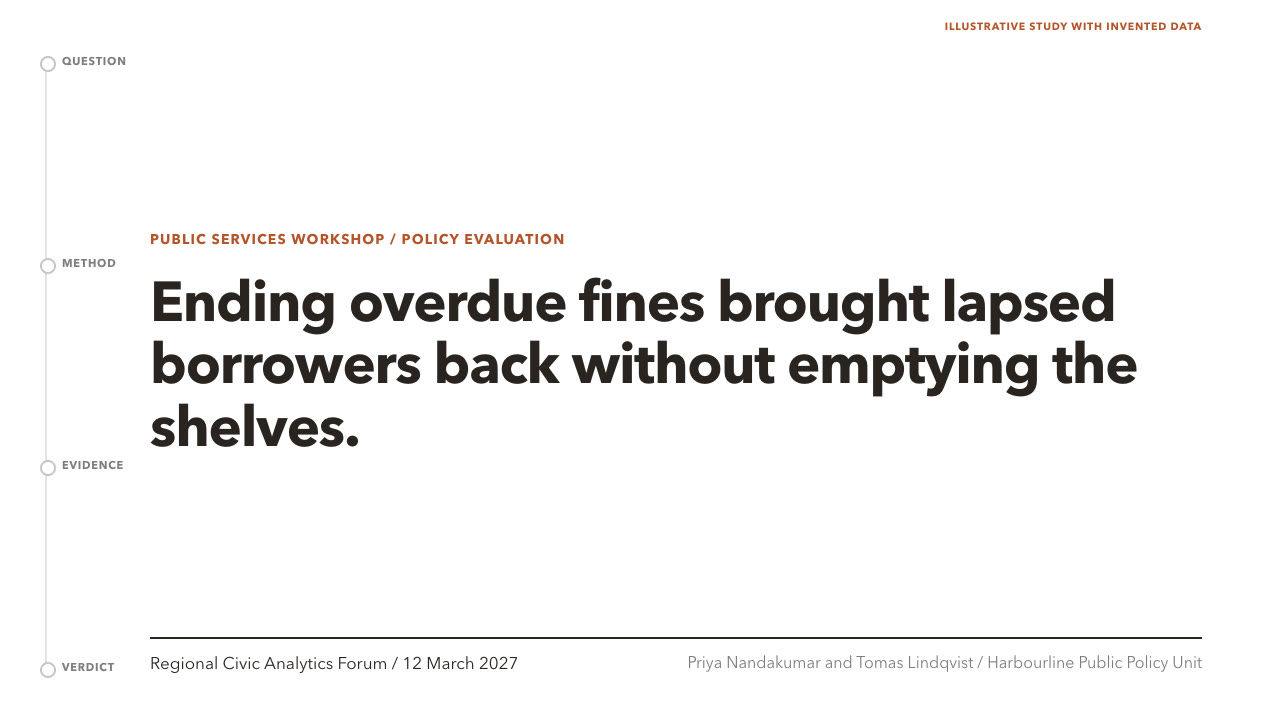
Thesis Spine Slides
Build a research talk whose titles, read in order, argue one claim from question to verdict, with one cited exhibit per evidence page.
Reading Digest Slides
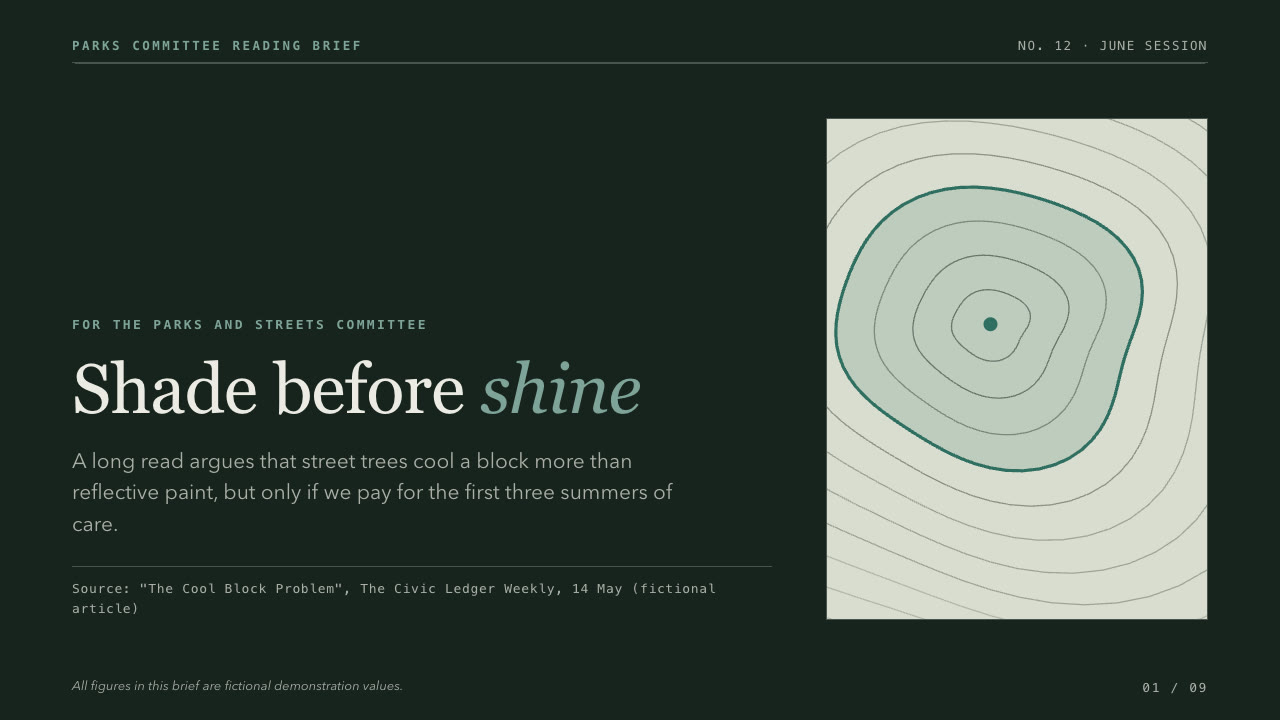
Turn one long read, essay or report into a reading brief a committee can decide on: a masthead, argument beats on a rail, a headline figure, bar charts and a source ledger that keep checked facts, assumptions and open questions apart, two readings, discussion prompts and the decision asked.
Cloudpane Slides
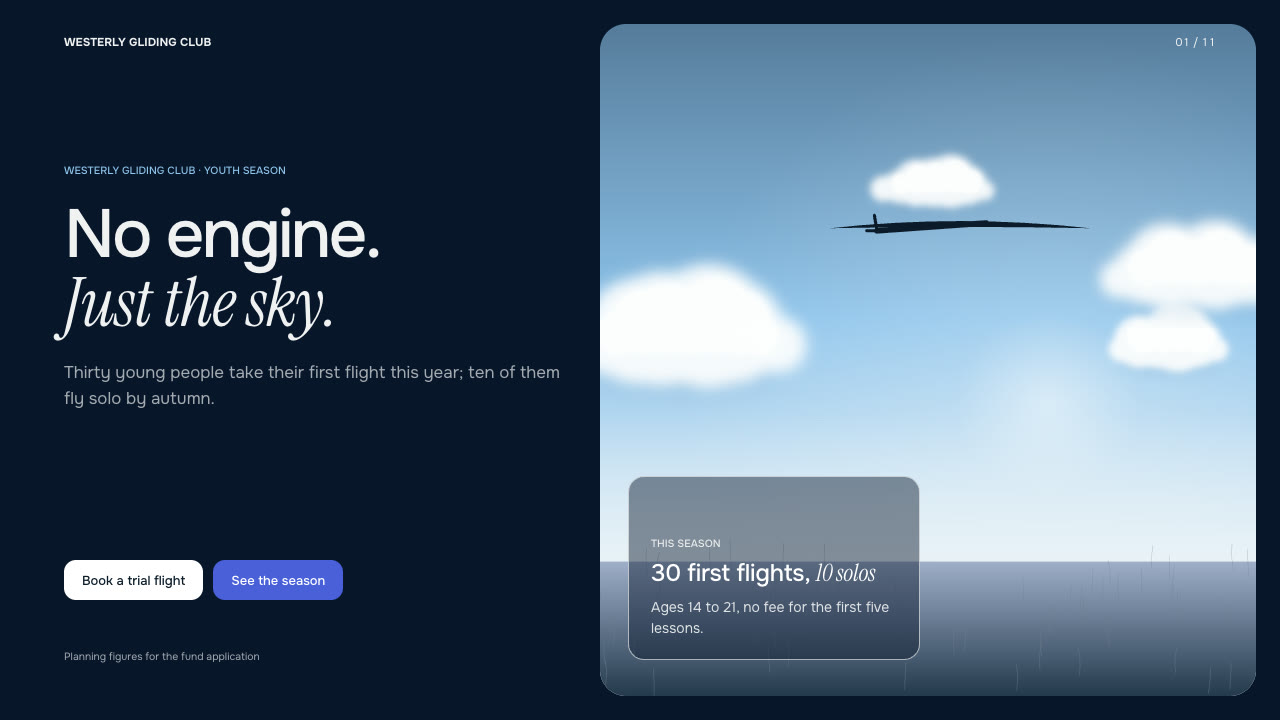
Make explainer and proposal decks that make a public subject feel approachable: open-sky pictures, clear optical glass and anonymous figures, thin-edged translucent glass cards over the pictures, broad mist-white pages, three deep night pages and headings with an italic serif accent.
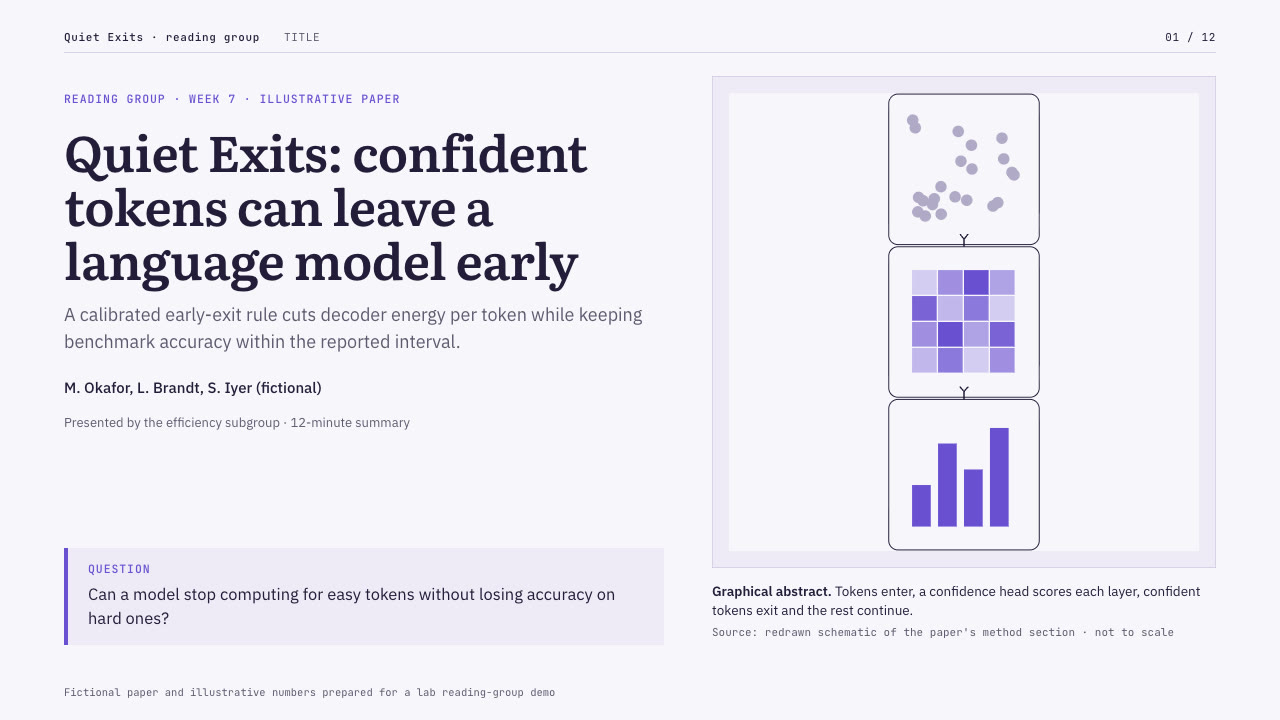
Figure First Slides
Make figure-led research talks such as paper summaries, journal clubs, lab and reading-group reviews and evidence briefings: every content page is built around one figure, chart or table with its caption and source underneath, numbers carry their comparator and interval, and a limits page states what the work can and cannot claim.
Seminar Math Slides
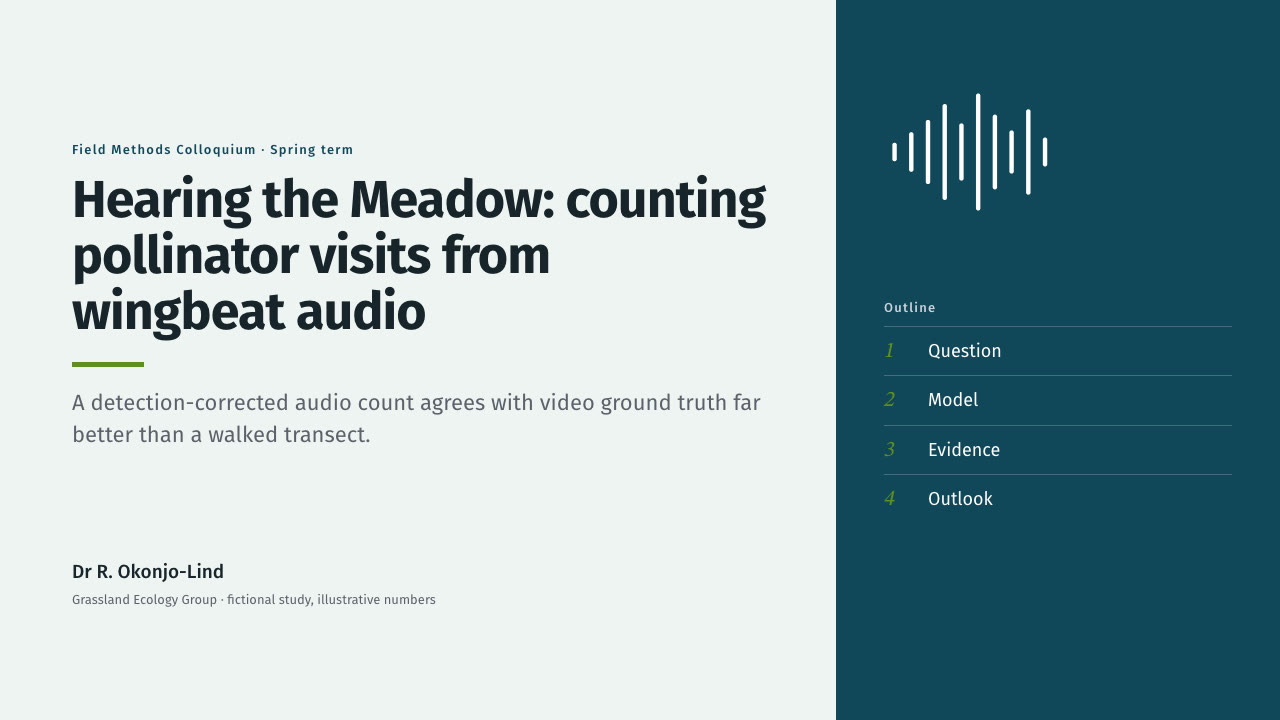
Turn a paper, thesis chapter or research notes into a projection-ready 16:9 talk for seminars, colloquia, defences and conference sessions: a section strip with the current section lit, equations with spoken readings and term glosses, a method pipeline, a proof sketch, native result bars and tables, plots drawn from data and a progress bar with frame counters.
Yellowpad Fieldnotes Slides
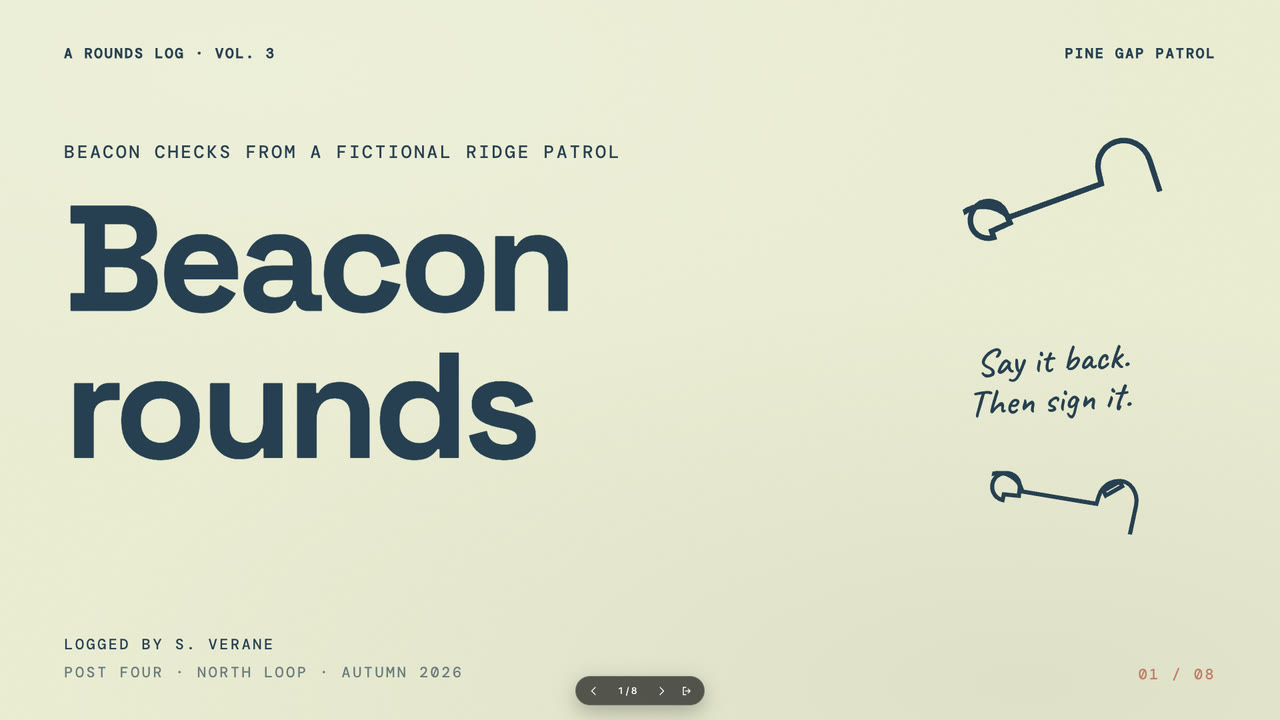
Make decks that read like pinned field notes: saturated yellow legal-pad paper, cobalt ink, hand-drawn safety pins, cream pinned cards, handwritten marginalia, mono archival tags and rotated red stamps.