
Wildscreen Slides
- Skill z Lab
- v1.0.3
- Education
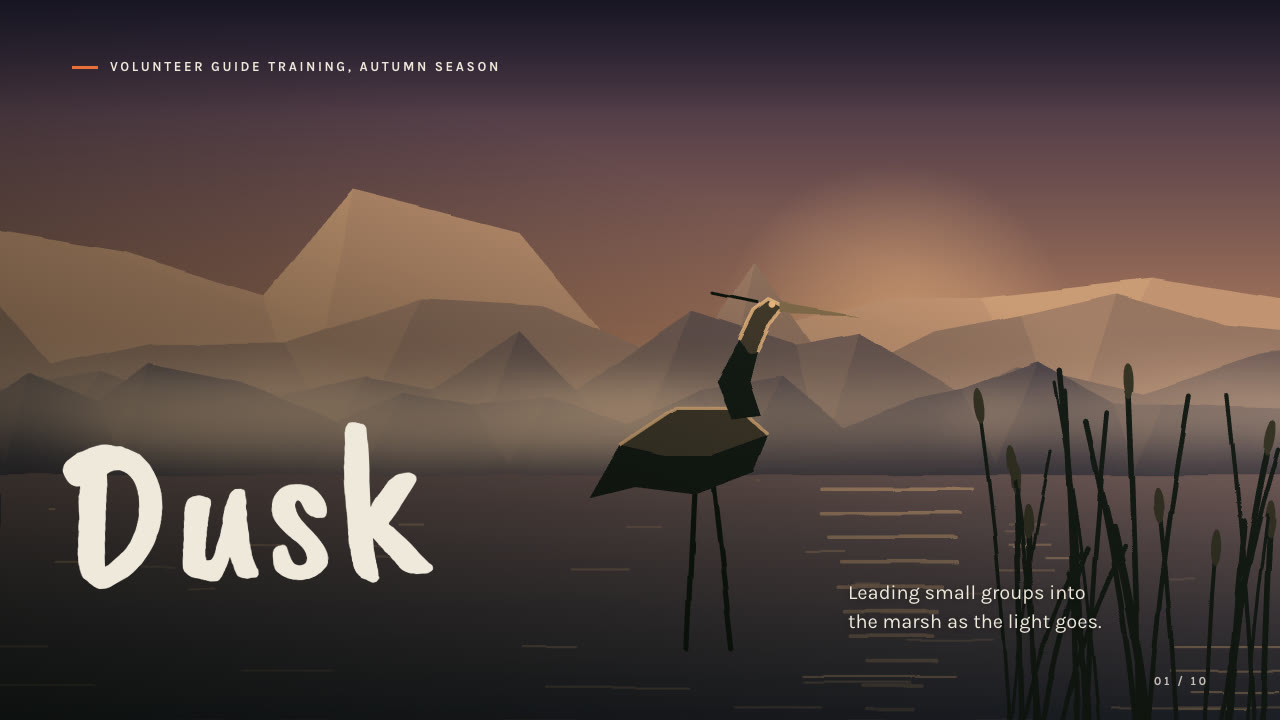
Tell a nature story the way a wildlife film would: full-bleed painted landscapes with animals at dusk, night or in snow, quiet paper pages with framed scenes, a hand-lettered brush headline face, film-strip montages and a ring of six prompts in two accents.
Przykłady · 2
Co otrzymasz
Bring a brief with the subject, the audience, the purpose, the facts you can stand behind and the page count; pictures optional. The Skill returns one offline HTML deck that edits in the browser and exports editable PowerPoint.
Jak to działa
- 01
Agree the outline and pages
Wildscreen Slides asks for the subject, audience, purpose, facts you stand behind, page count, language and pictures you own. It never invents sightings, measurements or results. Your Agent chooses from twelve layout recipes such as opening, world, presence, fragments, lens, motion, steps and closing, alternates dark and paper pages and avoids three full-bleed pages in a row.
- 02
Paint scenes for each page
Pictures you may use come first. Otherwise the Agent describes each scene in scenes.json and runs python3 scripts/wild-scenes.py scenes.json --out art/, painting every picture for one page only at the ratio the layout lists. Full-bleed scenes keep their text side calm and dark. plan.json sets text, pictures, alt, art icons and drops, and kit.py compose writes deck.json locally.
- 03
Build, shrink and check
make-deck.py writes presentation.html and verify-deck.py reports leftovers; generic prompt icons and the quote mark may stay. If the file grows past about 15 MB, run shrink-images.py. Over local HTTP, check headline wraps, text over the brightest part of each scene, frame crops, the film strip, the prompt ring, contrast and the page counter. Static checks do not prove layout.
FAQ
What talks is Wildscreen Slides made for?
Wildscreen Slides is made for talks where place and atmosphere carry the message: ranger and guided-walk training, nature film pitches, field-course introductions, conservation briefings and outdoor festival programmes. The demos are a 10-page dusk-walk guide training in Ember and a 9-page alpine series pitch in Glacier. It has no chart or table layouts.
What animals can Wildscreen Slides paint?
Wildscreen Slides paints stylised landscapes with simple animal figures: heron, stag, owl, bear, fish, whale, birds and moth. These are not records of real places or animals, so do not present them as observations. Use your own photographs when a talk is about real sightings.
Does Wildscreen Slides call a model to paint scenes?
No. Wildscreen Slides paints its landscapes and animals with wild-scenes.py on the Python 3 standard library, so no model or image service runs and the scenes are not billed. If your agent drafts the plan with a model, that is separate from the Skill, which itself calls none.
How big is a Wildscreen Slides PowerPoint?
Wildscreen Slides exports pictures as PNG re-encodings, from about 0.1 MB for simple scenes to about 2 MB for busy full-page ones. A ten-page deck with about twenty scenes exports at roughly 10 to 15 MB, larger than the HTML. Film grain makes each grained scene several times larger.
Which fonts does Wildscreen Slides use?
Wildscreen Slides uses Caveat Brush for headlines and the single brush word on the cover, and Karla for body text, both under the SIL Open Font License. The embedded subsets cover Latin letters, digits and common punctuation. Chinese, Japanese and Korean headlines use a heavy system face and lose the brush look.
What does Wildscreen Slides export as pictures in PowerPoint?
Wildscreen Slides exports headlines, copy, prompts and step rows as text boxes, scenes as pictures, and prompt orbs and card rules as shapes. Gradients over scenes, the film perforations and the dashed ring arrive as flat picture layers behind the text. Check the export with verify-pptx.py, which needs python-pptx.
Więcej Skills
Wszystkie Skills dla Education →
Science MV
Explain science through visible causes, transformations and results.
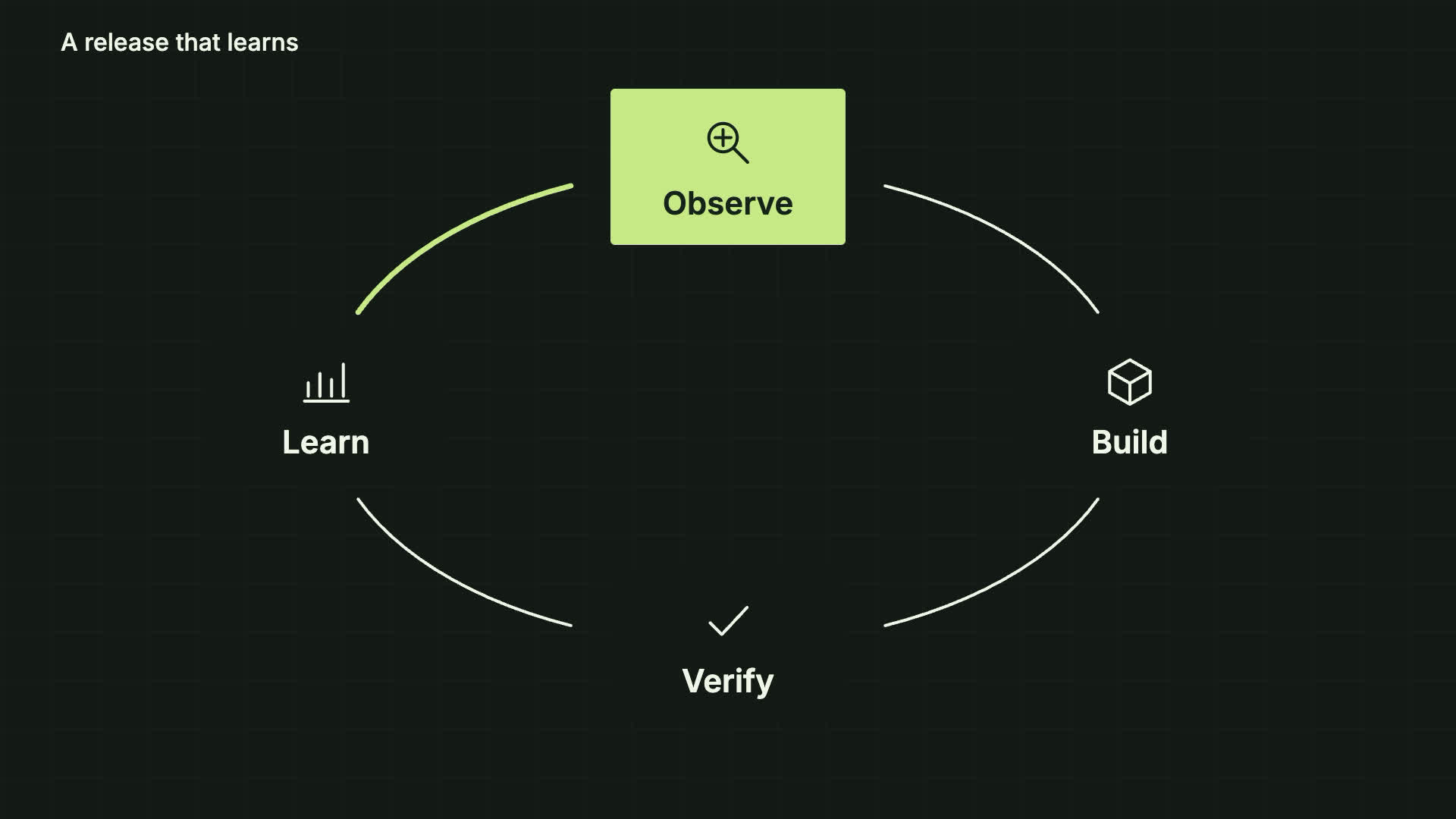
Loop Story
Explain a cycle: build each stage, close the loop, then reveal the takeaway.
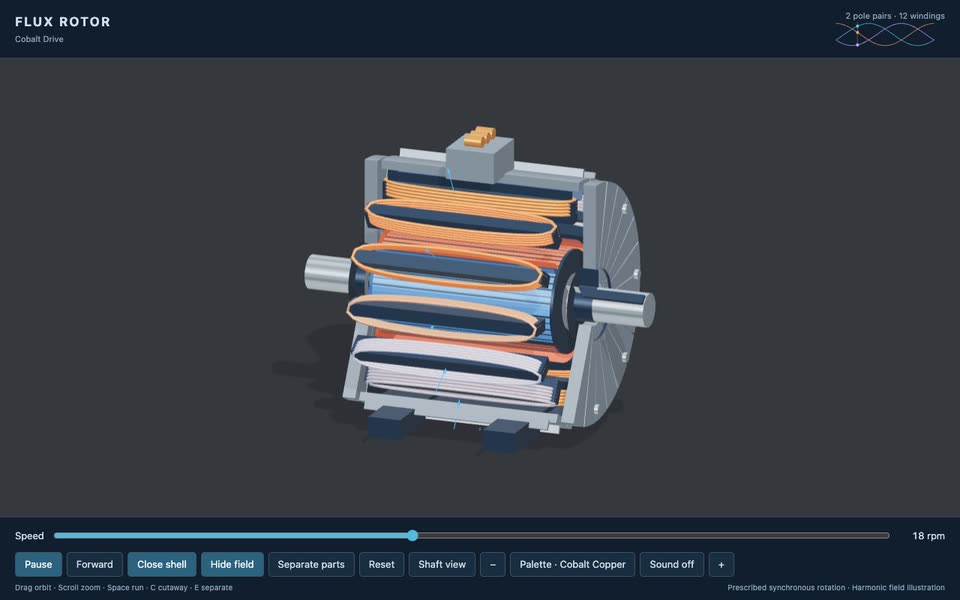
Flux Rotor: Cobalt Drive
Inspect an original motor with real winding groups, alternating magnet sectors and a keyed shaft. Balanced phase currents drive prescribed synchronous rotation, material colors and spatial harmonic markers. Open the actual cutaway and separate six components offline. This display does not solve torque, efficiency or magnetic finite elements.
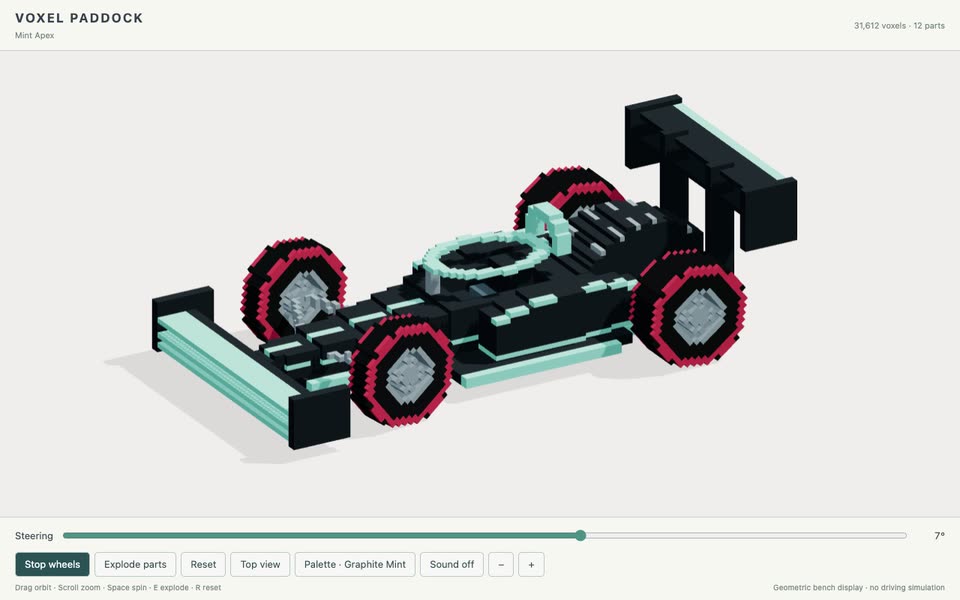
Voxel Paddock: Mint Apex
Inspect an original open-wheel vehicle built from procedural cubes. Spin actual wheels on a stationary display, turn nominal geometric steering and separate twelve component groups. Edit bounded dimensions, voxel density and three palettes offline. This is not a driving or aerodynamics simulation.
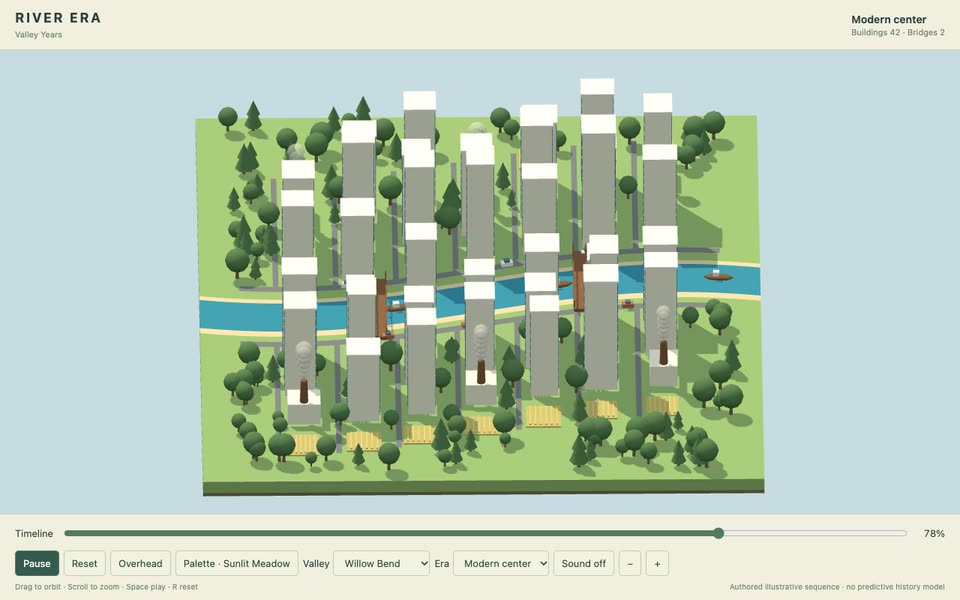
River Era: Valley Years
Scrub an authored river settlement timeline from camp and farms to town, workshops and speculative towers. Actual seeded geometry changes reversibly; boats and vehicles follow the same river and bank equations. This is an illustrative sequence rather than predictive history.
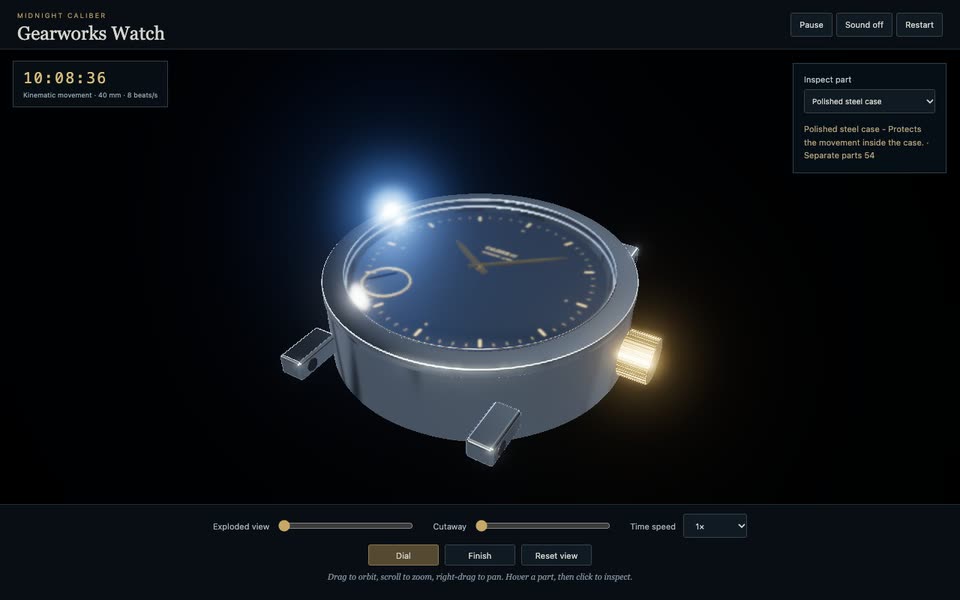
3D Mechanical Watch Explorer
Inspect a kinematic mechanical watch with actual meshed tooth ratios, 54 components, axial explosion, material cutaway and bilingual mouse/touch controls. One offline HTML with optional synthesized tones.