
Mirror Wedge Tumbler
- Skill z Lab
- v0.1.0
- Interactive 3D
A brass mirror tube seen end on, where a loose load of glass, beads and foil tumbles in a turning cell and two mirrors fold one wedge of it into a rose that keeps re-forming; drag round the eyepiece to turn the tube, tap to knock it, change the load or the fold count.
Przykład
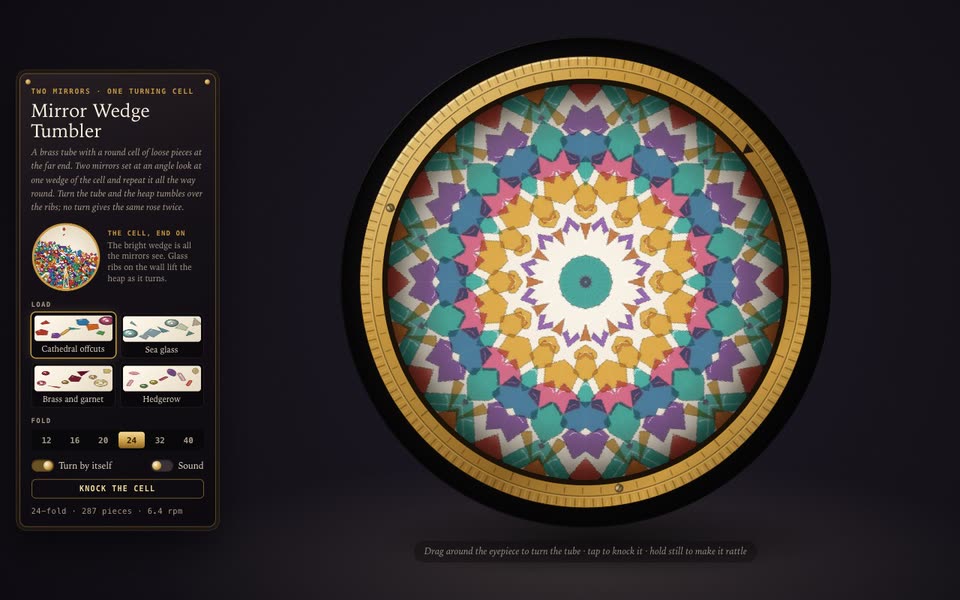
Mirror Wedge Tumbler mirror tube
Przykład działa w odizolowanej ramce bez dostępu do tej strony.
Uruchom online
Uruchom w sandboxie SandBase i zobacz wyniki w Lab.
Otwórz w Lab ↗Co otrzymasz
Bring the loads, colours and copy for your tube. The Skill returns a downloadable Skill and a runnable mirror-tube scene.
Jak to działa
- 01
Write the tube briefs
Each brief in assets/briefs/ holds the copy, the backlight and room colours, the fold steps and four loads. Each load sets its seed, fill share, size range, mix of pieces and palette. The bundled English brief pours cathedral offcuts, sea glass, brass and garnet, and a hedgerow mix; the Chinese brief pours celadon shards, glass beads, osmanthus foil and rouge. Ask your agent, for example: "Use mirror-wedge-tumbler with a load of blue sea glass and silver foil."
- 02
Build one offline page
npm run build inlines src/tumbler.js and both briefs into dist/index.html, about 56 KB. ?lang=en or ?lang=zh-CN picks the brief. The pieces tumble in a Verlet heap inside a turning cell with lifter ribs, the cell is drawn with Canvas 2D every frame, and two lookup tables fold one wedge of it into the rose. There are no images or network requests, no API key and no model calls.
- 03
Check the tube before you ship
npm install brings in playwright-core, then npm run shoot drives the page frame by frame in headless Chrome with the network blocked. It runs 39 checks: the load pours in and settles, turning lifts the heap over the ribs, the rose matches its own mirror and rotation copies, a drag turns and coasts, a tap knocks, a hold rattles, keys, the fold dial and loads work, and reduced motion opens still.
FAQ
Does Mirror Wedge Tumbler need an API key?
No. Mirror Wedge Tumbler is a single offline HTML page drawn with Canvas 2D, so it needs no API key and makes no model or network calls, before or after it is built. Node.js is only needed to run the build script, and playwright-core with a local Chrome only for the bundled browser checks.
Is Mirror Wedge Tumbler an optical simulation?
Partly. Mirror Wedge Tumbler folds the cell with ideal mirrors: it copies one wedge exactly, with no mirror absorption, no doubled images from the glass and no chromatic edges. The tumbling is a real particle heap under gravity, but pieces collide as circles, so their drawn outlines can overlap a little at rest.
What changes when I pick another fold count?
The fold count sets how many times Mirror Wedge Tumbler repeats the wedge round the eyepiece. The dial offers six steps, and the bracket keys step through them. A higher count gives a finer, busier rose from a narrower wedge, and the heap itself keeps tumbling the same way.
Does Mirror Wedge Tumbler work on a phone?
Yes. Mirror Wedge Tumbler answers touch the same way as a mouse: drag round the eyepiece to turn the tube, tap to knock it and hold still to rattle it. On narrow screens the case moves under the tube with larger load and fold buttons. The checks ran at 390 × 844 under emulation, not on real devices.
Does Mirror Wedge Tumbler make sound?
Only when you switch it on. Mirror Wedge Tumbler starts silent. With sound on, a soft noise bed follows how fast the tube turns and how hard it is shaken, and short bell-like chimes follow the fastest contacts, at most one every 70 ms. The sound was checked in code, not by ear.
Więcej Skills
Wszystkie Skills dla Interactive 3D →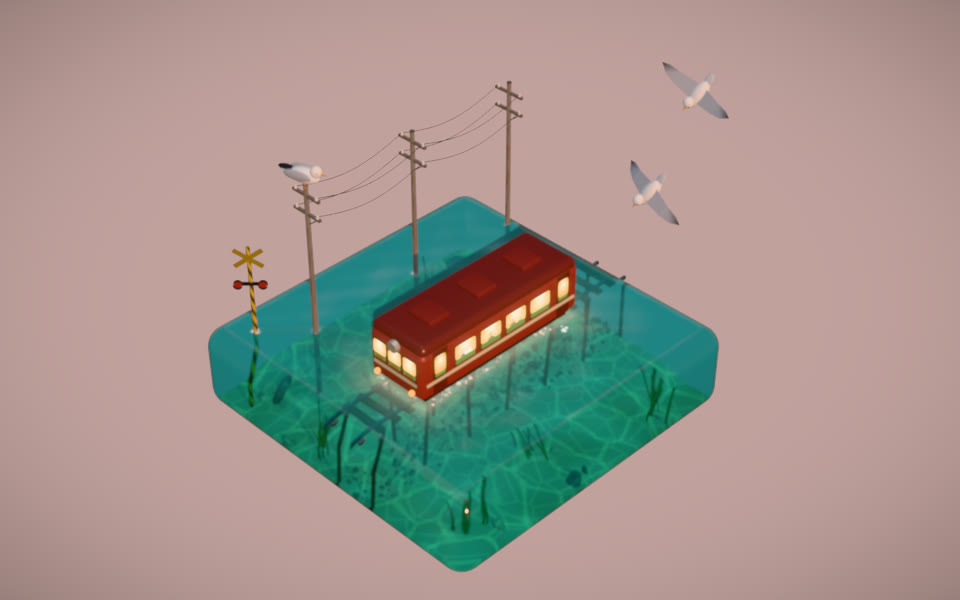
Resin Diorama
Live 3D resin-block dioramas in your browser: send a little tram across a clear turquoise sea, or ripple the bay of a cliff island. Synthesized sound, and every scene can be tuned.

3D Vehicle Worlds
Explore interactive 3D vehicle worlds in your browser, with varied terrain, camera controls and driving effects. Choose a playable example to begin.
3D Firefly Terrariums
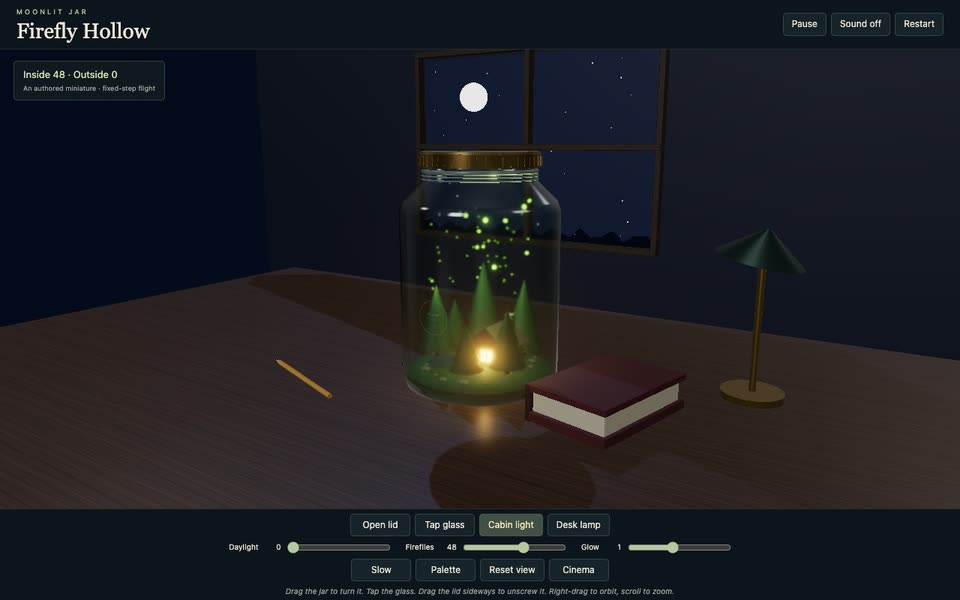
Turn a thick glass miniature, scatter glowing fireflies and open its brass lid. Actual particles leave through the neck and return before it seals. A moonlit cabin, forest and real local lights in one offline HTML.
Jelly Candy: Fruit Bears
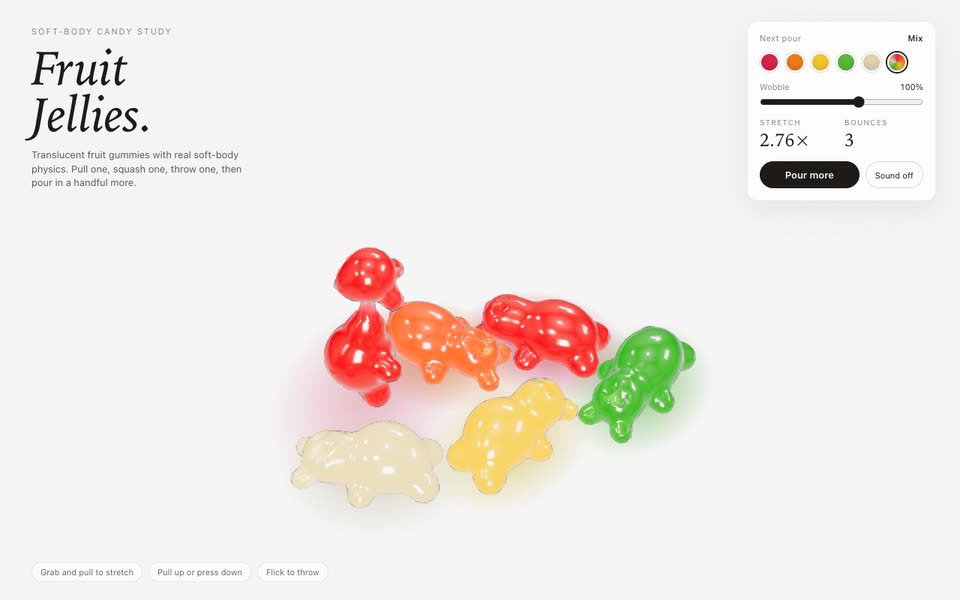
Six translucent fruit gummies on a white table. Grab any part and pull, lift a head until the neck stretches thin, press one flat until it springs back, flick one across the pile or pour in more. Fixed-step soft-body physics and a marching-cubes skin in one offline HTML.
WebGPU Soft-Body Gummy Bears
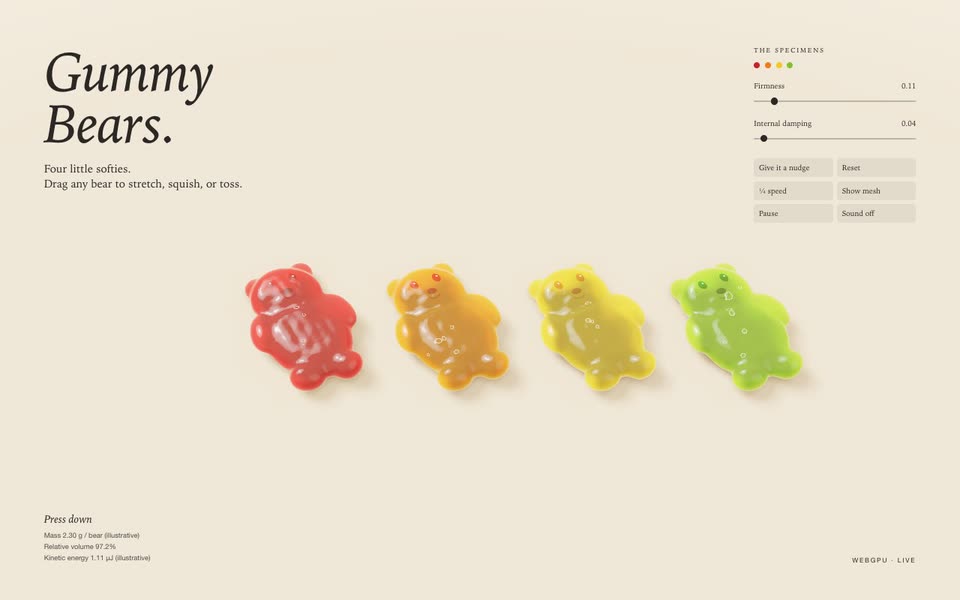
Four translucent gummy bears on an ivory floor, rendered with native WebGPU. A deterministic 36-second choreography stretches, presses, flips and tumbles them before they settle back to the exact rest pose. Drag any bear to stretch, squish or toss it. A fixed-step tetrahedral XPBD solver in one offline HTML.
Stone Stars: 3D Miniature Landmark City
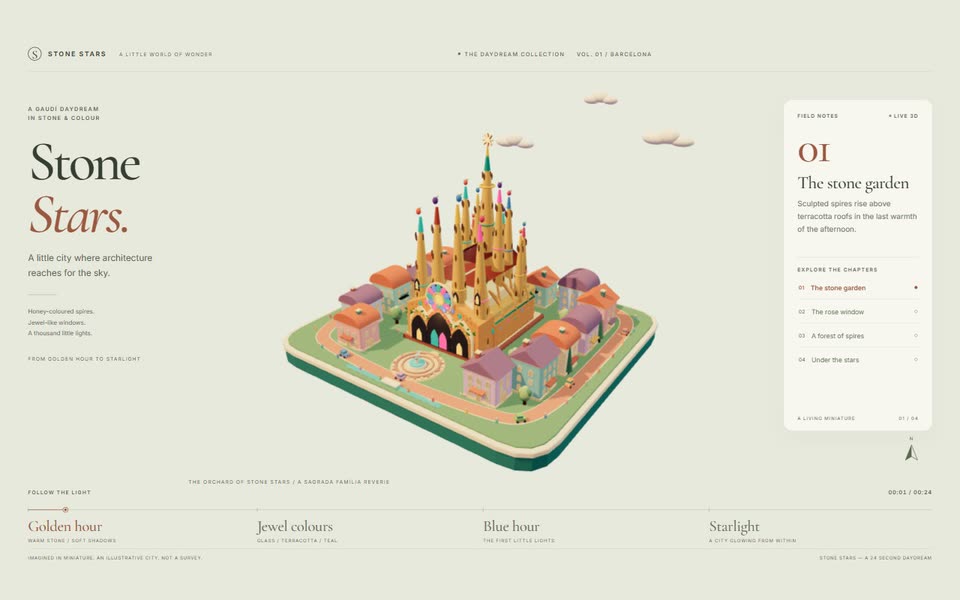
Turn a city into a storybook 3D island around one landmark, with chapters, a daylight-to-starlight slider, street life and a matching scored 24-second film. Sample: a Gaudí-style basilica.