
City Through Time
- Навык Lab
- v0.1.1
- Education
How a living city grew, era by era: its walls and extent light up across today's real streets and buildings, with English narration, subtitles and landmark illustrations.
Пример
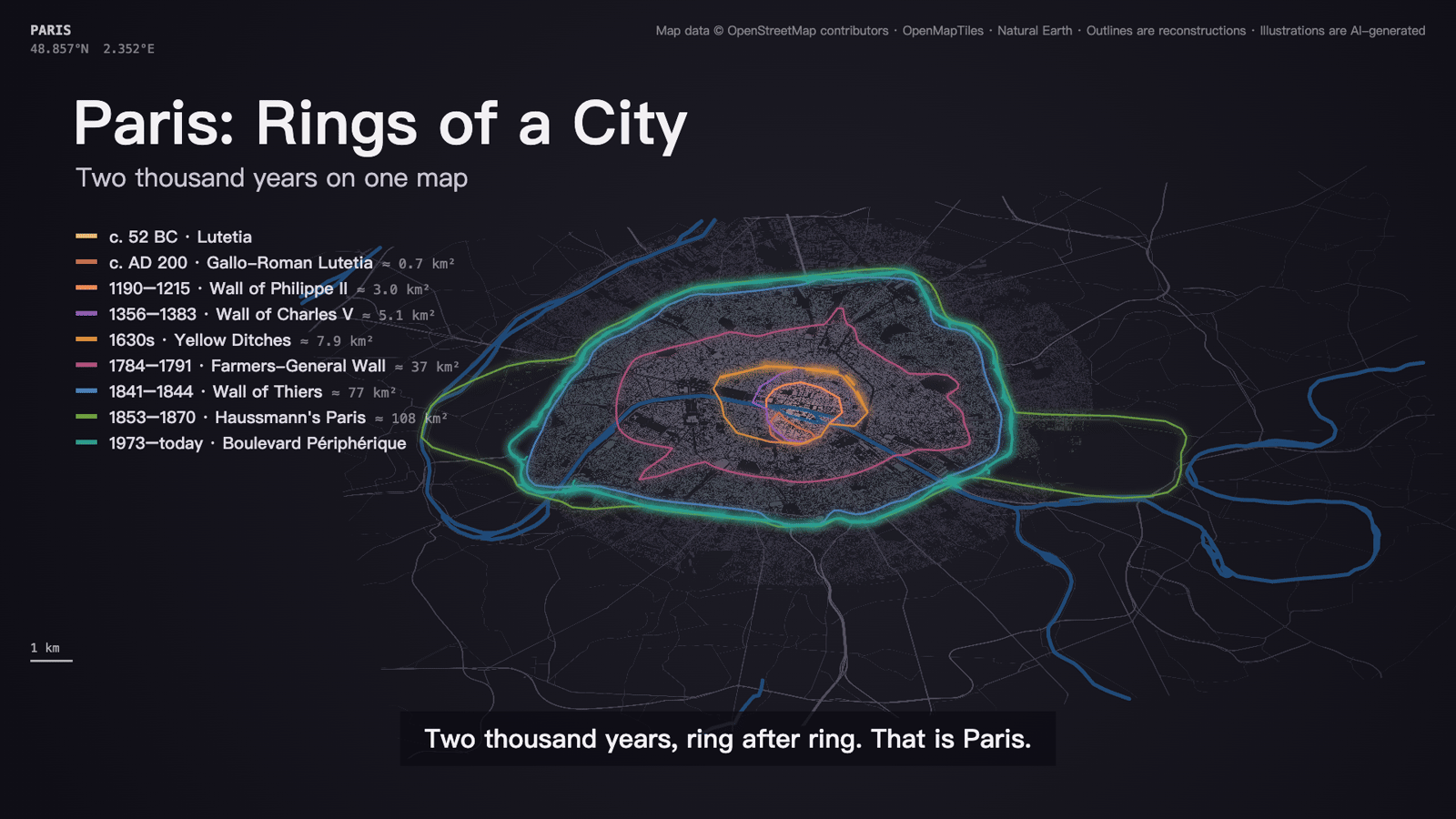
Paris: Rings of a City
Запустить онлайн
Запустите пример City Through Time в SandBase sandbox и сразу увидьте результат здесь.
Что вы получите
A narrated map film of how a living city grew and changed. A turning globe lands on the city, then a dark tilted map of today's real streets and buildings lights up era by era: each era's walls draw in while the streets and buildings inside them glow in its colour, landmark illustrations float up, and an English narrator tells each step with matching subtitles. It ends with every era's outline stacked as the city's rings.
Как это работает
- 01
Write the city story
City Through Time starts with an Agent writing story.json using MiniMax M3.1 flash through SandBase: seven to nine eras, each with a year, a label, one or two spoken sentences, a colour, an extent and up to two landmarks with illustration prompts. Extents prefer real OpenStreetMap references with accurate fallback outlines. Fact-check every line and date before generating media.
- 02
Resolve maps, then media
resolve.mjs validates the story, turns OSM references into closed outlines and downloads the basemap of today's streets and buildings, with no model calls. media.mjs then prints the plan and estimated cost and spends nothing; only with the confirm flag does it generate one narration clip per line with MiniMax Speech 2.8 HD and one illustration per prompt with Qwen Image 3.
- 03
Render the rings
film.mjs renders a 1920 by 1080, 30 fps film in headless Chrome: a globe turns to the city, the camera dives onto the tilted map, each era's walls draw in while streets and buildings inside glow in its colour and landmarks float up with narration and subtitles. It ends with every era's outline stacked as the city's growth rings.
FAQ
What does City Through Time make?
City Through Time makes a narrated 1080p map film of how a living city grew, lighting up its real streets era by era and ending on its growth rings. The demo, Paris: Rings of a City, covers 2,000 years in nine eras. It suits city history explainers for social video, classes, museums and tourism pages.
What does City Through Time cost to run?
City Through Time calls SandBase models for the story text, the narration and the illustrations, and that usage is billed to your SandBase account; rates are at https://www.sandbase.ai/pricing. Run media.mjs without the confirm flag first: it prints the plan and estimated cost and spends nothing. Existing clips are kept, so only changed lines are generated again.
Is City Through Time historically accurate?
City Through Time relies on the language model and OpenStreetMap, and models get facts and coordinates wrong; misattributed walls and fallback outlines several kilometres off are common. Review the narration and stills before generating media. Outlines are labelled as reconstructions, areas as approximate and illustrations as AI-generated on screen.
Which cities work with City Through Time?
City Through Time works for living cities that still exist, best where OpenStreetMap maps the historic centre's buildings. Vanished or fictional cities are out of scope, cities crossing the 180-degree meridian are unsupported, and sparse areas show streets only. Voice and subtitles are English in this version.
How long does City Through Time take to render?
City Through Time renders on the CPU, with no GPU needed. A two-minute film takes about 15 to 20 minutes on a laptop, and each era lasts as long as its narration. Map resolution takes about two minutes and retries busy public map servers.
How does City Through Time handle keys?
City Through Time never writes a key anywhere. The SandBase CLI uses its own login after connect, or a SANDBASE_API_KEY from the current environment. All model calls go through SandBase, including MiniMax for text and speech and Qwen for illustrations.
Больше Skills
Все Skills Education →
Science MV
Explain science through visible causes, transformations and results.
Loop Story
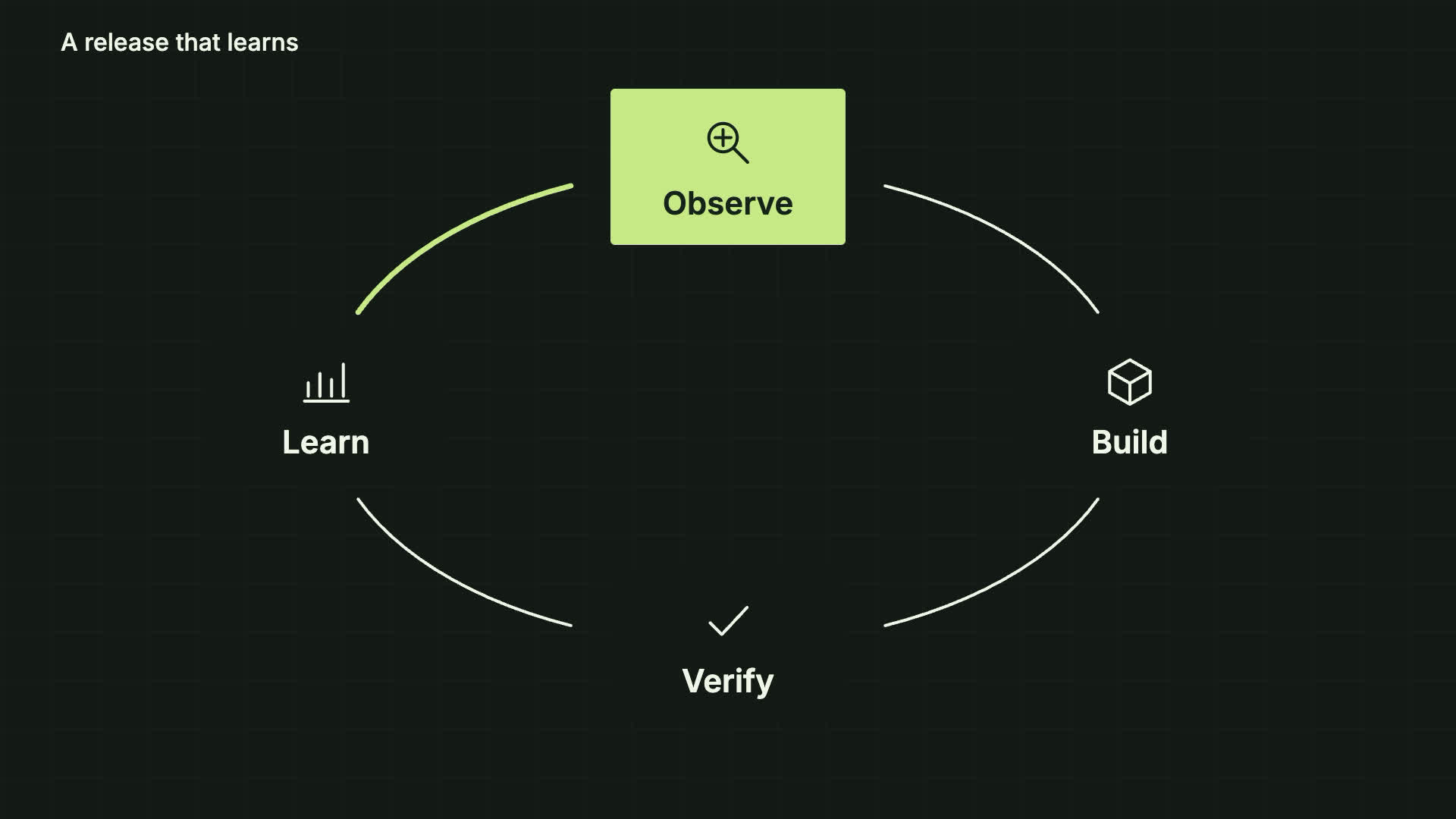
Explain a cycle: build each stage, close the loop, then reveal the takeaway.
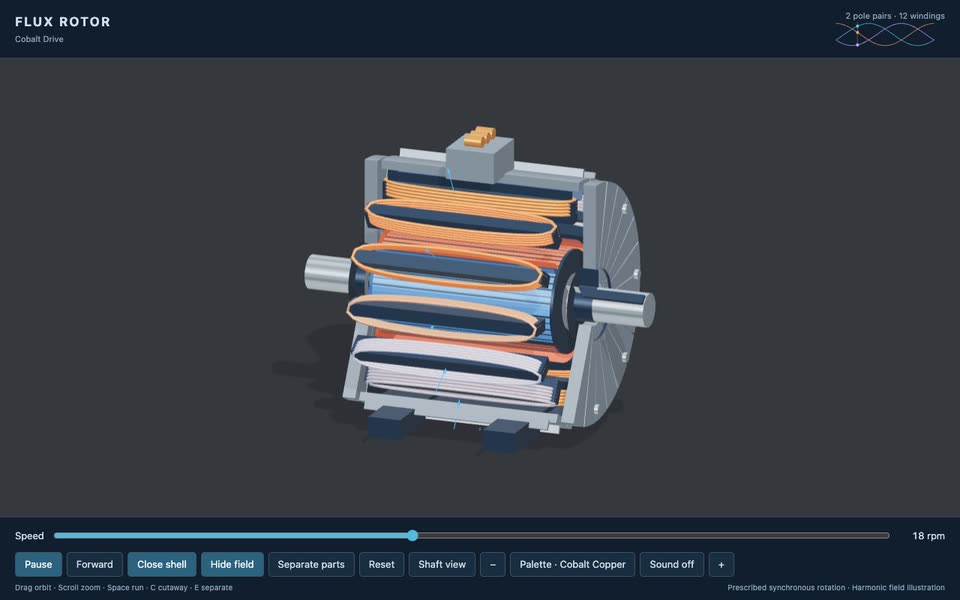
Flux Rotor: Cobalt Drive
Inspect an original motor with real winding groups, alternating magnet sectors and a keyed shaft. Balanced phase currents drive prescribed synchronous rotation, material colors and spatial harmonic markers. Open the actual cutaway and separate six components offline. This display does not solve torque, efficiency or magnetic finite elements.
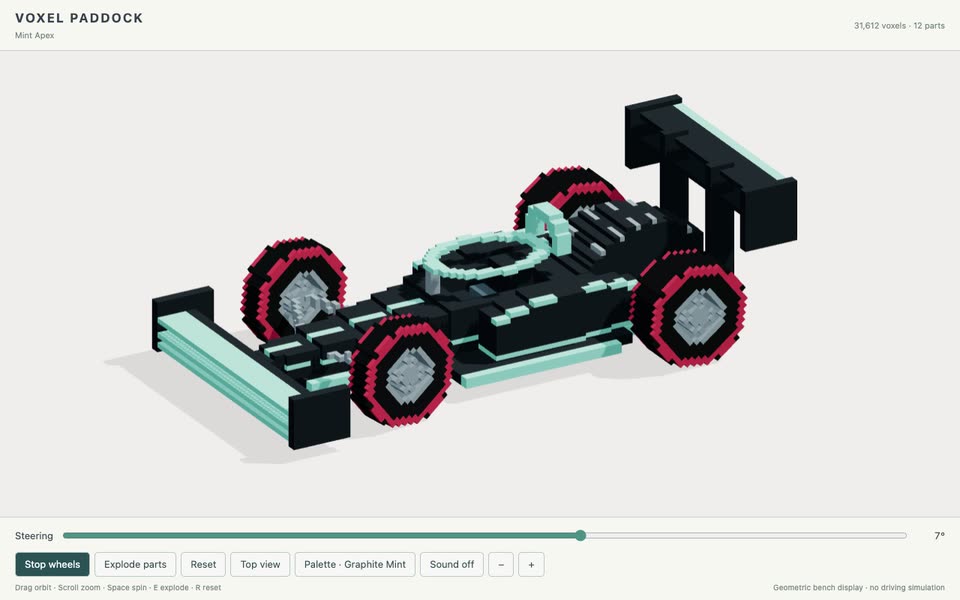
Voxel Paddock: Mint Apex
Inspect an original open-wheel vehicle built from procedural cubes. Spin actual wheels on a stationary display, turn nominal geometric steering and separate twelve component groups. Edit bounded dimensions, voxel density and three palettes offline. This is not a driving or aerodynamics simulation.
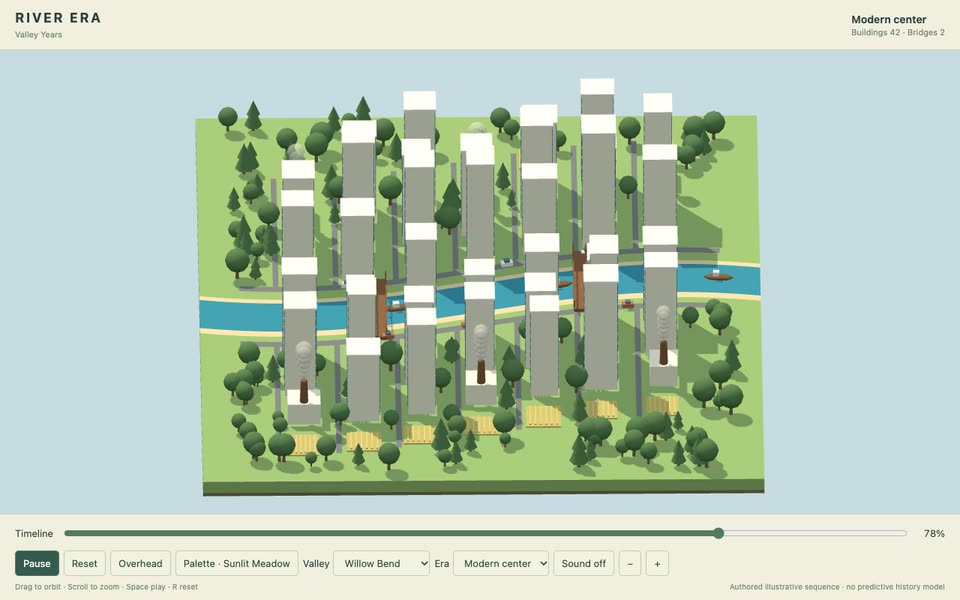
River Era: Valley Years
Scrub an authored river settlement timeline from camp and farms to town, workshops and speculative towers. Actual seeded geometry changes reversibly; boats and vehicles follow the same river and bank equations. This is an illustrative sequence rather than predictive history.
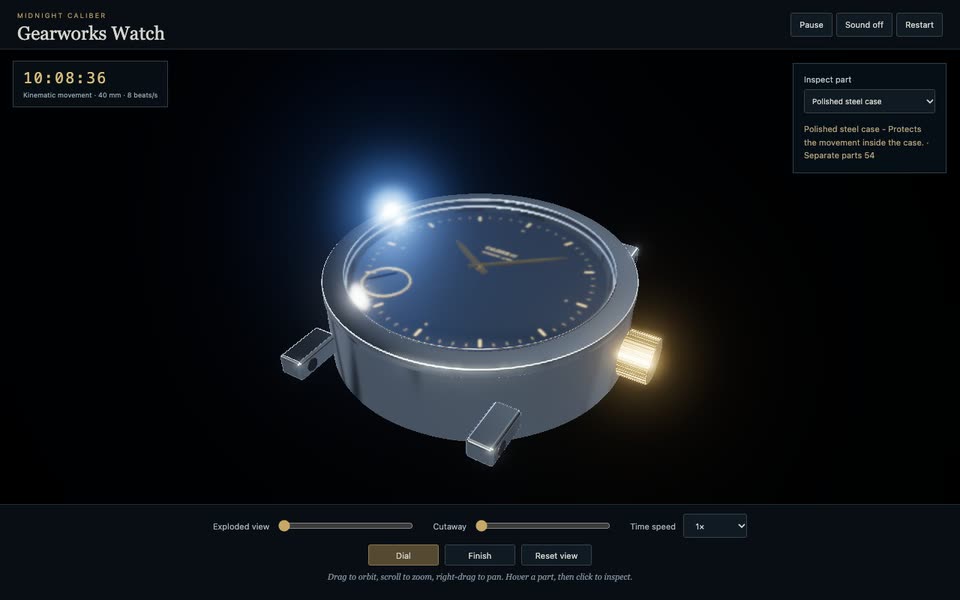
3D Mechanical Watch Explorer
Inspect a kinematic mechanical watch with actual meshed tooth ratios, 54 components, axial explosion, material cutaway and bilingual mouse/touch controls. One offline HTML with optional synthesized tones.