Catalog Bloom Slides
Make decks that read like a retro print catalogue: warm cream halftone paper, six locked primaries, diagonal rainbow ribbons, petal clusters, starburst seals, red stamps, product cards and ledger tables.
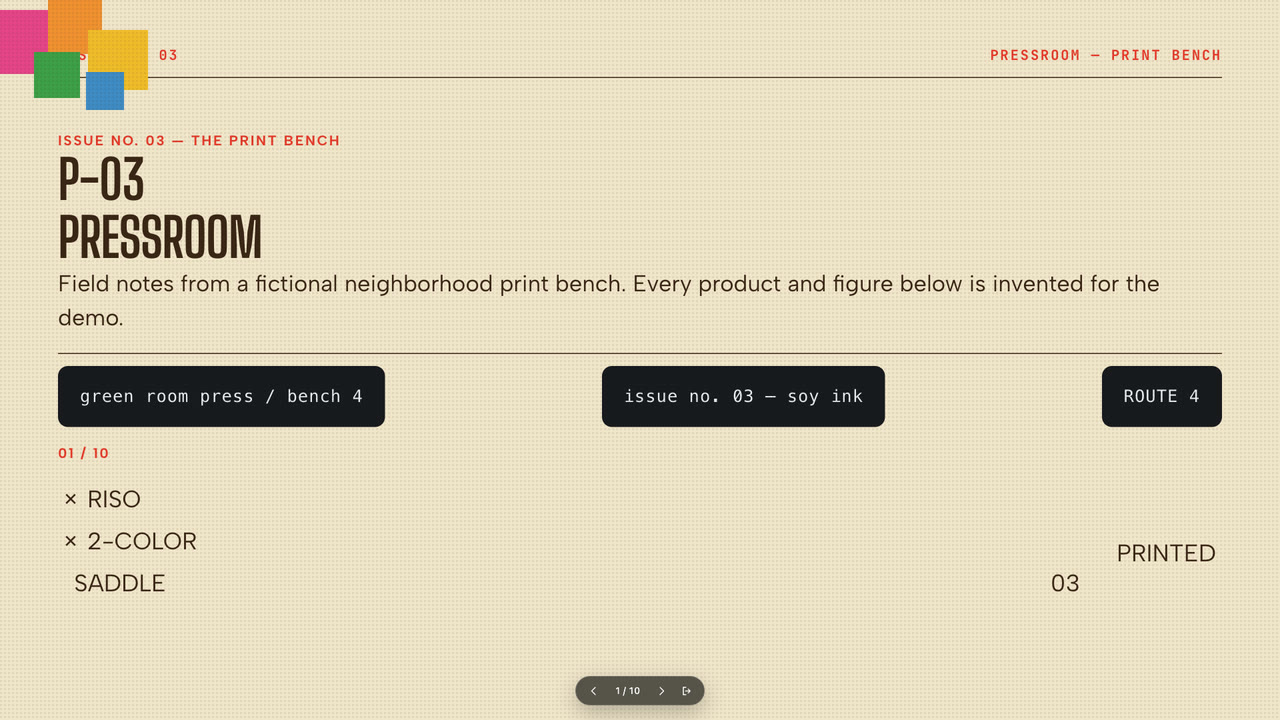
Bring the topic, the audience, the one decision the deck supports, the facts and numbers to use exactly, the page count and content language; your own pictures are optional. The Skill returns one offline HTML deck that edits in the browser and exports editable PowerPoint.
How it works
Brief and page order
The agent asks for the topic, the audience, the one decision the deck supports, the facts and numbers to use exactly, the content language and the page count, then assigns layouts and picks a palette.
Pictures and build
With no pictures of your own, panels are described in art.json and drawn by catalog-bloom-art.py — petal clusters, ribbons, seals; the agent writes plan.json, composes and builds the single HTML file, then looks at every page.
Check and PowerPoint
verify-deck.py checks the shell and deck rules; the agent edits a text in the browser, undoes, saves and presents. On request the file exports a native PowerPoint, verified with verify-pptx.py.
Frequently asked questions
Is the file really offline?
Yes. Fonts, engine and pictures are embedded in the one .html file; it opens, edits, presents and saves with no network.
Can I edit the PowerPoint afterwards?
Yes. Headlines, card names, spec rows, ledger cells and chip labels export as native PowerPoint text and shapes; the drawn panels come as flat picture layers.
Does it copy a real catalogue or brand?
No. There are no audio-vendor, console or catalogue-brand names, logos or trade dress — the six-primary print look is generic and every panel is drawn by the bundled generator.