Tile Positioning Slides
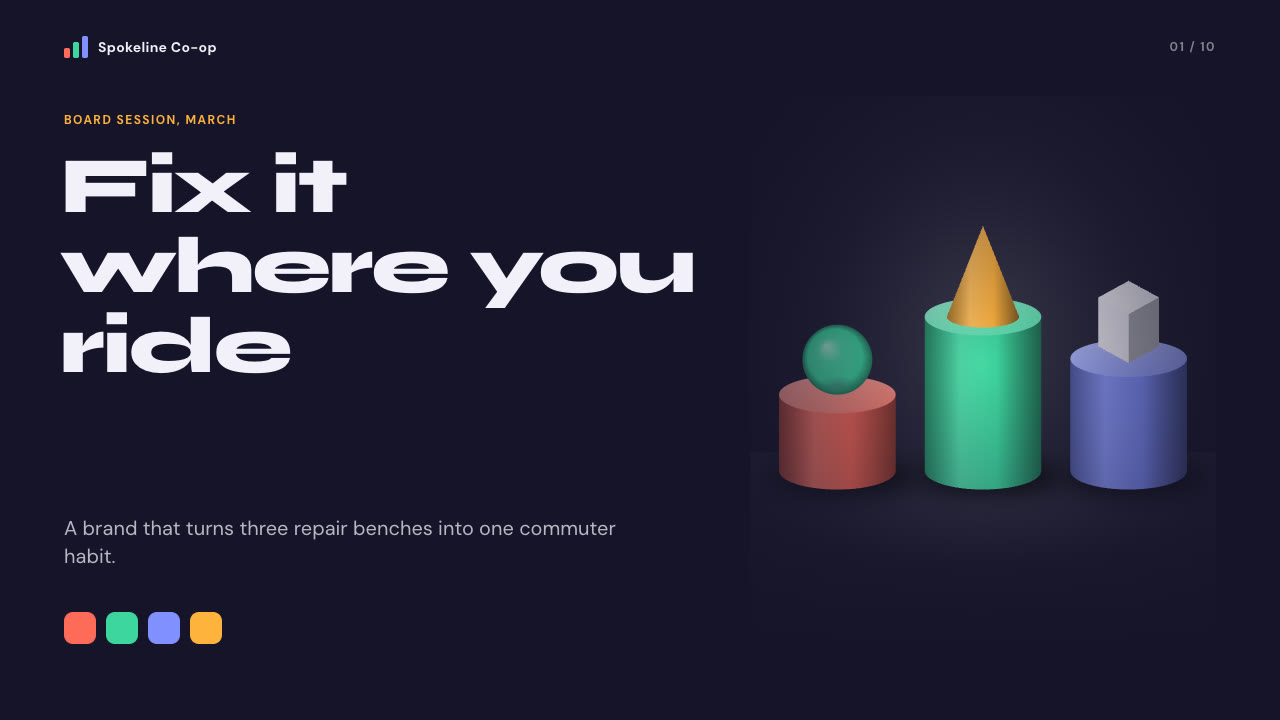
Make dark, decision-led brand positioning and strategy decks, such as a board approving a rebrand, partners joining a relaunch or a team choosing a focus audience: short, very heavy headlines, content in rounded tiles with one shared corner radius, one coloured tile per page, a perceptual positioning map and small 3D still lifes of coloured solids.
Bring the brand, the audience, the decision you need, the research, figures and map positions to use exactly and the page count; pictures are optional. The Skill returns one offline HTML deck that edits in the browser and exports editable PowerPoint.
How it works
Brief and sequence
Your Agent asks for the topic, the audience, what should happen after the talk, the facts and numbers to use exactly and the page count, then gives every page one layout and picks one palette.
Pictures and build
Without your own pictures it lists still lifes in art.json and draws them with still-life.py. It writes plan.json and settings.json, then runs kit.py compose, make-deck.py and verify-deck.py to build one offline HTML file.
Look and export
It opens every page in a browser and checks wraps, overlaps and labels, tries edit, undo, save and present, then exports PowerPoint and runs verify-pptx.py against the deck.
Frequently asked questions
Is the PowerPoint really editable?
Yes. Headlines, labels, tiles, chips, map dots and axes are native PowerPoint objects with speaker notes; each picture is its own image and no slide is a full-page image. The example decks have 120 and 94 text boxes.
Where do the pictures come from?
Your own pictures first. Otherwise the bundled still-life.py draws toy-like studio still lifes (plinths, stack, arch, orbit, steps, pair) in the deck's tones as SVG. It uses only the Python standard library and calls no model or image service.
Which fonts does it use?
Syne for display headlines and DM Sans for text, both under the SIL Open Font License. Install both on the presenting machine. PowerPoint has regular and bold only: Syne ExtraBold headlines export as the narrower Syne Bold, so they wrap into fewer lines than in the browser. Chinese, Japanese and Korean use the system face.
What are the known limits?
Geometry is fixed per layout (three pillars, segments, facts, tone rows, steps and decisions; up to five map dots). A map label near an axis or the right edge may need a small nudge, seen with Chinese labels. The Syne digit 1 has a distinctive shape.
What was tested?
Both example decks were built from a fresh unzip of the package. Every page was inspected in Chrome and in a LibreOffice render of the exported PowerPoint, 31 browser interaction checks and 20 error-path checks passed, and python-pptx edits survived save and reopen. PowerPoint, Keynote and WPS were not opened.