Sticker Zine Slides
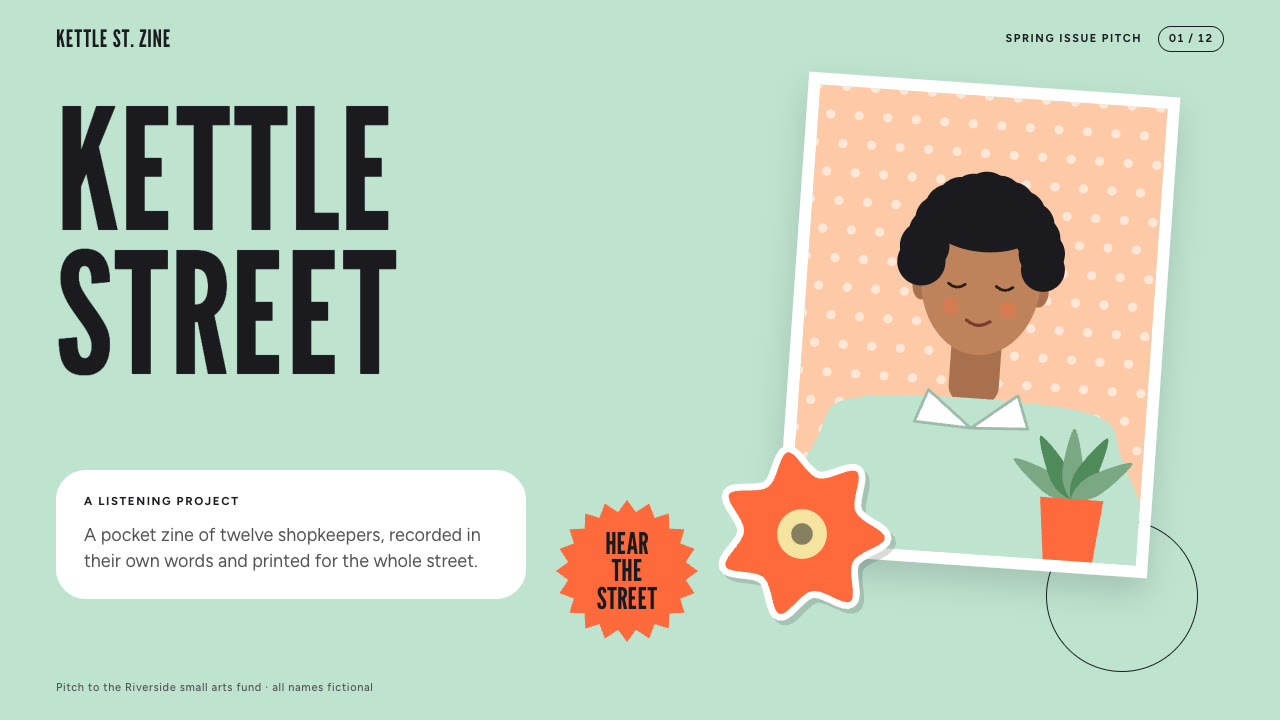
Make warm, hand-made looking decks for neighbourhood projects, small grant pitches, volunteer briefings and workshop invitations: very tall condensed headlines, pastel colour fields, white rounded cards, one deep feature panel, floating labels, tilted white-framed pictures, a serrated stamp and die-cut paper stickers.
Bring the topic, audience, what people should do afterwards, the facts and figures to use exactly and the page count; pictures optional. The Skill returns one offline HTML deck that edits in the browser and exports editable PowerPoint.
How it works
Brief and outline
Your Agent asks for the topic, audience, what people should do after the deck, the facts it may use, page count, language and any pictures you own, then gives every page one job from the thirteen layouts and picks one palette.
Pictures and build
Without your own pictures it describes each figure, sticker or object in art.json and draws them with sticker-art.py, writes plan.json and settings.json, then runs kit.py compose, apply-palette.py, make-deck.py and verify-deck.py to build one offline HTML file.
Look and export
It opens every page in a browser and checks headline wraps, label and sticker positions, bar labels and table rows, tries edit, undo, save and present, then exports PowerPoint and runs verify-pptx.py against the deck.
Frequently asked questions
Is the PowerPoint really editable?
Yes. Headlines, labels, numbers, bar labels and values and table cells are native text; cards, bar tracks and fills, circles and pills are native shapes; figures, stickers and objects are separate pictures, and no slide is a full-page image. On every slide a text was changed, a shape recoloured and a picture resized with python-pptx, then saved, reopened and rendered again.
Where do the pictures come from?
From you first. Otherwise the bundled sticker-art.py draws flat-vector pictures in the deck's palette: anonymous figures (seven hair styles, six skin tones, necklines, glasses and props), twelve die-cut sticker shapes with a white paper edge and still lifes of everyday objects. It uses only the Python standard library and calls no model or image service.
Which fonts does it use?
League Gothic for headlines and Figtree for body text, both under the SIL Open Font License and embedded in the HTML. Install them on the presenting machine for matching line breaks in PowerPoint. Chinese, Japanese and Korean use the system face and headline sizes step down automatically.
What are the known limits?
Layout geometry is fixed, so copy far over the word budget runs into neighbouring blocks. Tilted pictures export together with their white frame, and the serrated stamp exports as a picture behind native text. Bars are native shapes, not chart objects. Latin digits inside Chinese headlines can show a slightly wider gap in LibreOffice.
What was tested?
Both example decks and an internal Chinese long-title case were rebuilt from a fresh unzip of the package and matched the published HTML byte for byte. Every page was inspected in Chrome and in a LibreOffice render of the exported PowerPoint, python-pptx edits survived save and reopen, and 31 of 31 browser checks passed. PowerPoint, Keynote and WPS were not opened.