Broadsheet Wire Slides
Make decks that read like printed drawing sheets: cream paper pages beside near-black plate pages, a double-rule masthead, uppercase display type, monospace ledger copy, fig.-tagged wireframe figures, hatched fills, X-cross placeholders and dashed checklists.
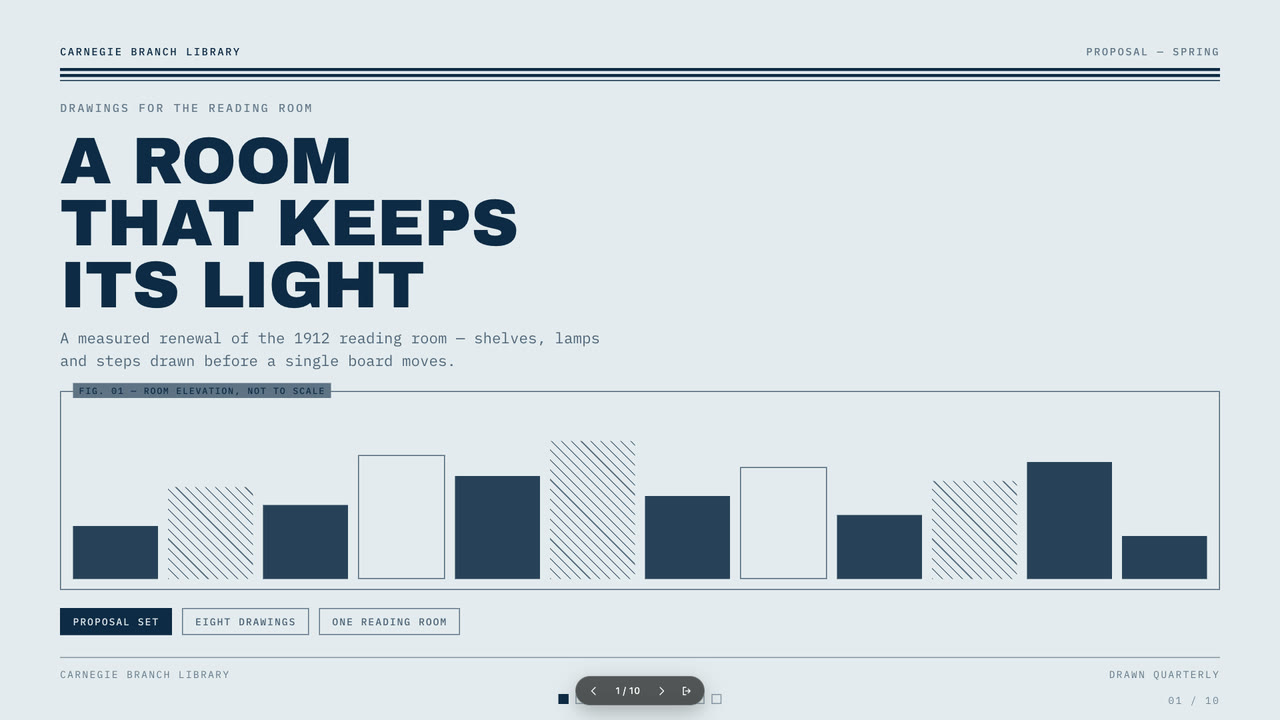
Bring the proposal, the audience, the facts and figures to use exactly, the page count and content language; wireframe plates are drawn by the bundled painter unless you supply your own pictures. The Skill returns one offline HTML deck that edits in the browser and exports editable PowerPoint.
How it works
Brief and page list
Your Agent asks for the proposal, the audience, the figures and the page count, then picks twelve layouts into plan.json — each one already knows its word budget.
Compose, draw and build
kit.py composes the plan into deck.json, broadsheet-wire-art.py draws any fig. panels, and make-deck.py assembles the offline presentation.html.
Look and export
Page through the deck, edit text and speaker notes in the browser, then export PowerPoint and run verify-pptx.py against the HTML.
Frequently asked questions
Why two registers on one sheet?
The deck argues like a drawing set: cream pages carry the running text, black plate pages hold the statements you read aloud. One paper and one ink do both jobs; more registers read as decoration.
Can I put a photograph on a plate?
The split page takes a fig.-tagged panel from the bundled painter. You can swap in your own image, but it keeps the same wireframe frame and mono caption.
What do the demos use?
demo-1 keeps the Blueprint palette for a 10-page reading-room renewal; demo-2 switches to Sepia for a 10-page kitchen annex with a reordered arc.