
Google Scholar Brief
- Lab Skill
- v0.1.0
- Google News
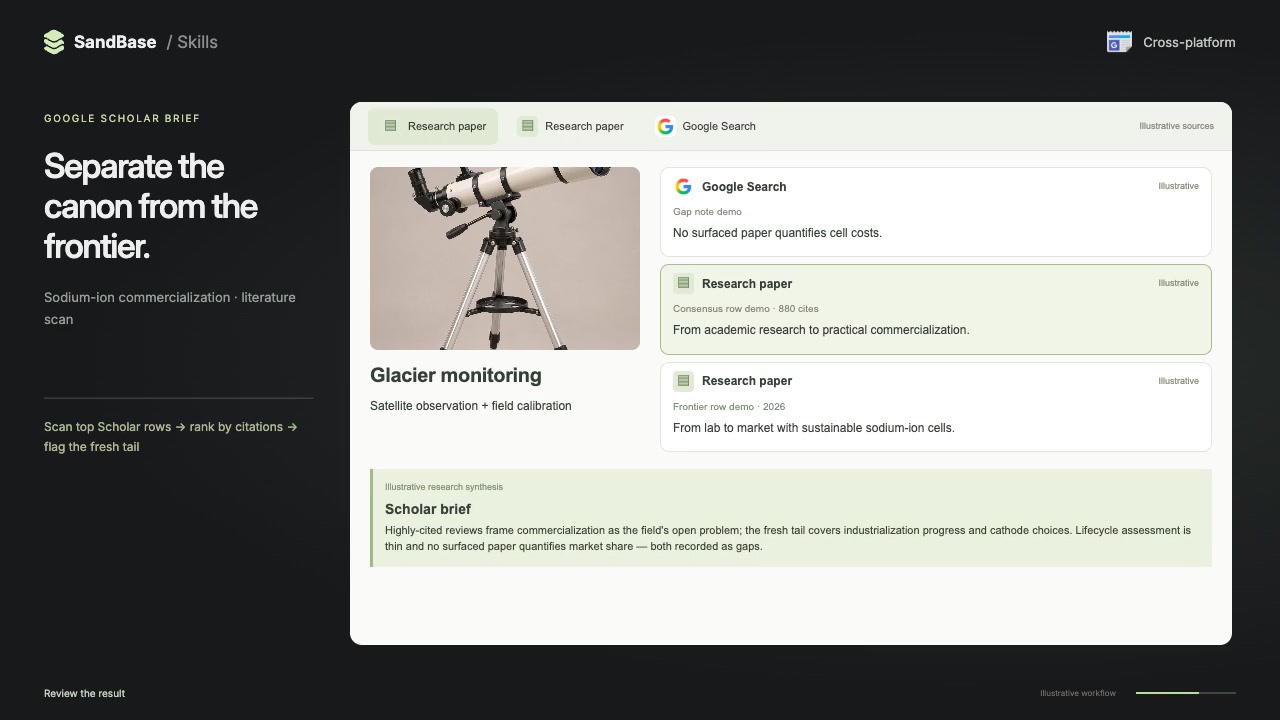
Fast literature scan of a topic through SandBase Google Scholar
Ảnh bìa
Bạn nhận được gì
Bring a topic, target or source set and the question to answer. The Skill returns a sourced brief with the findings.
Cách hoạt động
- 01
Phrase two Scholar queries
You give the topic and, optionally, a recency angle. The Agent writes one canonical query, such as sodium-ion battery commercialization, and one differently phrased recency or application query, such as sodium-ion battery grid storage 2026, because Scholar responds to phrasing. Both go to sandbase_google_scholar through the sandbase CLI or MCP tools, using SANDBASE_API_KEY from the environment.
- 02
Parse results and split by evidence
Each call returns up to about ten results with title, publicationInfo, citedBy, link, pdfUrl and snippet. The Agent strips [PDF] and [HTML] markers, parses authors, venue and year, and marks [CITATION] rows as citation records rather than zero-citation papers. High-citation older work becomes foundation; recent low-citation work becomes frontier, since low counts on new papers are normal.
- 03
Write the brief with references
The brief lists consensus points made by several papers, frontier claims from the last two years, gaps the top results do not cover, and a reference table with authors, venue, year, citation count and link. An optional sandbase_google_scholar_author call resolves a recurring author's affiliation. Check any claim by following its paper link or pdfUrl.
Câu hỏi thường gặp
What does Google Scholar Brief give me?
Google Scholar Brief gives a quick paper-level scan of what Google Scholar surfaces for a topic, with real titles, venues and citation counts. In the recorded run on sodium-ion batteries it found an 880-citation 2018 review and 2026 frontier work. It is not a systematic review; it covers the visible top of the literature.
Does Google Scholar Brief read full papers?
No. Google Scholar Brief works from the Scholar record only: title, publication string, citation count, snippet and any pdfUrl. The SKILL.md tells the Agent not to summarise a paper beyond what the record shows. Open the PDF link yourself when a claim matters enough to read the full text.
What does Google Scholar Brief call, and is it billed?
Google Scholar Brief mainly calls sandbase_google_scholar, which sits inside your organisation's shared daily free quota; a brief is about two to four calls. The optional sandbase_google_scholar_author lookup is billed to your SandBase account, and scholar search alternates exist when coverage is thin. The Agent checks each with sandbase inspect before calling; rates are at https://www.sandbase.ai/pricing.
Why does Google Scholar Brief separate foundation and frontier papers?
Google Scholar Brief separates them because citation counts grow with time. A 2025 or 2026 paper with few citations is normal, not a weak paper, while a highly cited older paper is established ground. Splitting the two keeps new work from being dismissed and old work from being mistaken for news.
How many results does Google Scholar Brief see per query?
About ten. Google Scholar Brief gets roughly ten results per call in Scholar's own order, which is why it runs a second, differently phrased query. citedBy is Scholar's count at read time, and [CITATION] rows lack it entirely. The Method and limits section names the queries and calls used.
Thêm Skills
Tất cả Skills Google News →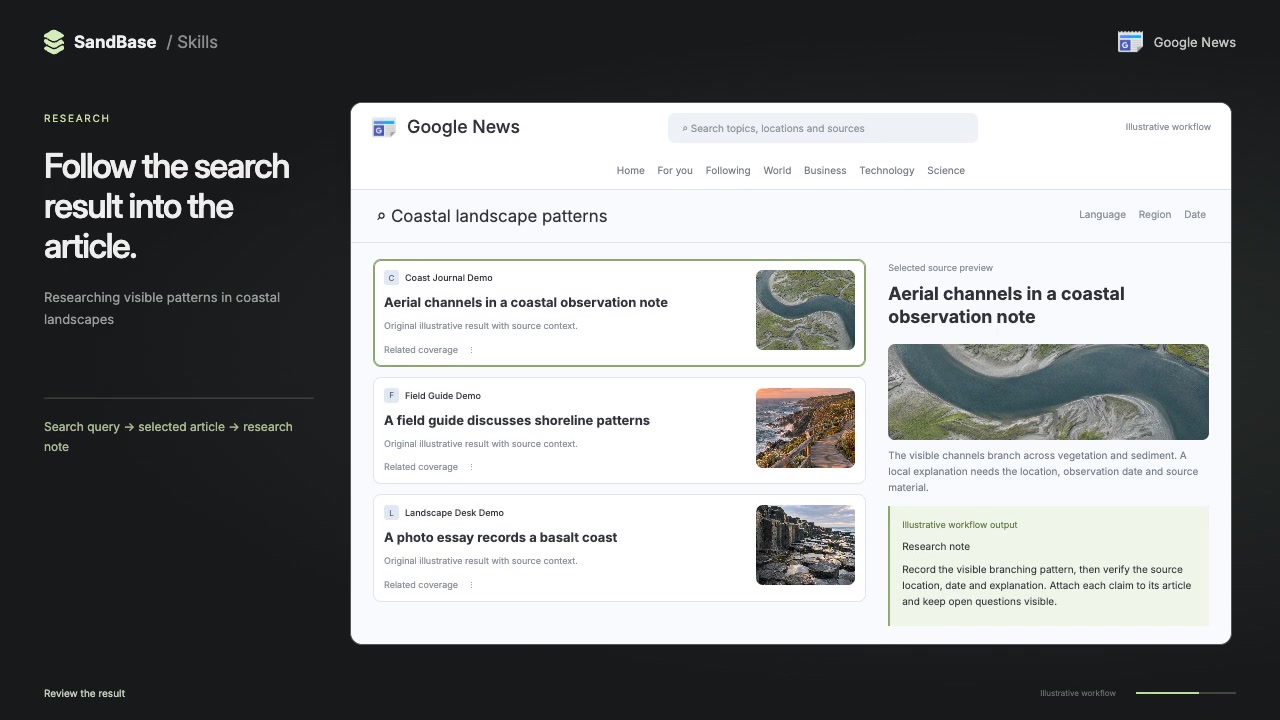
Google News Research
Search and monitor news articles across Google News through SandBase. Use when asked for news monitoring, current events research, news coverage analysis, or media tracking.
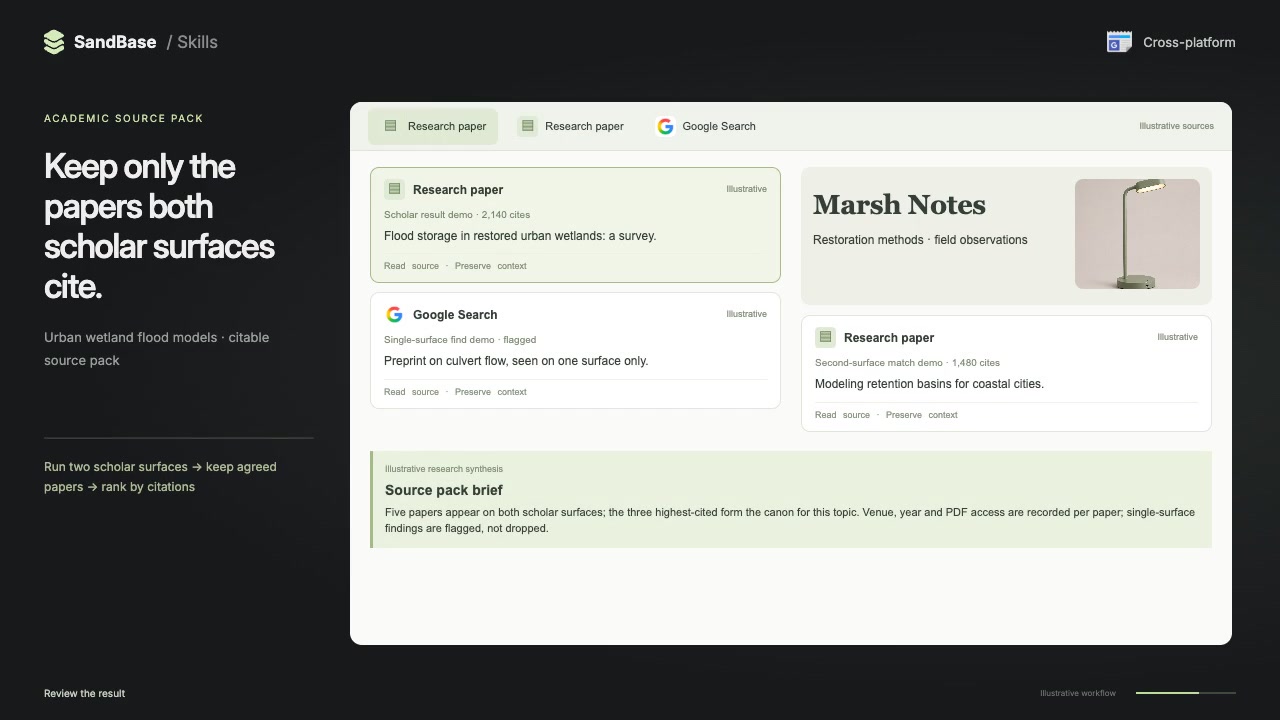
Academic Source Pack
Assemble a citable academic source pack for a topic through SandBase
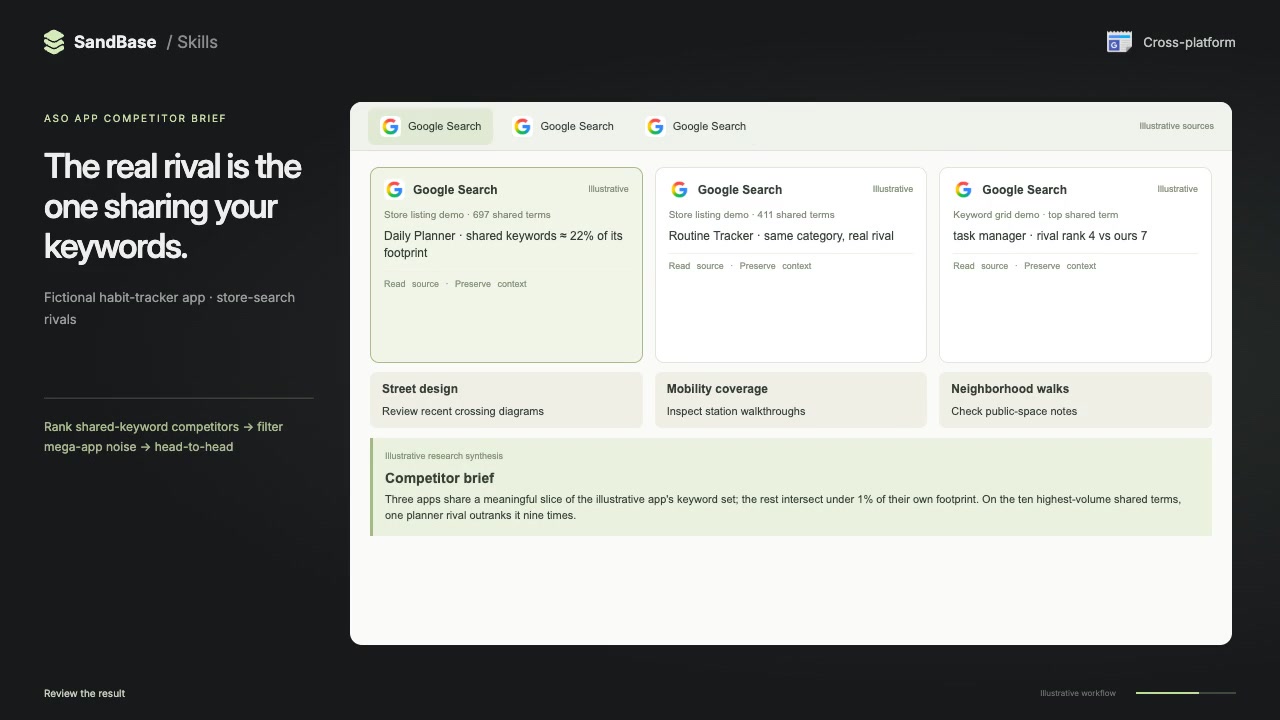
ASO App Competitor Brief
Map the App Store / Google Play apps that genuinely compete with one app through SandBase
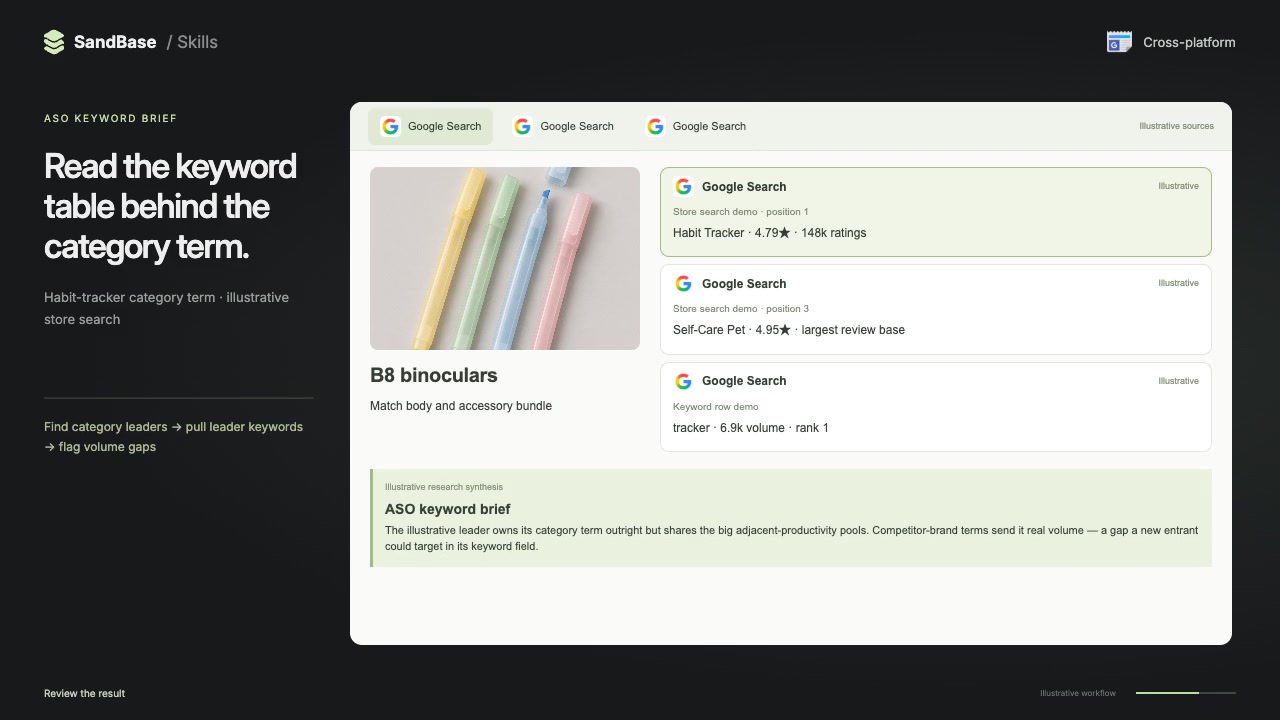
ASO Keyword Brief
Build an App Store Optimization keyword brief through SandBase
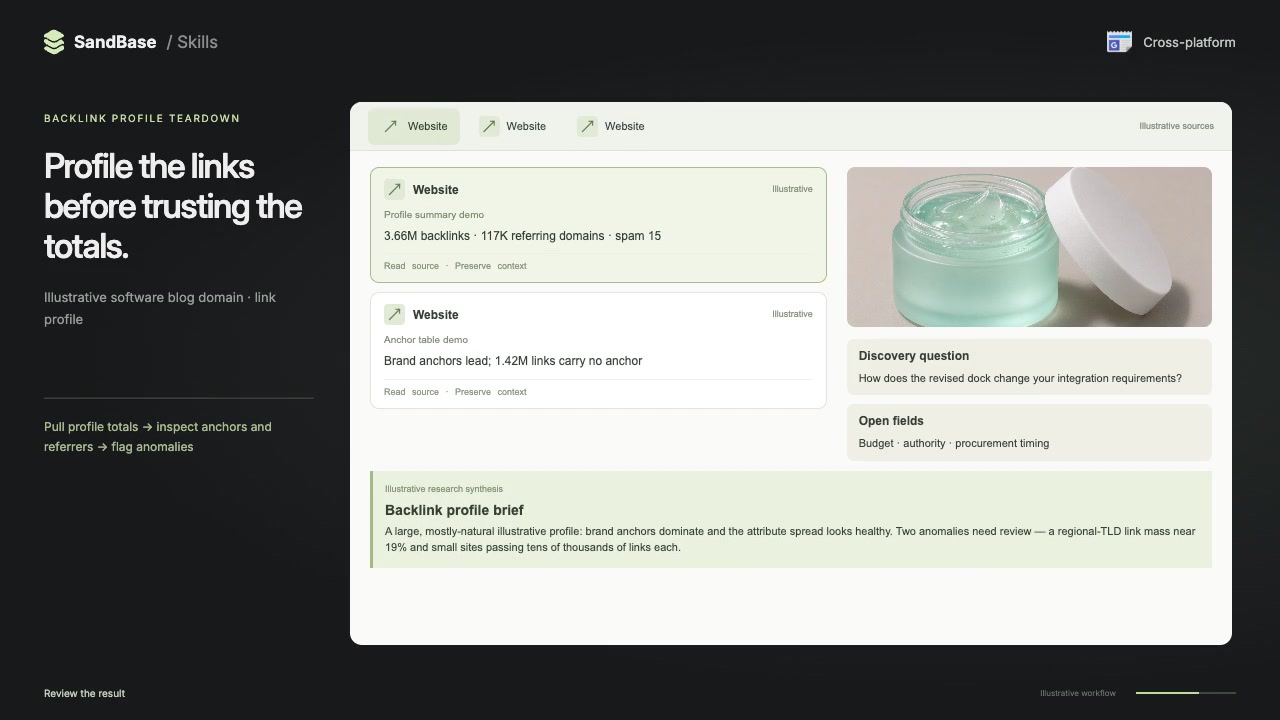
Backlink Profile Teardown
Tear down a domain's backlink profile through SandBase
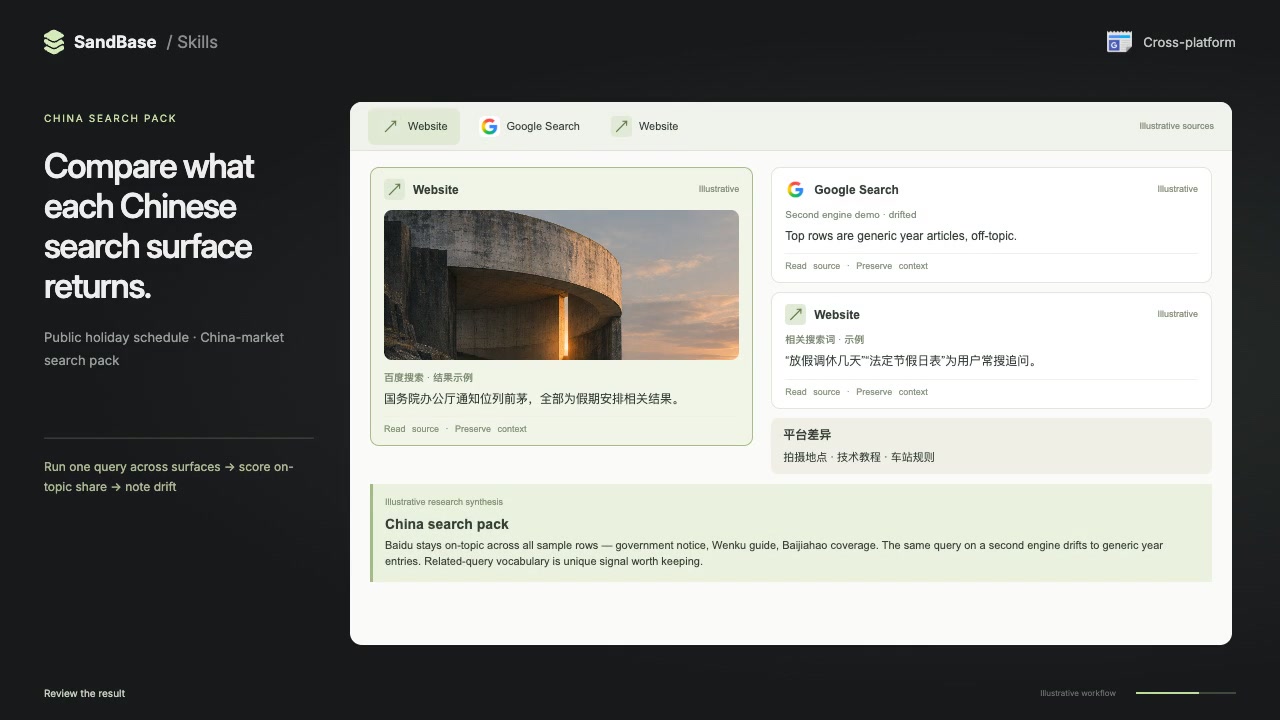
China Search Pack
Assemble a Chinese-web search pack for a query through SandBase