
Academic Source Pack
- Lab Skill
- v0.1.0
- Google News
Assemble a citable academic source pack for a topic through SandBase
封面
你将获得什么
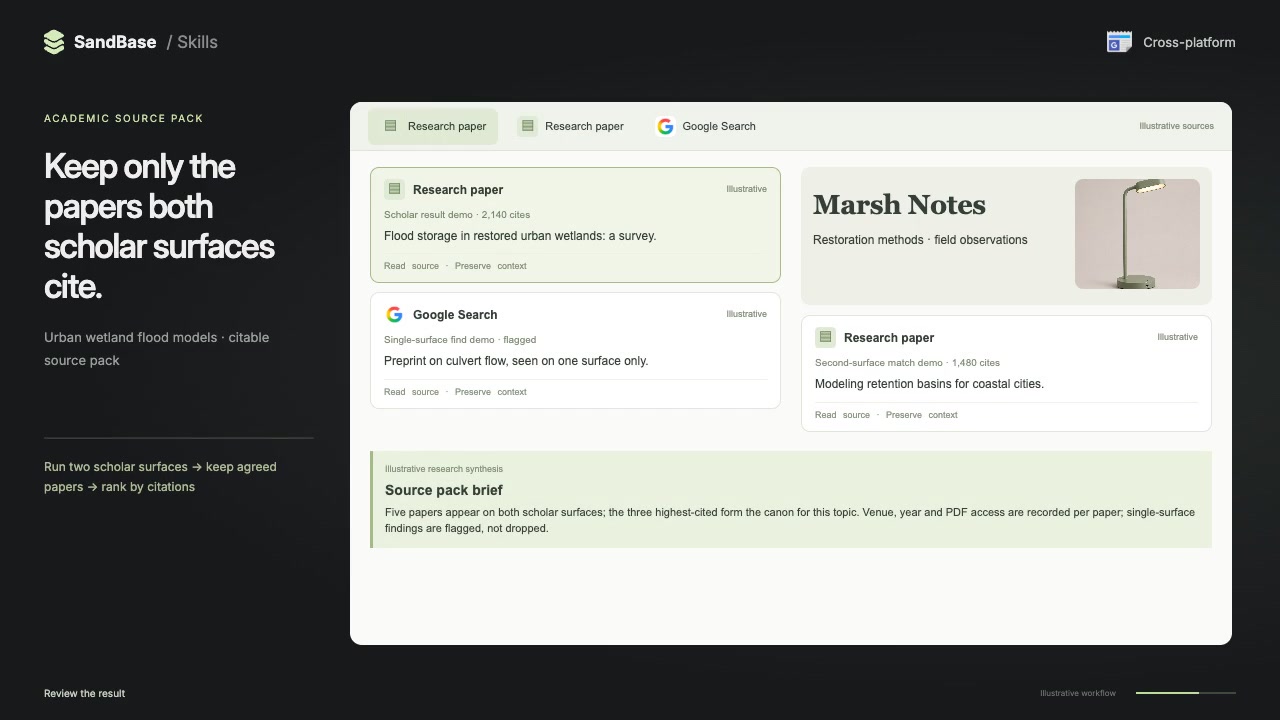
Bring a topic, target or source set and the question to answer. The Skill returns a pack that separates the canonical must-cite works from the long tail, with a plain note on where the two surfaces disagreed.
工作原理
- 01
Frame the topic as scholar queries
You give a topic, an optional year window and the number of papers you want. The Agent restates the topic as one or two noun-phrase queries, such as large language model agents survey, because phrases match better than full questions. It runs sandbase inspect on each scholar tool first to confirm parameters and price, using SandBase through MCP or the CLI.
- 02
Search two independent scholar surfaces
sandbase_scholar_search_scholar runs with query, as_ylo and max_num_results set to 15, reading title, authors, link, number_of_citations and snippet. sandbase_google_scholar adds publicationInfo, citedBy, pdfUrl and a cluster id. sandbase_scholar_search_mixed acts as an alternate ranking. Papers are matched by case-folded title, and papers found on both surfaces are treated as high-confidence.
- 03
Rank the canon and flag gaps
Papers are ranked by citation count and split into a canon both surfaces agree on and a long tail. Each entry gives title, first author and year, venue, citations, link and a PDF flag, with paywalled venues marked. Single-surface papers are listed separately. Check the pack by opening each link, because snippets are excerpts and do not prove what a paper claims.
常见问题
What does Academic Source Pack deliver?
Academic Source Pack delivers a vetted citation list for one topic: a short answer naming the two or three papers to cite first, a canon table, a long tail, a list of single-surface papers and a suggested reading order. It does not summarise a paper's argument, compare methods or draft the literature review; a general academic-research skill handles that work.
Which tools does Academic Source Pack use, and what does a pack cost?
Academic Source Pack calls sandbase_scholar_search_scholar, sandbase_scholar_search_mixed and sandbase_google_scholar, usually three to five calls per pack. The two scholar_search tools share the organisation's daily free API quota, with usage past it billed to your SandBase account, while sandbase_google_scholar is metered. The Agent runs sandbase inspect on each tool to read its price before any call; see https://www.sandbase.ai/pricing for rates.
Why does Academic Source Pack compare two scholar surfaces?
Academic Source Pack treats a paper that both the Scholar API and Google Scholar return as confirmed to exist, while a paper only one surface returns is still usable but flagged. The two rankings differ, and the pack reports that disagreement as signal. Citation counts should match or nearly match, and both are shown only when they diverge materially.
Does Academic Source Pack count the mixed search as a second confirmation?
No. Academic Source Pack treats sandbase_scholar_search_mixed as a second page or alternate ranking of the same index. On a survey query it returned an identical set to the Scholar API search, so when the titles match one to one the pack does not count it as independent confirmation.
Can Academic Source Pack download PDFs or read paywalled papers?
No. Academic Source Pack is read-only and does not download PDFs or access paywalled full text. It lists a pdfUrl when Google Scholar provides one and marks Springer, ACM or Wiley links without a PDF as paywalled. Neither surface returns abstracts, so open each paper before you cite its claims.
How does Academic Source Pack handle very recent topics?
Academic Source Pack can bound the Scholar API search with as_ylo and as_yhi when you need recent work. Scholar results favour highly cited older papers, so for a new topic set the start year deliberately. Google Scholar does not take those bounds in the documented call, and its ranking may still lean toward older work.
更多 Skills
所有 Google News Skills →
Google News Research
Search and monitor news articles across Google News through SandBase. Use when asked for news monitoring, current events research, news coverage analysis, or media tracking.
ASO App Competitor Brief
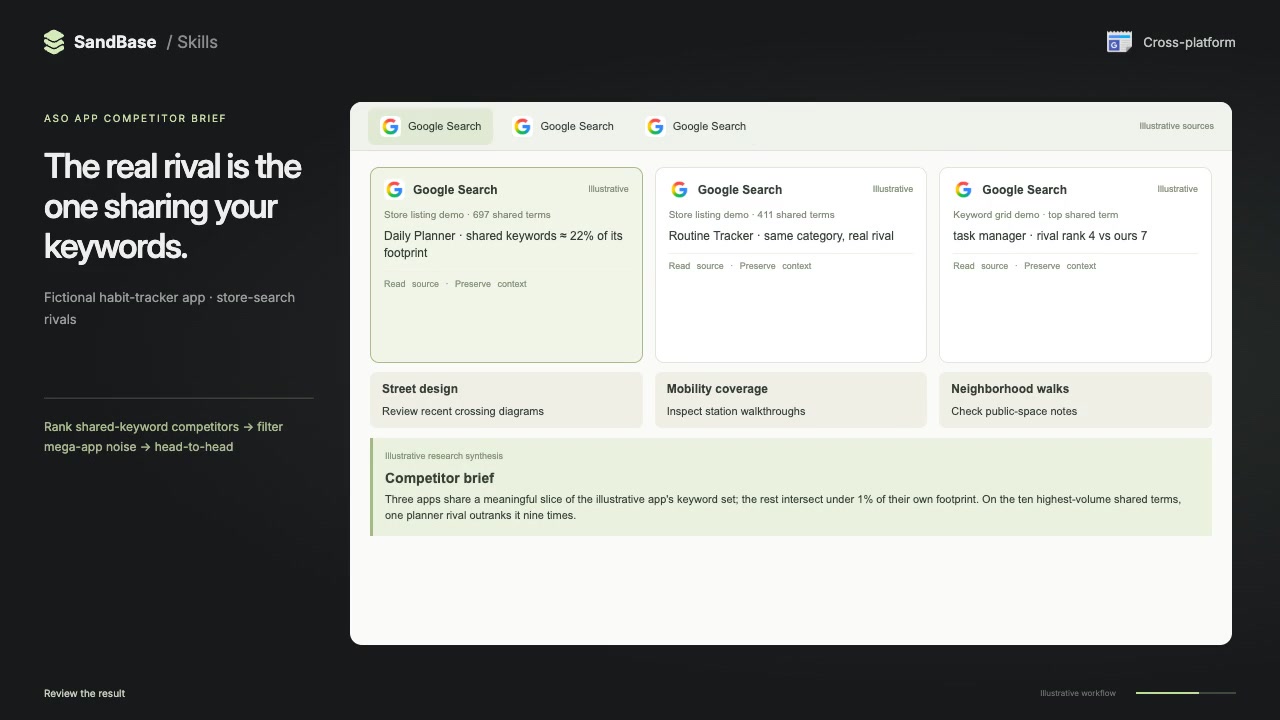
Map the App Store / Google Play apps that genuinely compete with one app through SandBase
ASO Keyword Brief
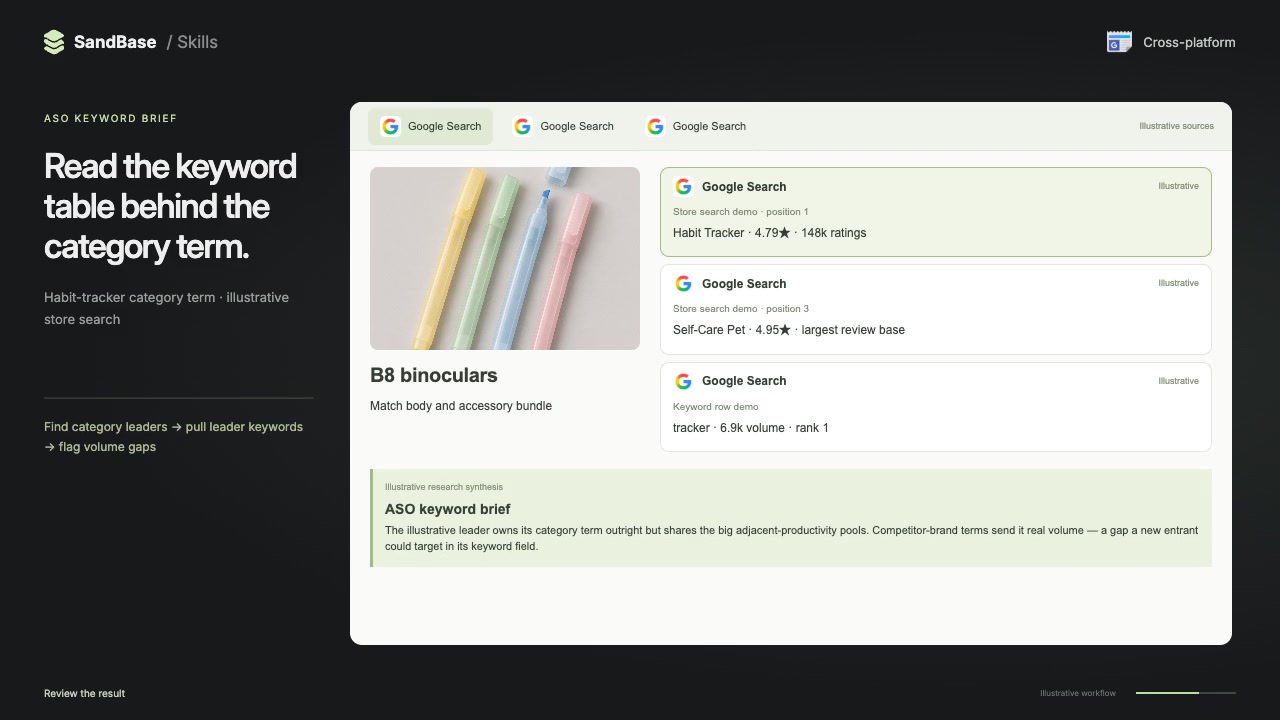
Build an App Store Optimization keyword brief through SandBase
Backlink Profile Teardown
Tear down a domain's backlink profile through SandBase
China Search Pack
Assemble a Chinese-web search pack for a query through SandBase
Content Cluster Audit
Audit how web content about one domain or keyword clusters