vLLM vs SGLang: Which Inference Engine for Agents (2026)
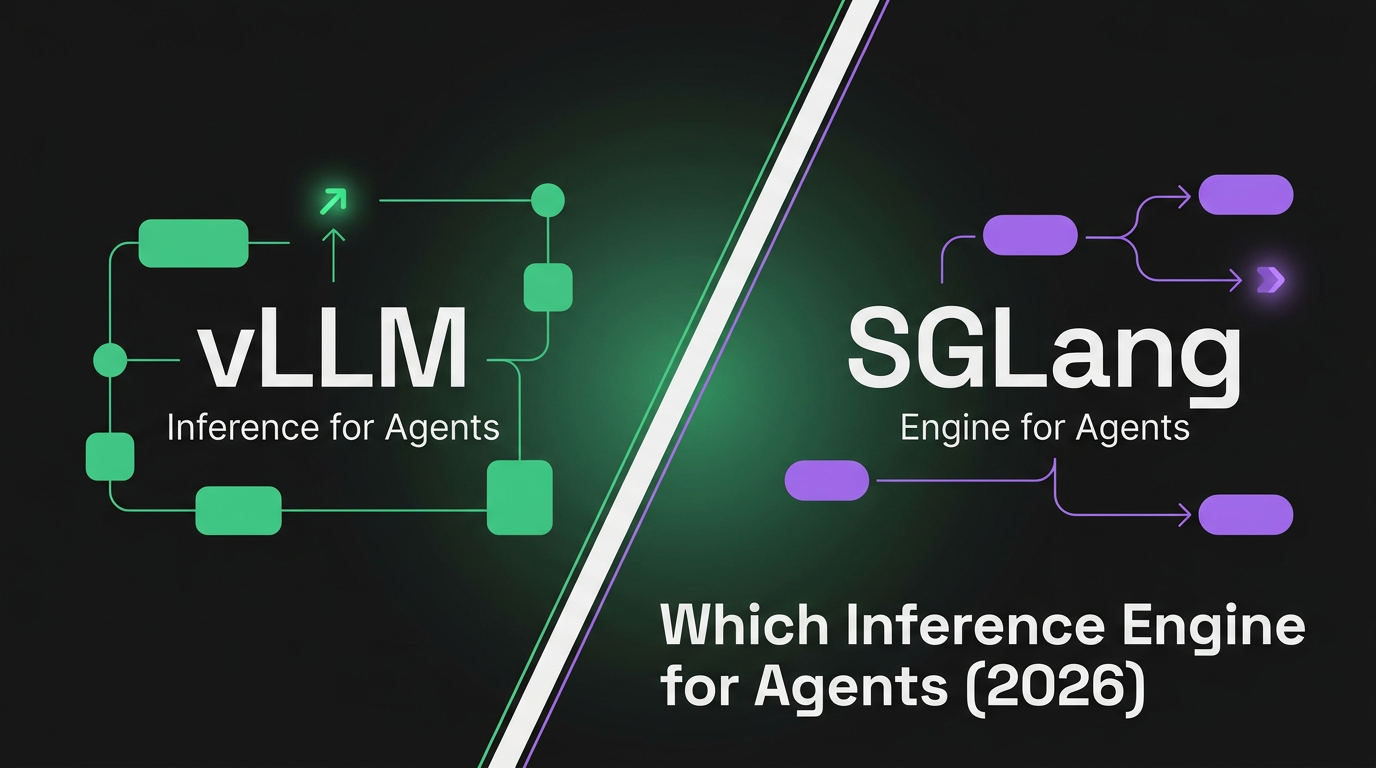
vLLM vs SGLang compared for agent workloads in 2026: throughput, latency, prefix reuse, and which inference engine to run for which use case.
TL;DR — vLLM and SGLang are the two leading open-source LLM inference engines in 2026. vLLM wins on raw throughput at large batch sizes, the widest model support, and the biggest community. SGLang wins on latency and prefix reuse (via RadixAttention), which matters most for agent workloads with shared system prompts and growing conversation histories. For high-throughput batch jobs pick vLLM; for latency-sensitive interactive agents pick SGLang. Many production stacks run both behind a gateway.
Both engines serve the same purpose — turn GPU memory into served tokens efficiently — and both expose an OpenAI-compatible API, so swapping between them is a config change, not a code rewrite. The differences that matter show up under agent-shaped load: many concurrent sessions, shared system prompts, conversation histories that grow turn over turn, and structured (JSON) tool-call output.
This is the head-to-head. For the full picture on each, see the vLLM deep-dive and the SGLang deep-dive.
The core architectural difference
The whole comparison reduces to one design choice: how each engine handles KV cache.
- vLLM → PagedAttention. Treats KV cache like OS virtual memory — fixed-size pages allocated on demand, freed when a request finishes. This eliminates memory fragmentation and lets vLLM pack more concurrent requests onto a GPU. Its prefix caching reuses cache at the block level when a new request starts with the same token blocks.
- SGLang → RadixAttention. Maintains a radix tree of all previously computed KV cache segments and automatically finds the longest shared prefix for each new request — at any depth, including branching conversations. No manual configuration.
For agents, RadixAttention’s automatic, any-depth prefix reuse is the differentiator. When every session shares a 3K-token system prompt and the history grows each turn, SGLang stops recomputing the parts it has already seen; vLLM reuses only when blocks align exactly.
Head-to-head
| Dimension | vLLM | SGLang |
|---|---|---|
| KV cache strategy | PagedAttention (paging) | RadixAttention (radix tree) |
| Throughput (large batch, 128+) | Higher | Competitive |
| p95 latency (streaming, small batch) | ~85ms | ~48ms |
| Prefix reuse | Block-level | Any-depth, automatic |
| Structured output (JSON) | Grammar-guided | FSM-native (faster) |
| Model support | Widest (100+ architectures) | Broad, growing |
| Community size | Larger (55K+ stars) | Smaller but fast-growing |
| RL training backend | Less common | Major rollout backend (AReaL, verl, Slime) |
| Deployment guides | Most abundant | Growing |
| Best fit | High-throughput batch serving | Low-latency interactive agents |
The latency numbers come from streaming with small batch sizes (under 8 concurrent) on Llama 3.3 70B at FP8 on a single H100. Flip to large-batch throughput and vLLM pulls back ahead by 5-10%. Neither is universally “faster” — the winner depends entirely on your batch profile.
Which to choose
Pick vLLM when:
- You’re optimizing for maximum throughput at large batch sizes (embedding, summarization, bulk jobs)
- You need the widest model support or the most battle-tested option
- Your workload is mostly independent requests with low prefix overlap
- You want the most deployment guides and community answers
Pick SGLang when:
- Your agent sessions share system prompts and grow conversation history (high prefix overlap)
- You need low p95 latency for interactive, user-facing agents
- Structured JSON tool-call output is a primary use case
- You want one engine for both serving and RL training
Run both when you have mixed traffic: SGLang on the latency-sensitive agent path, vLLM for throughput-heavy batch work. A model gateway like LiteLLM routes between them by request type — your agent code never knows which engine served a request.
Where they fit in the stack
Both are the bottom layer of the AI agent infrastructure stack — below your gateway and agent framework. They serve tokens; everything above decides which tokens to ask for. If you only use cloud model APIs, you don’t run either directly (your provider does), but the trade-offs still explain why your provider’s latency and pricing behave the way they do.
FAQ
Is SGLang faster than vLLM?
For low-latency, prefix-heavy agent workloads, yes — SGLang’s RadixAttention delivers lower p95 latency and higher cache hit rates. For maximum throughput at large batch sizes, vLLM is faster. There is no single winner; it depends on your batch size and prefix overlap.
Can I switch between vLLM and SGLang without changing my code?
Mostly yes. Both expose an OpenAI-compatible API, so your agent code (or gateway config) just points at a different endpoint. The DSL features are SGLang-specific, but the standard serving API is interchangeable.
Which has better model support?
vLLM supports the widest range of model architectures (100+) and tends to get new models first. SGLang’s support is broad and growing fast, covering the major families (Llama, Qwen, DeepSeek, GLM, Mistral, Gemma).
Do I need either if I use OpenAI or Anthropic?
No. Cloud providers run their own inference infrastructure. You only run vLLM or SGLang when self-hosting open-weight models for cost, privacy, or latency reasons.
Which is better for structured/JSON output?
SGLang has a slight edge — its FSM-native structured generation is integrated into the decode loop, skipping invalid tokens. vLLM supports grammar-guided generation too, but SGLang’s approach is typically faster for heavy JSON tool-call workloads.
Key takeaways
- The difference is KV cache strategy: vLLM’s PagedAttention maximizes throughput; SGLang’s RadixAttention maximizes prefix reuse and low latency.
- For agent workloads (shared prompts, growing histories, JSON output), SGLang usually has the edge; for bulk throughput, vLLM does.
- Both speak OpenAI-compatible APIs, so running both behind a gateway and routing by request type is a common, practical setup.
- Read the full vLLM and SGLang deep-dives before committing to one.