Frosted Venture Slides
Ask for a round, a grant or a budget with a frosted-glass pitch deck: translucent glass slabs on deep night pages, airy light pages, rounded picture windows, one accent card per page, a native bar-chart card, a use-of-funds table and a stepped roadmap.
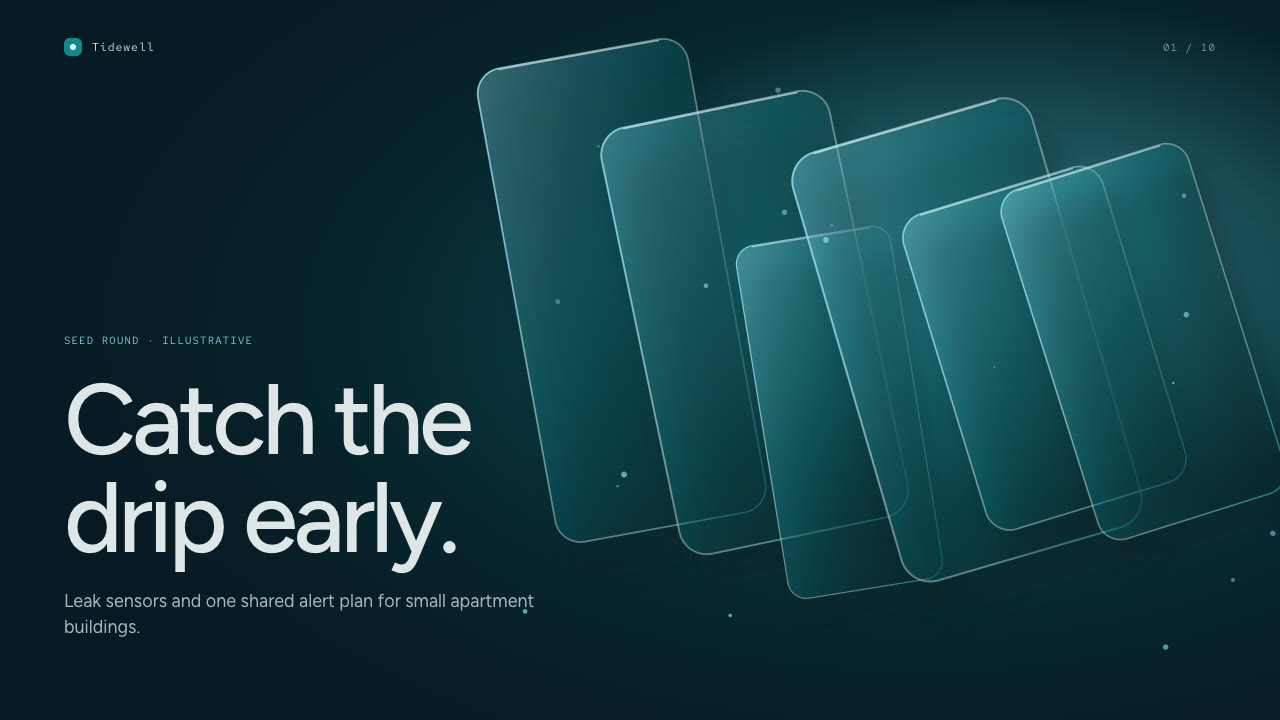
Bring a brief with the company or project, the audience, the decision you need, the facts you can stand behind and the page count; pictures optional. The Skill returns one offline HTML deck that edits in the browser and exports editable PowerPoint.
How it works
Brief and story
Your Agent asks for the company or project, the audience, the one decision the deck should get, the facts you can stand behind and the page count, then walks one argument from problem to ask and gives every page one job.
Pictures and build
It uses your pictures or writes one entry per slot in art.json for glass-art.py, writes plan.json with bar heights for the chart, and runs kit.py compose, apply-palette.py, make-deck.py and verify-deck.py to build one offline HTML file.
Look and export
Look at every page in a browser at 1280×720 for heading length against the art, chart labels, price widths, table rows and the contact line, try edit, undo, save and present, then export PowerPoint and run verify-pptx.py against the deck.
Frequently asked questions
Is the PowerPoint really editable?
Yes. Headings, labels, numbers, cards, chart bars, axis labels, legend keys, the roadmap rail and knots and the brand mark are native PowerPoint objects with speaker notes, and the use-of-funds table is a native table. The only full-slide picture is the cover art, under native text; there are no rendered text layers.
Where do the pictures come from?
From you, or from the bundled glass-art.py, which draws deterministic vector pictures from art.json: glass slabs and stair-step runs, frosted shapes, abstract product screens without lettering (laptop, tablet, phone, wall board), anonymous illustrated portraits, ribbons and line icons. It needs no model calls or keys.
Which fonts does it use?
Figtree 400/500/700 for headings and text and Red Hat Mono for labels, axes and the counter, under the SIL Open Font License and embedded in the deck. Install both from their standard distributions on the presenting machine for close wraps; Figtree 500 maps to an installed weight. Chinese, Japanese and Korean use a system face.
What are the known limits?
The chart is native rectangles with hand-set heights, not a chart object bound to data. PowerPoint can wrap a line one word later than the browser, as on page 3 of the Loafline example. Long Chinese headings take three lines on the cover and overview pages.
What was tested?
Both example decks were rebuilt from a fresh unzip of the package and matched the published files. Every page was inspected in Chrome and in a LibreOffice render of the exported PowerPoint, and edits made with python-pptx (text, shape colour, picture size) survived save and reopen. No other presentation app was opened.