Obsidian Proposal Slides
Make monochrome proposal decks that ask for a decision, such as a pilot for a board, a room for trustees or a service for a client: near-white paper, very large tightly tracked grotesk headlines, short copy in small columns, mono labels and chips, rounded grey, dark and accent cards and drawn material pictures.
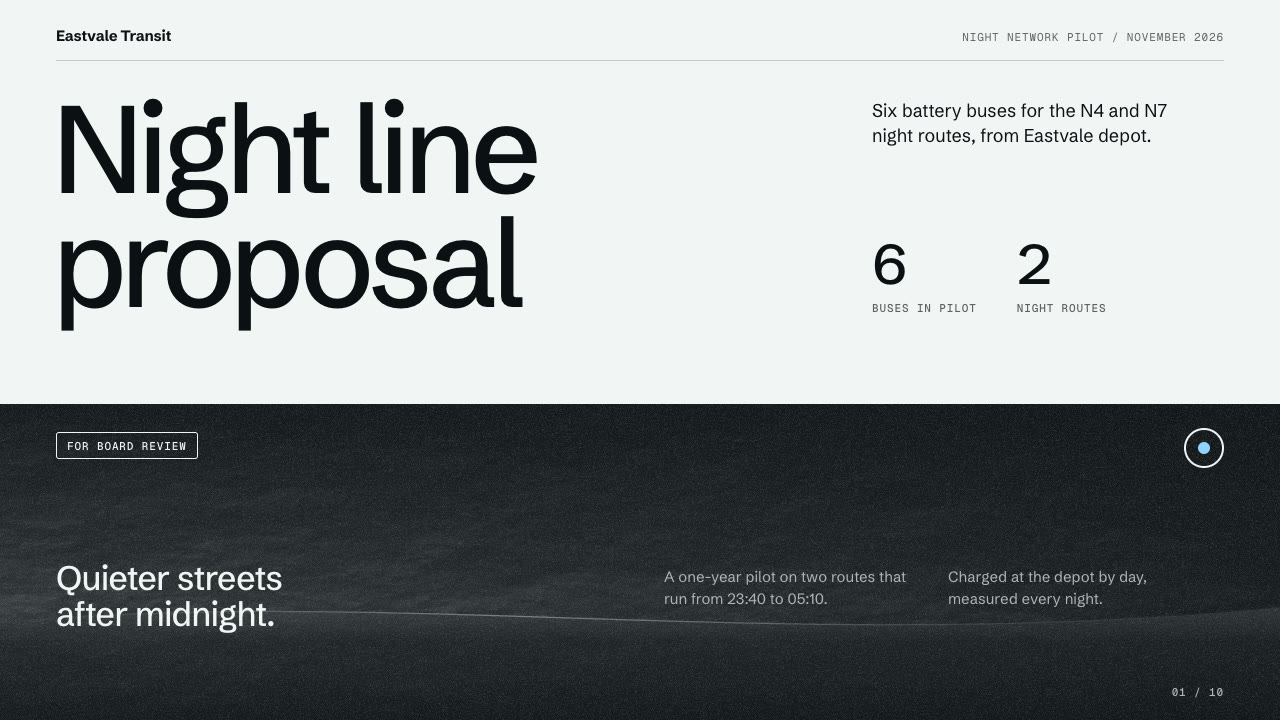
Bring the proposal, the audience, the decision you need, the figures to use exactly and the page count; pictures optional. The Skill returns one offline HTML deck that edits in the browser and exports editable PowerPoint.
How it works
Brief and sequence
Your Agent asks what decision the deck asks for, who decides and when, the facts you stand behind, the language and the page count, then picks one layout per page, for example cover, contents, premise, problem, answer, numbers, phases and close.
Pictures and build
Without your own pictures it describes them in art.json and draws them with material-art.py, writes plan.json and settings.json, then runs kit.py compose, make-deck.py and verify-deck.py to build one offline HTML file.
Look and export
It opens every page over local HTTP and checks headlines inside their area, card text clear of card edges, chips on one line, bars in proportion and the folio, tries edit, undo, save and present, then exports PowerPoint and runs verify-pptx.py against the deck.
Frequently asked questions
Is the PowerPoint really editable?
Yes. Every headline, label, chip, card, number, bar and mark is its own native object, and every picture is its own image; speaker notes are kept. No slide is a full-page picture. Text was rewritten, a shape recoloured and moved and a picture resized with python-pptx, then saved and reopened.
Where do the pictures come from?
From you first. Otherwise the bundled material-art.py draws monochrome material studies in the deck's own tones from art.json: stone relief, metal rings, hills, spheres, ripples, folded bands, an arch, a glass cube and floating plates. It uses only the Python standard library and calls no model or image service.
Which fonts does it use?
Schibsted Grotesk for headlines and Geist Mono for labels, chips and folios, both under the SIL Open Font License; the web subsets are embedded in the HTML. Install the desktop fonts on the presenting machine for matching line breaks in PowerPoint. Chinese, Japanese and Korean text uses the system face.
What are the known limits?
Pictures are abstract studio objects, not photographs, and export to PowerPoint as raster images. PowerPoint has regular and bold only, so medium weights export as regular. Geometry is fixed per layout (four index cards, three answer cards, five bars), and bar widths are set by hand.
What was tested?
Both example decks were rebuilt from a fresh unzip of the package and matched the published files byte for byte. Every page was inspected in Chrome and in a LibreOffice render of the exported PowerPoint, and python-pptx edits survived save and reopen. PowerPoint itself was not opened.