Operations Pulse Slides
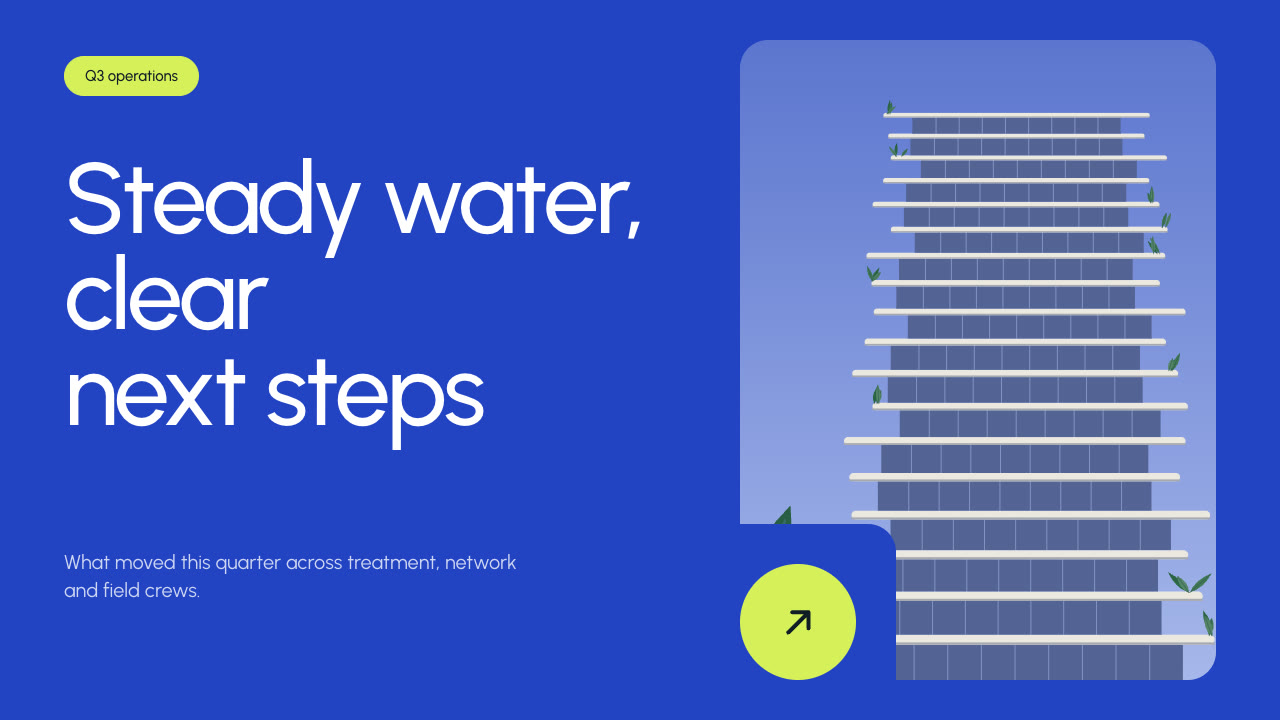
Make operations report decks, such as quarterly operations reviews, service performance updates and programme status for a board or committee: cover and close on a strong theme colour, a tall drawn building whose corner is notched around a round arrow, bright utility cards with one big figure, short capsule tags, editable index bars and growing stage circles, with Urbanist headlines.
Bring the service or programme, the audience, the period, the figures to use exactly and the page count; your own pictures are optional. The Skill returns one offline HTML deck that edits in the browser and exports editable PowerPoint.
How it works
Brief and sequence
Your Agent asks for the topic, the audience, what should happen after the talk, the facts and numbers to use exactly and the page count, then gives every page one layout and picks one palette.
Pictures and build
Without your own pictures it lists the drawings in art.json and draws them with pulse-art.py. It writes plan.json and settings.json, then runs kit.py compose, make-deck.py and verify-deck.py to build one offline HTML file.
Look and export
It opens every page in a browser and checks wraps, overlaps and labels, tries edit, undo, save and present, then exports PowerPoint and runs verify-pptx.py against the deck.
Frequently asked questions
Is the PowerPoint really editable?
Yes. Headings, cards, capsules, bars, circles, dots and arrows are native PowerPoint text and shapes with speaker notes, and each picture is its own image. The example decks have 87 and 72 text boxes and no rendered layers. The field and atrium layouts put one replaceable picture across the whole page under native text.
Where do the pictures come from?
Your own pictures first. Otherwise the bundled pulse-art.py draws towers in four forms under three skies, glazed roofs seen from below, foliage fields, faceless round portraits and table tops. It uses only the Python standard library, calls no model or image service, is deterministic and refuses to draw the same picture twice.
Which fonts does it use?
Urbanist under the SIL Open Font License, embedded in the deck. Install it on the presenting machine for matching line breaks in PowerPoint. Chinese, Japanese and Korean use the system face.
What are the known limits?
The notched corner is a separate rounded shape in the page colour, so recolour it too if you change the page background in PowerPoint. LibreOffice sets the type a little wider than Chrome, so a few lines wrap one word earlier. Long Chinese headlines break wherever the line ends unless you place a break.
What was tested?
Both example decks were built from a fresh unzip of the package. Every page was inspected in Chrome and in a LibreOffice render of the exported PowerPoint, 31 of 32 browser interaction checks passed on each deck (the remaining check expects a dragged paragraph in the outer box, the editor places it in the inner box that accepts it), with 17 engine and 27 generator and palette error-path checks, and python-pptx edits survived save and reopen. PowerPoint, Keynote and WPS were not opened.