Pastel Grain Slides
Make calm, light decks for proposals, reviews, member meetings and programme updates where colour lives only in the backgrounds: each page gets one of three painted washes (warm Orchard, cool Tide, muted Haze), soft colour fields with a fine film grain, or a plain paper page, and a rhythm rule keeps the same wash off three pages in a row. Headlines are large, tight Funnel Display in black.
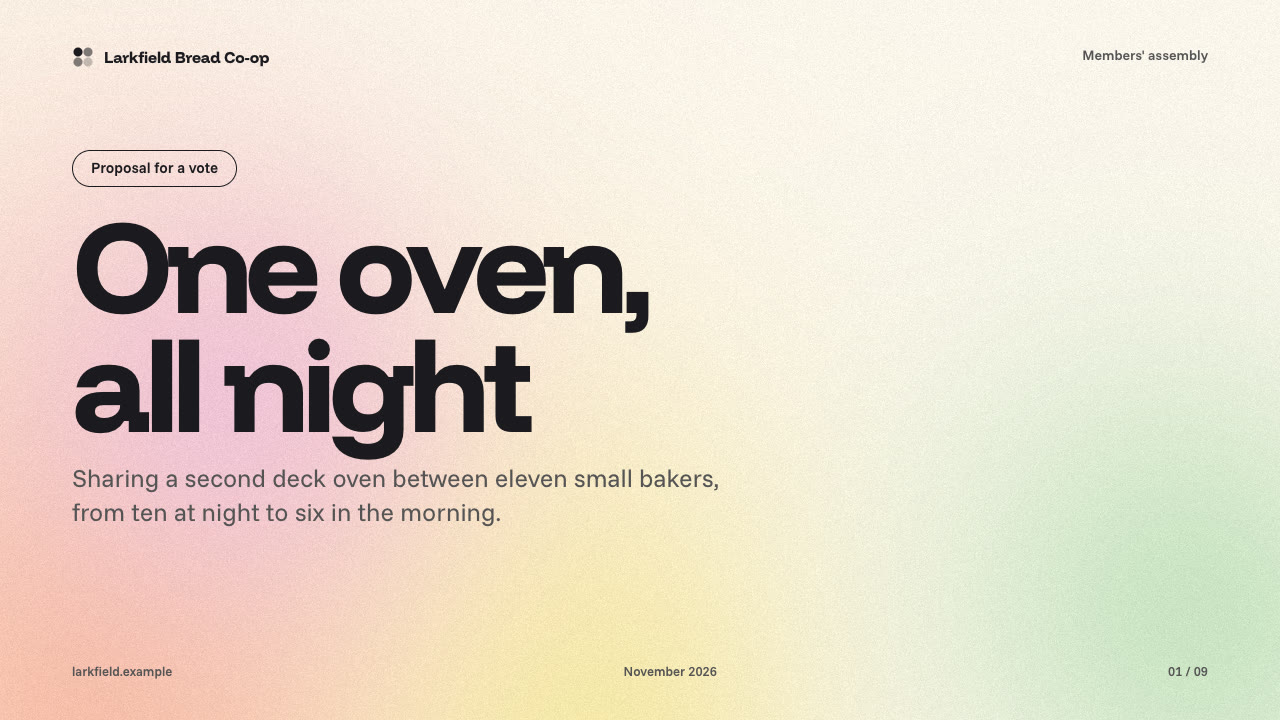
Bring the topic, the audience, what you want decided, the figures to use exactly and the page count; your own photographs are optional. The Skill returns one offline HTML deck that edits in the browser and exports editable PowerPoint.
How it works
Brief and sequence
Your Agent asks for the topic, the audience, what should happen after the talk, the facts and numbers to use exactly and the page count, then gives every page one layout and picks one palette.
Pictures and build
It lists the washes and any abstract pictures in washes.json and paints them with grain-wash.py, which also checks the wash rhythm against the plan. It writes plan.json and settings.json, then runs kit.py compose, make-deck.py and verify-deck.py to build one offline HTML file.
Look and export
It opens every page in a browser and checks wraps, overlaps and labels, tries edit, undo, save and present, then exports PowerPoint and runs verify-pptx.py against the deck.
Frequently asked questions
Is the PowerPoint really editable?
Yes. Text is native text boxes; cards, panels, step circles, rules and tag outlines are native shapes, with speaker notes. Each wash is one background picture with no text in it, so it can be replaced or deleted. The example decks have 107 and 84 text boxes and no rendered layers.
Where do the colours and pictures come from?
The bundled grain-wash.py paints the washes and optional abstract pictures (shaded spheres, an arch, layered bands) at the slot size. It uses only the Python standard library, calls no model or image service, refuses a broken wash rhythm and checks that the plan uses every painted wash. Your own photographs can go in the picture slots.
Which fonts does it use?
Funnel Display for headlines and Funnel Sans for copy, under the SIL Open Font License. Install them on the presenting machine for matching line breaks; weight 800 exports as bold. Chinese, Japanese and Korean use system faces at a reduced size, which look lighter than the Latin display cut.
What are the known limits?
Layout geometry is fixed (five steps, three cards, four figures, two panels, two chapter pictures), so drop or repeat layouts instead of adding items. A ten-page deck is around 6 MB of HTML and 5 MB of PowerPoint. LibreOffice spaces the tight headline letters slightly differently from Chrome.
What was tested?
Both example decks were built from a fresh unzip of the package. Every page was inspected in Chrome and in a LibreOffice render of the exported PowerPoint, 31 of 31 browser interaction checks passed on each deck, and an internal Chinese long-text deck was built and inspected the same way, and python-pptx edits survived save and reopen. PowerPoint, Keynote and WPS were not opened.