How Hermes' Self-Improving Agent Loop Actually Works (2026)
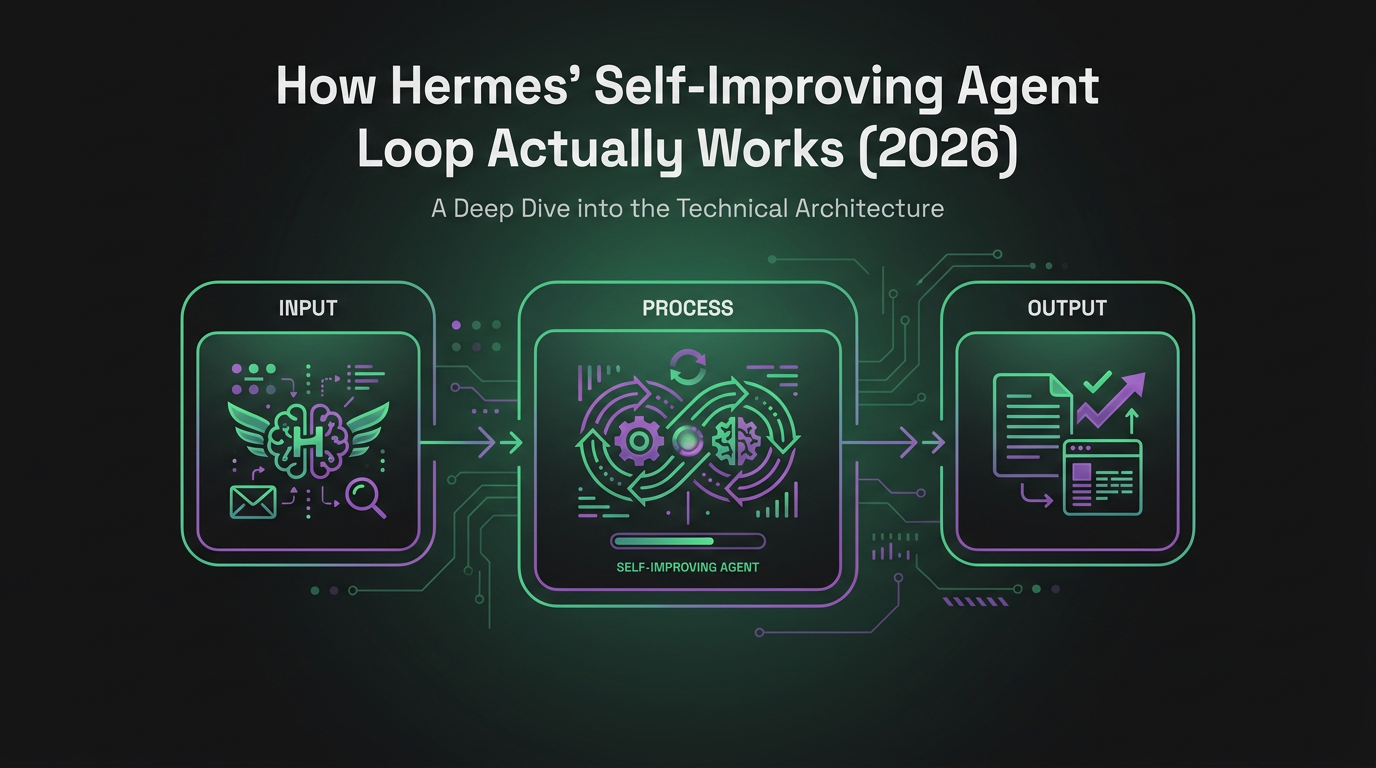
How Hermes Agent's self-improving loop works in 2026: the skill-generation mechanism, what it actually persists, and where the 40% task-time gains come from.
TL;DR — Hermes’ self-improving loop isn’t magic. It’s three concrete mechanisms working together: skill extraction (turning solved problems into reusable docs), layered memory (carrying context across sessions), and a nudge system (the agent reminds itself to persist what it learned). The 40% task-time reduction comes from not re-solving problems it already solved. Here’s the actual machinery.
What “Self-Improving” Actually Means
A self-improving agent is one that gets measurably better at recurring tasks without you changing its code or prompts. That’s the claim Nous Research makes about Hermes Agent, and unlike most “learning AI” marketing, there’s real machinery behind it.
Most agents are amnesiacs. Every session starts from zero. You explain your project structure, your preferences, your past decisions — again. Hermes breaks this loop by treating memory and learning as core architecture, not bolt-ons. I dug into how it actually works, because “the agent learns” is the kind of phrase that usually falls apart under scrutiny. This one mostly holds up.
The Three Mechanisms
1. Skill Extraction
This is the headline feature. When Hermes solves a non-trivial problem — say, figuring out the exact sequence of commands to deploy your app to a finicky staging server — it can write that procedure down as a skill document. A skill is just structured Markdown: a description of when to use it, the steps, and any gotchas discovered along the way.
The next time a similar task comes up, the relevant skill loads into context. The agent doesn’t re-derive the solution from scratch; it follows the procedure it already worked out.
# Skill: Deploy to staging

## When to use
User asks to deploy the current project to staging.

## Steps
1. Run `npm run build` — fails if NODE_ENV not set, so prefix with NODE_ENV=production
2. The staging server rejects connections on first try; retry once after 3s
3. Health check endpoint is /healthz, NOT /health (learned the hard way)

## Gotchas
- Staging DB migrations must run BEFORE the deploy, not after
The crucial detail: that “learned the hard way” note. Skills capture not just the happy path but the failures the agent hit and corrected. That’s where the compounding value lives.
2. Layered Memory
Skills handle procedures. Memory handles facts. Hermes uses two Markdown files:
user.md— durable facts about you. Preferences, your stack, your timezone, how you like things done.memory.md— long-term recall of decisions and context that accumulate over time.
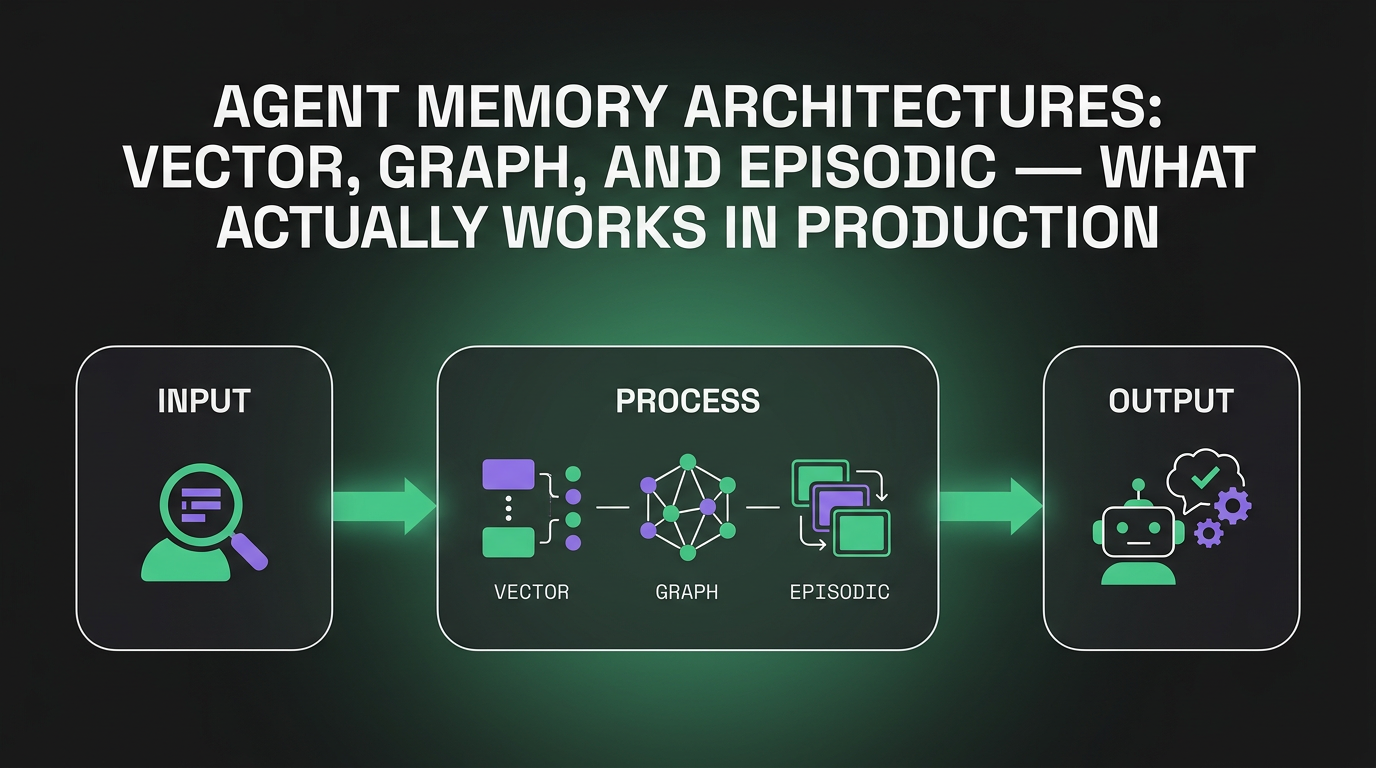
Both load at the start of every session. This is the “warm memory always loaded” pattern I covered in our deep-dive on agent memory architectures — cheap to load, high signal, no retrieval latency.
3. The Nudge System
Here’s the part most people miss. An agent that can save skills won’t necessarily remember to. Hermes includes a self-nudging mechanism: after completing complex work, it prompts itself to consider whether the experience is worth persisting as a skill or memory update.
Without this, the learning loop stays theoretical — the capability exists but never fires. The nudge is what closes the loop. It’s a small thing that makes a big difference, and it’s why Hermes’ learning is more reliable than frameworks that technically support memory but never proactively write to it.
Where the 40% Comes From
Community benchmarks (TokenMix.ai) report that self-created skills cut research-task time by roughly 40% versus a fresh agent instance. That number sounds like marketing, but the mechanism is mundane: the agent isn’t smarter, it just isn’t redoing work.
Think about your own workflow. The first time you set up a new project’s CI pipeline, it takes hours of trial and error. The fifth time, it takes 20 minutes because you remember the gotchas. Hermes’ skill library is that institutional memory, except it’s the agent’s, and it compounds across every task you throw at it.
The catch: the advantage is zero on day one. A fresh Hermes install is no better than any other agent. The 40% is an asymptote you approach as your skill library grows. Week one, you’ll see little. Month three, the difference is obvious.
How It Compares to Anthropic’s Dreaming
Anthropic launched “Dreaming” for Claude Managed Agents in May 2026 — a background process where agents review past sessions and curate their own memory. (Anthropic’s engineering blog covers the technical background.) It sounds similar to Hermes, but the mechanism is different:
| Aspect | Hermes Skills | Anthropic Dreaming |
|---|---|---|
| Trigger | Active, during/after a task | Scheduled background process |
| Output | Reusable procedure docs | Curated/rewritten memory store |
| Hosting | Self-hosted, you own it | Managed by Anthropic |
| Visibility | You read/edit the skill files | Opaque consolidation |
| Cost model | Your inference costs | Extra background LLM calls |
Dreaming makes the agent remember better. Hermes skills make it act faster on repeats. They’re complementary — and in principle you could run Hermes using a Claude model with Dreaming enabled, getting both.
Running It with Any Model
Hermes is model-agnostic — it uses any OpenAI-compatible endpoint as its reasoning engine. This matters for the self-improving loop because skill quality depends heavily on the model doing the extraction. A weak model writes vague, useless skills. A strong one writes precise, reusable ones.
Pointing Hermes at SandBase lets you mix models by role:
# cli-config.yaml
providers:
  - name: sandbase
    api_base: https://api.sandbase.ai/v1
    api_key: ${SANDBASE_API_KEY}
    models:
      - anthropic/claude-sonnet-4   # primary reasoning + skill writing
      - google/gemini-2.5-flash     # cheap, fast routine tasks
A practical pattern: use a strong model (Claude Sonnet) for the main loop and skill extraction, and a cheap model (Gemini Flash) for routine summarization. The skills written by the strong model keep paying off even when the cheap model executes them.
Is It Worth It?
If your work with an agent is one-off and varied, the self-improving loop adds overhead without much payoff — you never hit the same task twice. If your work is recurring (same codebase, same deployment targets, same kinds of research), the compounding is real and significant.
The honest take: Hermes’ learning loop is the most credible implementation of “agent that gets better” I’ve seen, precisely because it’s boring under the hood. No emergent intelligence, no hand-waving. Just skill files, memory files, and a nudge to write them. Boring mechanisms that actually ship beat exciting ones that don’t.
FAQ
Q: Does Hermes actually learn, or is it just caching?
It’s closer to caching procedures than learning in the ML sense. There’s no weight update or fine-tuning. It writes reusable skill documents and loads them when relevant. Whether you call that “learning” is semantics — the practical effect is it stops re-solving solved problems.
Q: Can skills become stale or wrong?
Yes. If your deployment process changes, an old skill can actively mislead the agent. Because skills are plain Markdown files you can read and edit, you can prune or fix them. Treat your skill library like code — it needs occasional maintenance.
Q: How is this different from just writing good system prompts?
System prompts are static and you maintain them manually. Skills are written by the agent from actual experience, including failures it hit. The agent grows its own playbook instead of you predicting everything it’ll need upfront.
Q: Do I need a powerful model for the self-improving loop to work?
For skill extraction, yes — weak models write vague skills that don’t help. For skill execution, a cheaper model often suffices. Splitting roles across models (via a router like SandBase) is the cost-effective sweet spot.
Q: Where are skills and memory stored?
As plain Markdown files on the infrastructure you run Hermes on. You own them completely — no vendor lock-in, no opaque cloud store. That’s the upside of self-hosting; the downside is you’re responsible for backups.