Why Production AI Agents Need a Runtime Layer
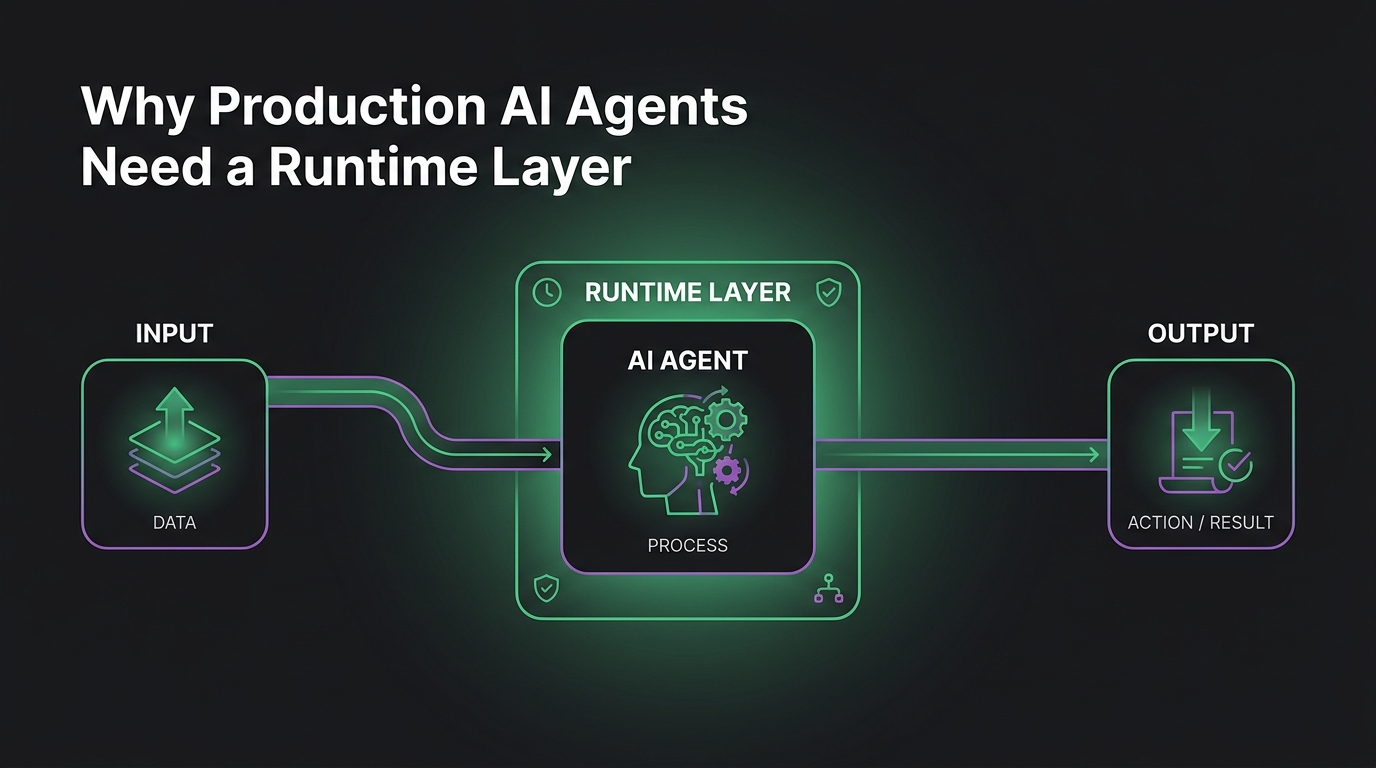
The agent runtime layer is the production infrastructure between your framework and model. Why it decides durability, isolation, and recovery.
TL;DR — A framework decides what your agent thinks next. The runtime layer decides whether that thought survives a crash, can’t
rm -rfyour host, and stops when the budget runs out. Most teams build the framework and skip the runtime, then discover in production that model APIs and frameworks manage neither process state, isolation, nor recovery. The runtime is the layer that keeps a long-running agent durable, contained, and resumable. Skip it and your agent is a demo that dies on the first timeout.
A working demo and a production agent run on completely different infrastructure, and the gap between them is the runtime layer. Most “build an agent” tutorials stop at the framework: wire up a reasoning loop, give it some tools, watch it solve a task. That works on your laptop for ten minutes. It does not survive a multi-hour job, a process restart, a prompt injection, or a runaway loop. The agent runtime layer is the part that handles all of that, and it’s the part nobody shows you.
I’ve watched the same failure twice now: a team ships an agent that’s brilliant in the demo and falls over the first week in production. Not because the model was bad or the prompts were wrong, but because there was no runtime underneath. The job that ran for forty minutes crashed at minute thirty-eight and started over from zero. The agent that generated a cleanup script ran it on the wrong directory. The cost dashboard showed a single task that looped 4,000 times before anyone noticed. None of those are framework bugs. They’re missing-runtime bugs.
The framework is not the runtime
These get conflated constantly, so let’s separate them. A framework like LangChain or LangGraph is an orchestration library: it structures the reasoning loop, holds the message history in memory, and decides which tool to call next. It runs inside a process you started.
The runtime is everything around that process. It answers a different set of questions:
- Where does the agent’s code actually execute, and what can it touch?
- If the host dies mid-task, does the agent resume or start over?
- What stops a loop from running forever or spending unlimited tokens?
- How do you run 500 of these concurrently without them stepping on each other?
A framework assumes a stable, trusted, single process. Production gives you none of those. The runtime is what fills the gap, and the model API certainly won’t, it’s stateless and forgets everything between calls.
What the runtime layer actually does
Four responsibilities, none of which the framework or model handles for you:
| Responsibility | What it covers | What breaks without it |
|---|---|---|
| Durable state | Checkpoint progress, resume after a crash | A 40-minute job restarts from zero on any failure |
| Isolation | Sandbox where agent code runs | One prompt injection reaches your DB credentials |
| Resource control | CPU/memory caps, token budgets, step limits | A loop runs 4,000 times and bills you for it |
| Lifecycle | Spawn, supervise, reap concurrent agents | Zombie processes pile up, state leaks between tasks |
Notice these are all operational concerns, not intelligence concerns. The model can be perfect and you’ll still hit every one of these. That’s why the runtime is orthogonal to model quality, and why throwing a smarter model at a reliability problem never works.
Durability: the one that bites first
Agents are long-running by nature. A coding agent works for ten minutes; a research agent for an hour; an autonomous pipeline for a day. The longer the job, the higher the chance something interrupts it: a deploy, a node eviction, an OOM kill, a network blip. Without durable state, every interruption means starting over, and for a multi-hour task, restarting from zero isn’t a degraded experience, it’s a broken one.
The fix is durable execution: checkpoint the agent’s state after each step so it can resume from exactly where it stopped. This stopped being exotic in 2026. As one analysis put it, every serious framework has quietly admitted durable execution is table stakes, with LangGraph shipping a Postgres checkpointer and Microsoft’s Durable Task framework adding agent-specific resume primitives.
Here’s the thing most teams get wrong: a checkpoint is not the same as durable execution. Saving state to a database is the easy 80%. The hard 20% is the runtime guaranteeing the workflow runs to completion, detecting the crash, and re-scheduling the resume without you writing the recovery logic. Diagrid’s team made this distinction sharply, arguing that checkpoints alone fall short of production durability because the runtime, not your application code, should own crash recovery. If your “durability” is a try/except that reloads state, you’ve built half a runtime and you’ll find the other half during your first outage.
A concrete LangGraph checkpointer looks like this, and it’s the minimum bar for a stateful agent:
from langgraph.checkpoint.postgres import PostgresSaver
from langgraph.graph import StateGraph, START, END
from typing import TypedDict

class AgentState(TypedDict):
    messages: list
    step: int

def think(state: AgentState) -> AgentState:
    # one reasoning step; in reality this calls your model
    return {"messages": state["messages"], "step": state["step"] + 1}

# Postgres-backed checkpointer: every node transition is persisted
DB_URI = "postgresql://localhost:5432/agents?sslmode=disable"

with PostgresSaver.from_conn_string(DB_URI) as checkpointer:
    checkpointer.setup()  # creates the checkpoint tables on first run

    builder = StateGraph(AgentState)
    builder.add_node("think", think)
    builder.add_edge(START, "think")
    builder.add_edge("think", END)

    graph = builder.compile(checkpointer=checkpointer)

    # thread_id ties a run to its checkpoint history; reusing it resumes
    config = {"configurable": {"thread_id": "task-1742"}}
    result = graph.invoke({"messages": [], "step": 0}, config)
    print(result["step"])
Kill the process after the checkpoint and re-invoke with the same thread_id: it resumes from the saved state instead of restarting. That’s the runtime doing its job. Note this gives you checkpointing, not the automatic crash-detection-and-reschedule that a dedicated durable engine like Temporal provides, which is exactly the 80/20 line above.
Isolation: the one that ends careers
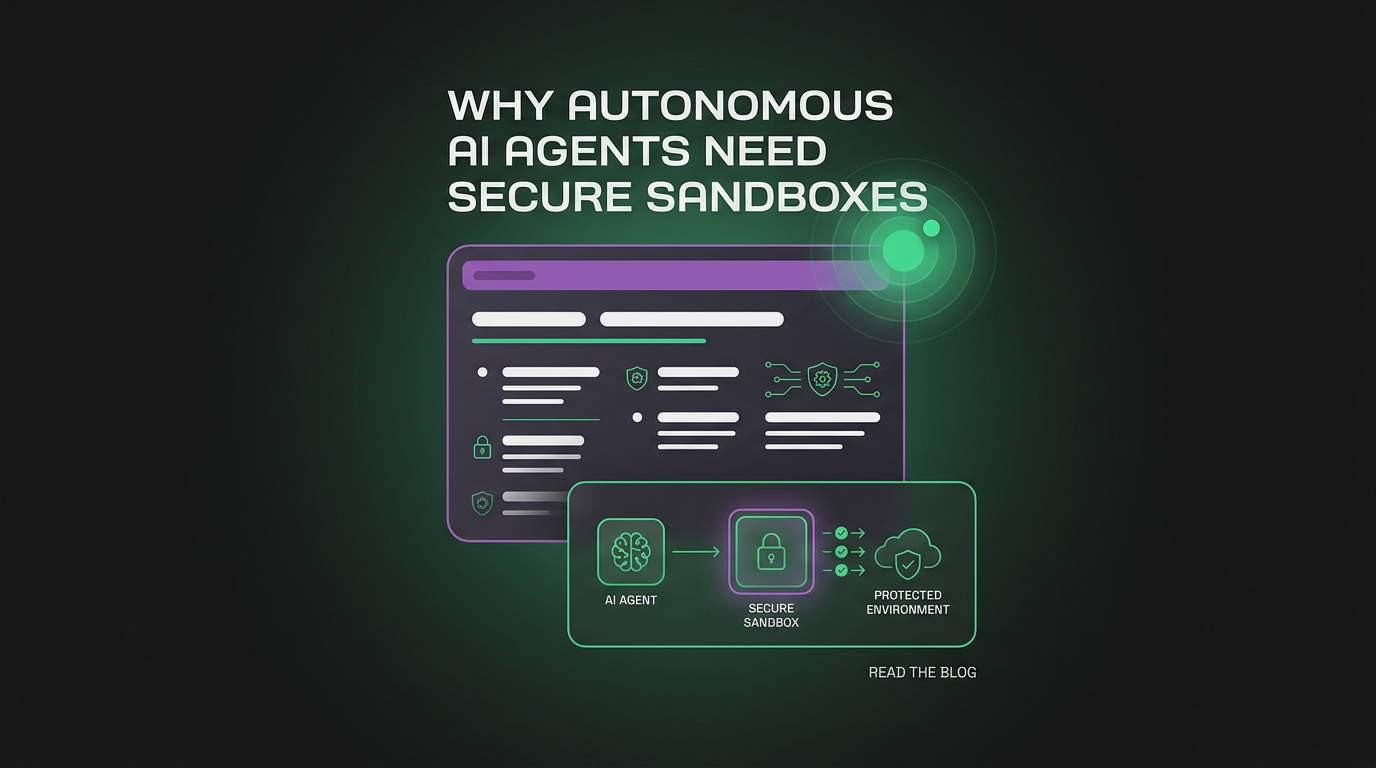
The moment your agent can run code it wrote, you have a security problem, not a hypothetical one. A model steered by a malicious prompt now holds a shell. This deserves its own treatment, and I’ve written the full case for why autonomous agents need secure sandboxes separately, so I’ll keep it short here: the runtime is where isolation lives.
The framework can restrict which tools exist, but a single “run Python” tool reopens the entire surface, and that’s exactly the tool code agents need. Isolation has to happen at the execution boundary, below the framework. In 2026 the consensus hardened: shared-kernel Docker is no longer enough for untrusted agent code, and the field moved toward microVMs (Firecracker, gVisor) for hardware-enforced separation. One write-up documented a real incident where an agent broke out of a Docker container to reach the host. The runtime’s job is to make that breakout land in a throwaway box, not your infrastructure.
Resource control and lifecycle
The unglamorous two. They don’t make headlines, but they’re what separate a system that runs 500 concurrent agents from one that falls over at 20.
Resource control means hard ceilings the agent cannot exceed: a token budget per task, a wall-clock timeout, a maximum step count, CPU and memory caps on the sandbox. Agents fail in expensive ways. A reasoning loop that can’t make progress will happily retry until your bill is four figures. The runtime caps the blast radius in dollars the same way the sandbox caps it in damage.
Lifecycle is the plumbing: spawning an isolated environment per task, supervising it, and reaping it cleanly when the task ends or dies. Ephemerality matters here, a fresh environment per task means a compromised or confused run can’t poison the next one. This is the same principle behind cron-driven autonomous agents: each scheduled run should be a clean, disposable box, not a long-lived machine accumulating state and risk.
When something does go wrong, you need to see it. Resource control and lifecycle are only useful if they’re observable, which is why agent observability is the runtime’s nervous system: it turns “the task hung” into a trace showing exactly which step looped and how many tokens it burned.
Build vs buy
You don’t write a runtime from scratch, the same way you don’t write a database. The practical question is how many layers to assemble yourself. A realistic 2026 setup:
- Durable execution via a framework checkpointer (LangGraph + Postgres) for simple cases, or a dedicated engine (Temporal, Restate) when you need guaranteed completion and automatic recovery.
- Isolation via a microVM-based sandbox, self-hosted or as a service, for any agent-generated code.
- Resource ceilings enforced at the sandbox and the orchestration layer: token budgets, timeouts, step limits.
- Lifecycle and observability wired together so every run is spawned clean, reaped clean, and traced.
For where each of these sits relative to the model and gateway, see the full AI agent infrastructure stack. The runtime is the layer most teams discover last and wish they’d designed first.
The action item: before you ship, write down what happens to an in-flight task when the host restarts, what the agent can reach when it runs code, and what stops it from spending forever. If you don’t have an answer for all three, you have a framework, not a runtime, and production will find the difference.
FAQ
What is the agent runtime layer? It’s the production infrastructure between your agent framework and the model that manages durable state, isolation, resource limits, and process lifecycle. The framework decides what the agent does; the runtime decides whether it survives crashes, can’t damage the host, and stops when budgets run out.
Isn’t my framework already the runtime? No. Frameworks like LangGraph orchestrate the reasoning loop inside a single trusted process. They don’t sandbox agent-generated code, guarantee crash recovery, or enforce host-level resource caps. Those are runtime concerns the framework assumes someone else handles.
Do I need a runtime for a simple agent? If the agent runs briefly, executes no code, and losing its progress is fine, you can skip most of it. The moment a task runs for minutes, executes generated code, or runs autonomously on a schedule, each missing runtime piece becomes a production incident waiting to happen.
What’s the difference between a checkpoint and durable execution? A checkpoint saves state to storage. Durable execution adds the runtime guarantee that a workflow runs to completion, automatically detecting crashes and rescheduling the resume. Checkpointing is the easy part; the recovery guarantee is what separates a real durable runtime from a try/except.
Can I buy a runtime instead of building one? Largely yes. Use a framework checkpointer or a durable engine like Temporal for state, a microVM sandbox service for isolation, and your orchestration layer for budgets. You assemble these layers rather than writing them, the same way you assemble a database and a queue rather than building them from scratch.